Quick answer
The DBT skills list is organized into four modules: Mindfulness (observing the present moment without judgment), Distress Tolerance (surviving crises without making them worse), Emotion Regulation (understanding and changing intense emotions), and Interpersonal Effectiveness (asking for what you need and keeping relationships healthy).
General information about DBT skills. It does not replace therapy, and in an emergency contact your local emergency number or crisis line.
Dialectical Behavior Therapy teaches concrete, learnable skills, not abstract insight. Below is the full map of what those skills are, what each one is for, and the order most people learn them in. You do not need to memorize all of them; most people build a personal toolkit of five to ten skills they actually use.
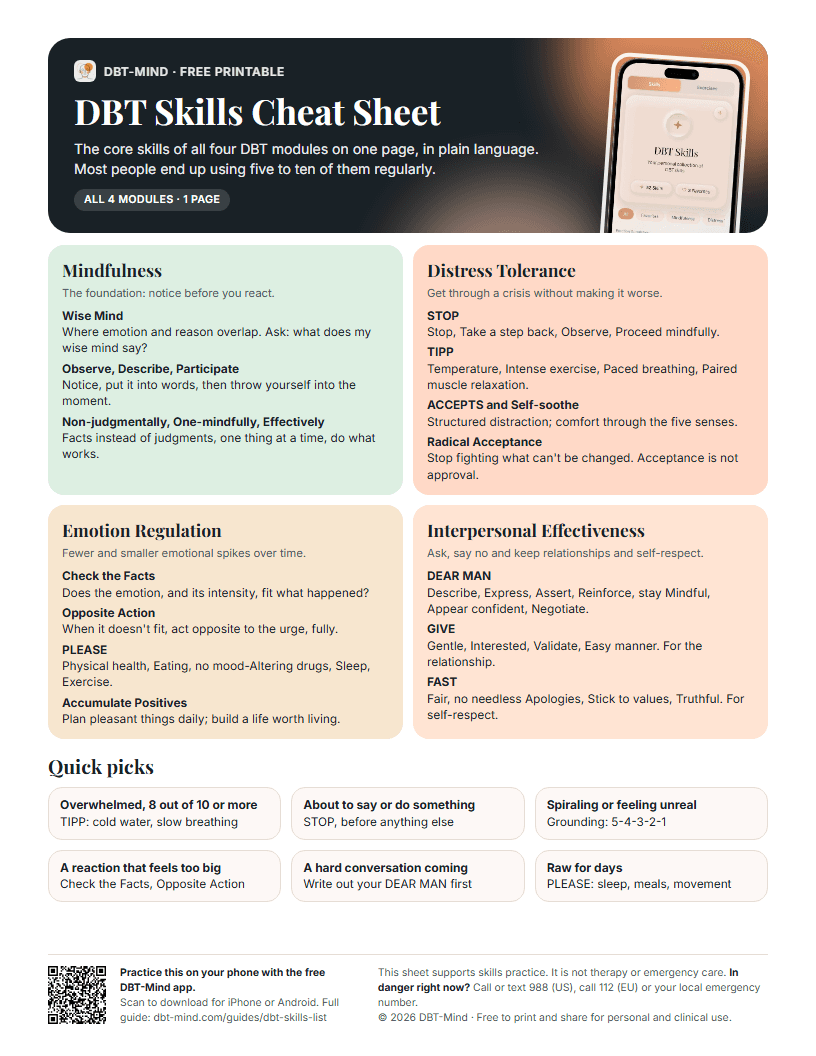
Free printable PDF
DBT Skills Cheat Sheet
The core skills of mindfulness, distress tolerance, emotion regulation and interpersonal effectiveness on one page.
- All 4 modules
- Plain-language definitions
- Quick picks by situation
1. Mindfulness skills (the foundation)
Mindfulness is taught first because every other DBT skill depends on noticing what is happening inside you before reacting to it.
Wise Mind
Finding the overlap between emotion mind and reasonable mind: the state where good decisions happen.
"What" skills
Observe, Describe, Participate: three ways of engaging with the present moment.
"How" skills
Non-judgmentally, One-mindfully, Effectively: the manner in which you observe and act.
2. Distress tolerance skills (crisis survival)
These distress tolerance skills are for the worst moments: when emotion is so high that solving the problem is impossible and the goal is simply not making things worse.
TIPP
Temperature, Intense exercise, Paced breathing, Paired muscle relaxation: fast body-based techniques that lower emotional arousal in minutes (TIPP step by step).
STOP
Stop, Take a step back, Observe, Proceed mindfully: a circuit breaker between trigger and reaction (how to use STOP).
ACCEPTS
Distraction strategies (Activities, Contributing, Comparisons, Emotions, Pushing away, Thoughts, Sensations) for riding out an urge.
Self-Soothe
Calming each of the five senses deliberately.
Radical Acceptance
Fully accepting reality as it is, to stop adding suffering to pain.
3. Emotion regulation skills
Where distress tolerance handles the acute spike, emotion regulation reduces how often and how hard the spikes hit.
Check the Facts
Testing whether your emotional reaction fits the actual facts of the situation.
Opposite Action
Acting opposite to an emotion’s urge when the emotion does not fit the facts: approach what you fear, be kind when angry.
PLEASE
Reducing emotional vulnerability by treating PhysicaL illness, balanced Eating, avoiding mood-Altering substances, balanced Sleep, and Exercise.
Accumulate Positives
Deliberately scheduling pleasant events and building a life worth living, so emotions have a stable baseline.
4. Interpersonal effectiveness skills
Skills for the situations that trigger the most intense emotions: other people.
DEAR MAN
A step-by-step script for asking for something or saying no: Describe, Express, Assert, Reinforce, stay Mindful, Appear confident, Negotiate.
GIVE
Keeping relationships healthy: be Gentle, act Interested, Validate, use an Easy manner.
FAST
Keeping self-respect: be Fair, no Apologies (unwarranted ones), Stick to values, be Truthful.
Which module should you start with?
Standard DBT programs start with mindfulness and cycle through the other modules. On your own, a practical rule: if crises are frequent, start with distress tolerance (TIPP and STOP give the fastest relief). If your days are stable but emotionally exhausting, start with emotion regulation. Mindfulness runs underneath everything, so a few minutes of daily practice pays off regardless.
Practice it in DBT-Mind
Learning DBT skills in DBT-Mind
DBT-Mind contains the complete skills library across all four modules as interactive, step-by-step exercises, not just definitions.
- 1Browse the Skills section, organized by the four DBT modules, each with plain-language instructions and worksheets.
- 2Follow the structured learning path if you are new. It sequences skills the way a DBT skills group would.
- 3Get smart skill recommendations based on your patterns: the app learns what helps you in the morning stress spike versus the 11 pm spiral.
- 4Add your own custom skills so your personal toolkit lives in one place, available offline in any moment.

Frequently asked questions
- How many DBT skills are there in total?
- Depending on how you count sub-skills, standard DBT teaches roughly 25-30 named skills across the four modules. Nobody uses all of them. The goal is a personal set of five to ten skills that reliably work for you.
- What are the 4 modules of DBT?
- Mindfulness, Distress Tolerance, Emotion Regulation, and Interpersonal Effectiveness. Mindfulness is considered the core module and is woven through the other three.
- Can I learn DBT skills without attending a skills group?
- Yes, the skills themselves are learnable from books and apps, and DBT-Mind structures them the way a group would. For diagnoses like BPD, self-study works best alongside professional therapy rather than instead of it.
- Is there a DBT skills cheat sheet I can print?
- Yes. The free DBT-Mind skills cheat sheet (PDF, one page) lists the core skills of all four modules in plain language, with quick picks for common situations. It is free to print and share.
Keep learning
All guides
Can You Do DBT on Your Own? A Realistic Guide to Self-Guided DBT
What self-guided DBT realistically can and cannot do, and how to structure learning DBT skills while waiting for (or instead of) therapy.
Read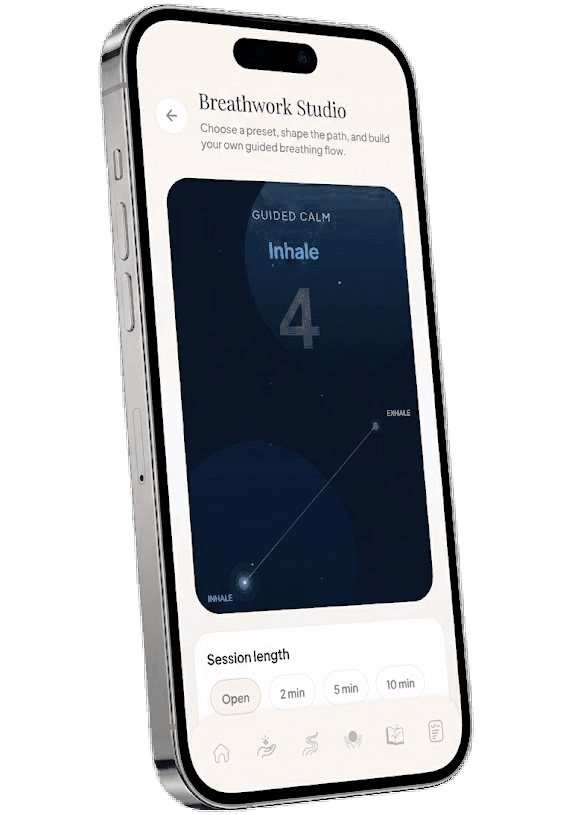
TIPP Skill: Calm Your Body Down in Minutes (DBT)
The fastest-acting DBT skill: four body-based techniques that lower overwhelming emotion in minutes, explained step by step.
Read
DEAR MAN: The DBT Script for Asking for What You Need
DBT’s seven-step script for difficult conversations (asking for something or saying no) with a full worked example.
Read