DBT Guides: Learn the Skills That Actually Help
Plain-language guides to the core DBT skills, each with steps you can practice today.


Best DBT Apps in 2026: DBT Coach, DBT-Mind, DBT Pal and More Compared
An honest side-by-side of four DBT apps: what each one costs, what it does best, where it falls short, and how to choose.
- DBT Coach
- DBT Diary Card & Skills Coach
- DBT Pal
- DBT-Mind

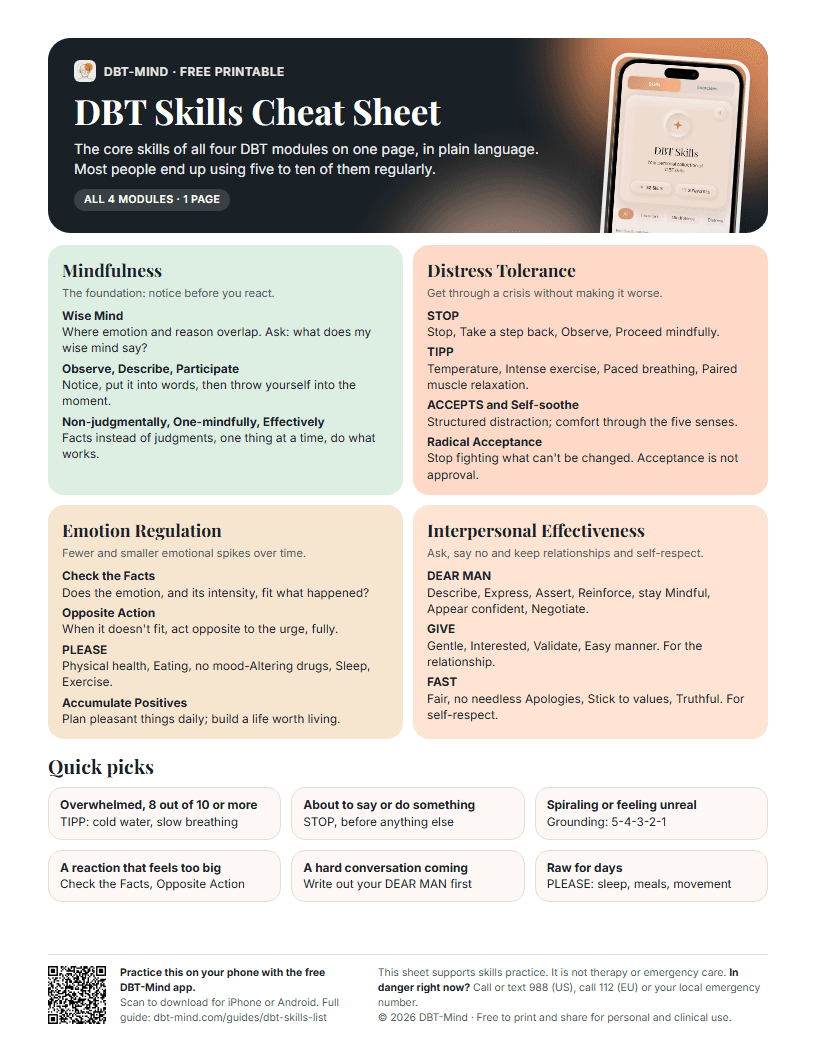
Free DBT worksheets to print
Diary card, skills cheat sheet, TIPP, STOP, a crisis plan and an emotion regulation worksheet. No sign-up.
Browse the worksheets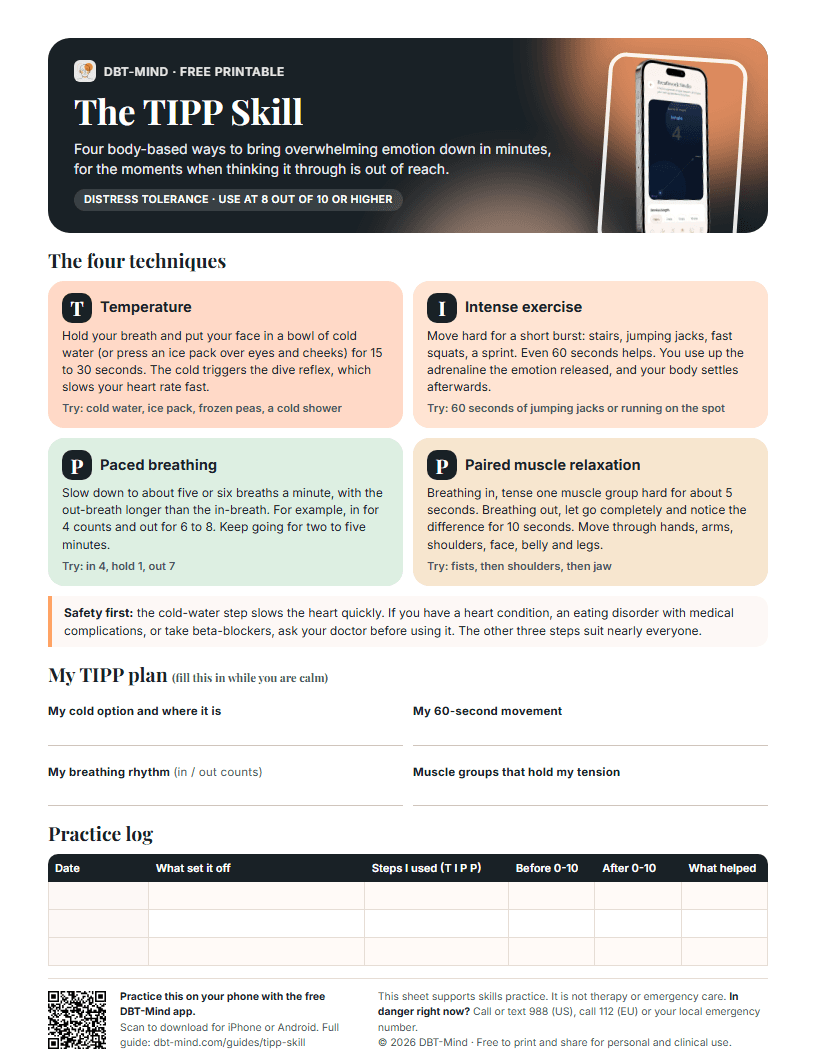
Start here
How the DBT skills fit together and how to practice them day to day.
What Is DBT Therapy? Dialectical Behavior Therapy in Plain Language
A plain-language explainer: where DBT comes from, the four parts of a full program, how long it takes and how it differs from CBT.
ReadDBT Skills List: All 4 Modules Explained Simply
Every core DBT skill across the four modules, explained in plain language, with guidance on which module to start with.
Read
Can You Do DBT on Your Own? How to Practice DBT at Home
What self-guided DBT realistically can and cannot do, a weekly routine for practicing DBT at home, and when to look for a therapist.
Read
Free DBT: Free and Low-Cost Ways to Get Dialectical Behavior Therapy
What DBT usually costs in the US, the real low-cost routes (training clinics, health centers, skills-only groups) and the free resources for practicing DBT skills.
ReadDBT Diary Card: What It Is, a Filled-Out Example and How to Fill It Out
What a diary card tracks, a filled-out example week, how to rate emotions and urges, and how to keep the habit in under two minutes a day.
Read
DBT Mindfulness Skills: Wise Mind, What and How Skills
Wise mind, the three what skills and the three how skills of DBT mindfulness, each with an everyday example, plus short exercises to practice them.
Read
DBT Journal Prompts: 24 Prompts by Skill Module, Plus How to Track Your Skills
Short writing prompts for each DBT skills module, a five-minute daily routine, and how to track which skills you used, on paper or in an app.
ReadDBT Skills Cards: Free Printable Pocket Cards for 12 Skills
A free set of 12 printable DBT skills cards, one skill per card, with tips on where to keep them and how to write your own coping cards.
Read
DBT Workbooks: Which Book Fits Your Situation
The main DBT workbooks and manuals sorted by reader: skills group members, self-learners, teens and therapists, with how to use one on your own.
ReadDBT House: The Activity, the House of Treatment and a Free Worksheet
The two meanings of "DBT House": the drawing activity with a question for each part of the house, and the house of treatment as a picture of the DBT stages. With a free worksheet PDF.
ReadCrisis skills
For the moments when emotions are too strong to think straight.
TIPP Skill: Calm Your Body Down in Minutes (DBT)
The fastest-acting DBT skill: four body-based techniques that lower overwhelming emotion in minutes, explained step by step.
Read
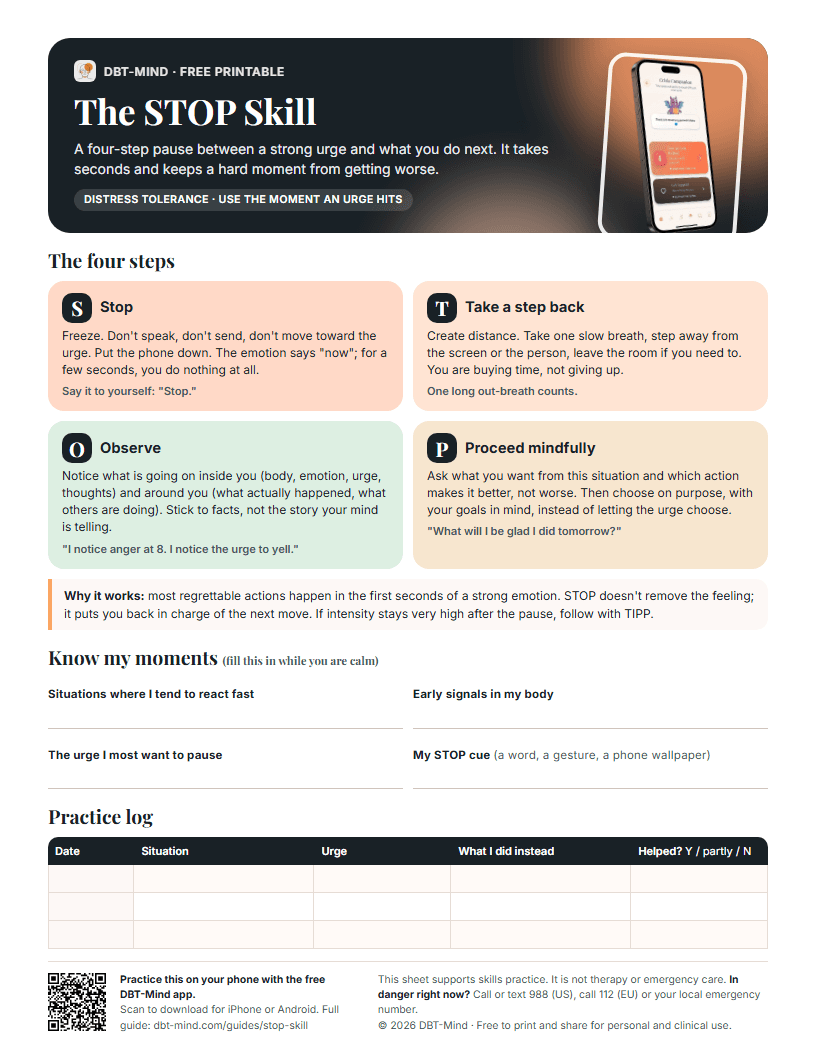
STOP Skill: How to Pause Before You React (DBT)
Stop, Take a step back, Observe, Proceed mindfully: the few seconds between a strong urge and what you do next, explained with an example.
Read
Distress Tolerance Skills: Surviving a Crisis Without Making It Worse
The DBT crisis survival toolkit (TIPP, STOP, ACCEPTS, self-soothing) and how to assemble them into a personal crisis plan.
ReadGrounding Techniques for Anxiety, Panic, and Dissociation
Which grounding technique fits anxiety, panic, dissociation or rumination, plus 5-4-3-2-1 step by step and a one-week practice plan.
ReadBehavior Chain Analysis (DBT): Steps, Example and Free Worksheet
The steps of a DBT chain analysis, a filled-out example chain, how to find where a skill could have helped, and a free one-page worksheet.
ReadIMPROVE the Moment: The DBT Skill, Letter by Letter
Seven ways to make a painful moment easier to bear when you cannot change it yet: every letter with small examples, and a table for picking one.
ReadACCEPTS in DBT: The Distraction Skill, Letter by Letter
Seven ways to distract yourself on purpose until an urge is easier to sit with: every letter with examples, the limits, and a free one-page worksheet.
ReadThe DBT Pros and Cons Skill: Four Boxes, One Example and a Free Worksheet
Four boxes for an urge that keeps coming back: how to fill them in, a full example, what to do when the urge returns, and a free one-page worksheet.
ReadEmotions and relationships
Skills for intense feelings, painful facts and asking for what you need.
Emotion Regulation Skills: The DBT Toolkit for Intense Feelings
The DBT skills that reduce how often and how hard intense emotions hit: Check the Facts, opposite action, PLEASE, and more.
Read
Check the Facts (DBT): 6 Steps to Test If an Emotion Fits
The six questions of the DBT skill Check the Facts, worked examples, and what to do next when your emotion fits the facts and when it does not.
Read
Opposite Action DBT: How to Act Against an Emotion’s Urge
What opposite action means in DBT, the opposite action for seven emotions, how to do it all the way, and when it is the wrong tool.
ReadRadical Acceptance: 7 DBT Exercises for Pain You Can’t Change
What radical acceptance means (and doesn’t), seven exercises to practice it, examples from everyday life and statements you can use when you are stuck fighting reality.
Read
DEAR MAN DBT Skill: Script Template, Examples and Role Play
DBT’s seven-step script for difficult conversations, with a fill-in template, examples for work, family and saying no, and a role-play plan.
ReadWise Mind DBT: How to Find the Balance Between Emotion and Reason
The three states of mind in DBT, five short practices to reach wise mind, and examples of what a wise mind choice looks like.
ReadDBT Interpersonal Effectiveness Skills: DEAR MAN, GIVE and FAST
The three goals of DBT interpersonal effectiveness, GIVE and FAST letter by letter with examples, and which skill to lead with in a hard conversation.
ReadCope Ahead: The DBT Skill for Hard Situations You Can See Coming
The DBT skill for getting ready for a hard situation you can see coming: five steps, three worked examples and a free one-page plan.
ReadDBT Validation: The 6 Levels, Self-Validation and What Validation Is Not
What validation means in DBT, the six levels with examples for someone else and for yourself, and a free one-page self-validation worksheet.
ReadDBT for Anxiety: Which Skills Help in Which Anxious Moment
Which DBT skill fits a panic surge, a worry spiral, dread before an event or the urge to avoid, plus a 3-minute panic routine and honest limits.
ReadWalking the Middle Path in DBT: Dialectics, Validation and Behavior Change
What walking the middle path means in DBT, both-and examples for teens, parents and adults, the dialectical dilemmas, and a free one-page both-and worksheet.
ReadThe GIVE Skill in DBT: How to Keep the Relationship in a Hard Talk
Gentle, Interested, Validate, Easy manner: what each letter sounds like, one conversation written twice, and how to use GIVE when you are angry or texting.
ReadThe FAST Skill in DBT: How to Keep Your Self-Respect in a Hard Talk
Fair, no Apologies, Stick to values, Truthful: what each letter sounds like, one conversation written twice, and how to drop the apologies nobody needs.
ReadChoosing an app
What a DBT app can do for you, and how the main apps compare.
DBT-Mind vs DBT Coach: Which DBT App Fits You?
Two DBT apps, compared feature by feature: what each one costs, what stays free, and which kind of person each one suits.
ReadDBT Coach Alternatives: 4 DBT Apps for Different Needs
The right alternative depends on why you are looking: price, privacy, Android, a simpler diary card or more crisis support.
ReadDBT App for BPD: Which Skills Help, What to Look For and How to Use One
Which DBT skills fit which BPD struggles, what to look for in a BPD app, a simple routine between sessions, and what an app cannot do.
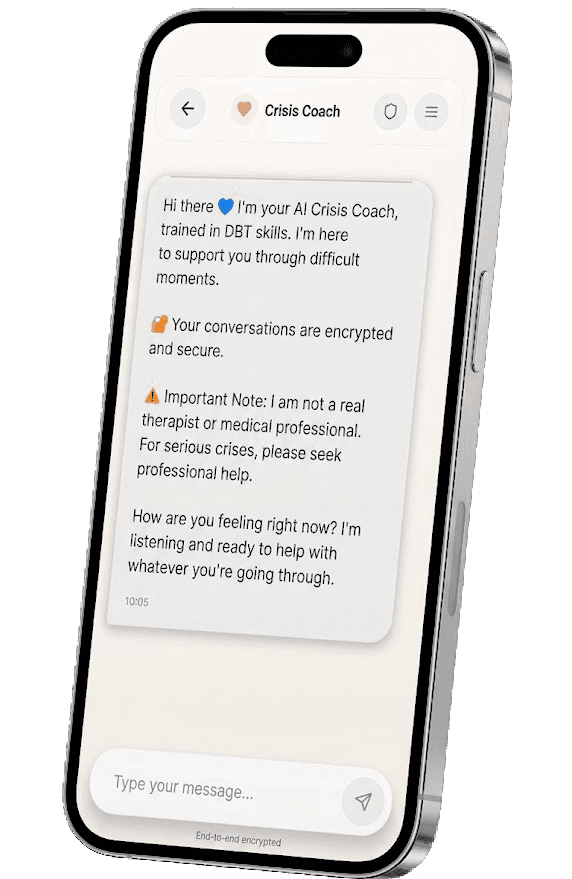
ReadAI DBT App and Chat: What an AI Can (and Cannot) Do for DBT Skills Practice
What an AI chat can do for DBT skills practice, where it stops being safe to rely on, and the questions to ask before you use one.
ReadApps for Emotional Regulation: How to Choose One That Actually Helps
Five apps sorted by what they actually do for intense emotions: name the feeling, change it with a skill, track patterns, or get through an urge.
ReadGrounding Apps: Which One Helps With Panic, Anxiety or Dissociation
Five grounding apps sorted by the moment they are for: panic, feeling unreal, trauma reminders, or grounding as part of DBT practice.
ReadBox Breathing App: Free and Paid Options Compared
Box breathing apps sorted by what you need: a quick timer, vibration cues, lessons on breathing, or breathing next to DBT skills, with what each one costs.
ReadPractice every skill in one app
Skills library, guided exercises, journal and crisis support together. Free to download.