Quick answer
STOP is a DBT distress tolerance skill for the moment a strong emotion pushes you to act. It stands for Stop (freeze, do nothing for a moment), Take a step back (breathe, create distance), Observe (notice what is happening inside you and around you), and Proceed mindfully (choose the action that fits your goals). STOP takes only seconds, and its job is to keep you from making a hard situation worse.
General information about DBT skills. It does not replace therapy, and in an emergency contact your local emergency number or crisis line.
Most of the things people regret in an emotional moment happen fast: the message sent, the door slammed, the drink poured. The emotion does not ask for permission; it pushes for action right now. STOP is the brake. It does not make the feeling go away. It puts a short gap between the urge and what you do, and in that gap you get your choice back.
Free printable PDF
STOP Skill Worksheet
Stop, Take a step back, Observe, Proceed mindfully: the steps, your personal triggers and a practice log.
- The 4 steps
- Know my moments
- Practice log
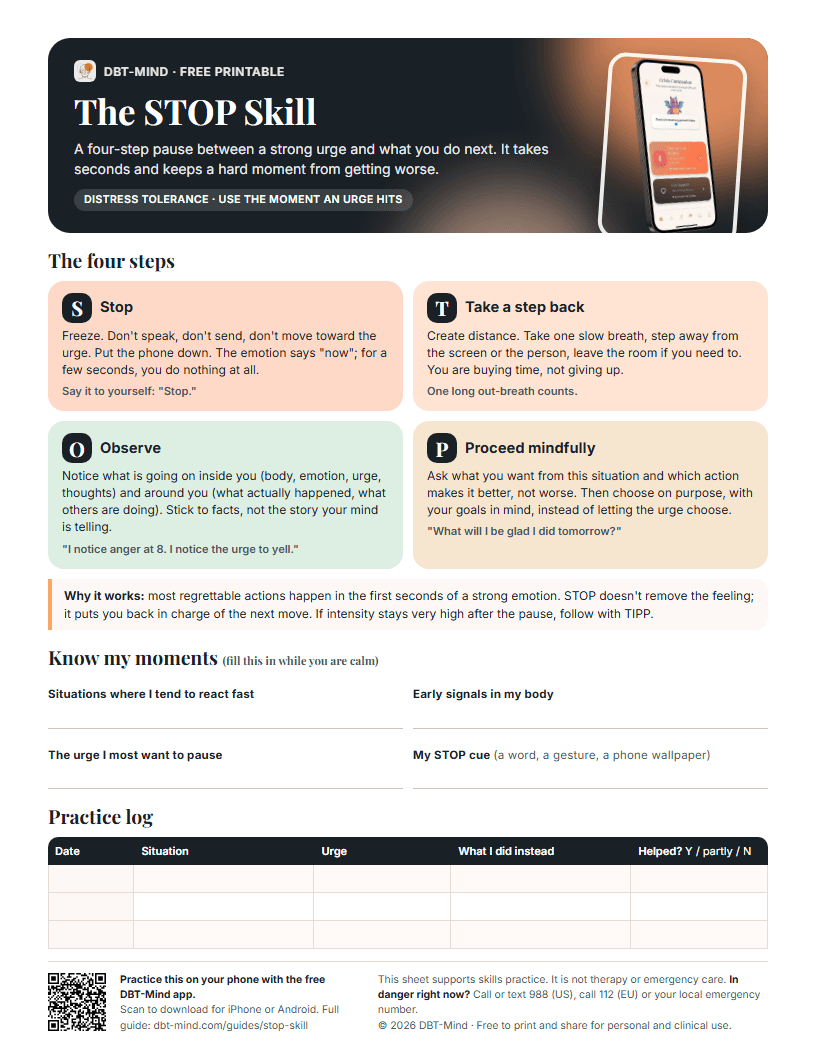
The four steps of STOP
- 1
S: Stop. Freeze. Do not speak, do not type, do not move toward the urge. Put the phone down. For a few seconds you do nothing at all, even though everything in you says "now".
- 2
T: Take a step back. Create distance from the situation. Take one slow breath with a long exhale, step away from the screen or the person, or leave the room if you need to. You are buying time, not giving up.
- 3
O: Observe. Notice what is going on inside you (body sensations, the emotion and how strong it is, the urge, your thoughts) and around you (what actually happened, what other people are doing). Stick to facts rather than the story your mind is telling.
- 4
P: Proceed mindfully. Ask yourself what you want from this situation and which action would make it better rather than worse. Then act on purpose, with your goals in mind, instead of letting the urge decide.
When to use STOP
STOP is for the first seconds of a strong emotional reaction, when you feel pulled to do something right away. Typical moments:
Before you hit send
An angry text, a reply-all, a post you would not write tomorrow. STOP before the message leaves your phone.
In the middle of an argument
When your voice gets louder and you feel the urge to say the thing that hurts most.
When an old urge shows up
Urges you are working on with your therapist, such as self-harm, drinking or bingeing. STOP is the first step; your crisis plan is the next.
When panic says run
Leaving, cancelling, quitting. STOP gives you a moment to check whether escaping actually helps.
A STOP example, step by step
You read a message from a friend: "We need to talk later." Within seconds your chest tightens, your mind jumps to "they are done with me", and your thumb is already typing "Fine, forget it then."
Stop: you put the phone face down. Take a step back: you breathe out slowly and walk to the kitchen. Observe: "My heart is racing. I feel fear, about 8 out of 10. The urge is to end things before they can. The facts: they wrote one sentence and did not say what it is about." Proceed mindfully: you want to keep this friendship, so you reply "Sure, when works for you?" and plan a distraction until then.
Nothing about the situation changed, and the fear is still there. What changed is that you did not act on it, so you did not create a second problem on top of the first.
STOP or TIPP: which comes first?
STOP comes first. It is a behavioral pause and costs only a few seconds, so it fits any situation, even in public. It does not lower the emotion itself, though. If the intensity is still very high after the pause, around 8 out of 10 or more, follow with the TIPP skill, which calms the body directly through cold water, intense movement, paced breathing and muscle relaxation.
Once the wave has passed, other skills take over: Check the Facts to test your interpretation, opposite action if the emotion does not fit, or DEAR MAN for the conversation you need to have.
How to make STOP automatic
- 1
Know your moments. Write down the two or three situations where you most often react fast, and the body signals that come first (hot face, clenched jaw, a racing heart).
- 2
Pick a cue. A word you say to yourself, pressing your feet into the floor, or a STOP reminder on your lock screen.
- 3
Practice on small things. Run STOP when you are mildly annoyed in traffic or a queue. A skill practiced at 3 out of 10 is there for you at 8.
- 4
Log what happened. Note the situation, the urge, what you did instead and whether it helped. The free STOP worksheet above has a practice log for this.
Practice it in DBT-Mind
Using STOP with DBT-Mind
STOP is part of DBT-Mind’s crisis section and skills library, so the steps are on your phone at the moment you need them.
- 1Open the Crisis section and rate how intense things are on the crisis thermometer.
- 2Follow the emergency skills step by step, including STOP, even offline.
- 3If the intensity stays high after the pause, move straight on to guided paced breathing.
- 4Log the moment in your journal afterwards so you can see which situations trigger you and what helped.

Frequently asked questions
- What does STOP stand for in DBT?
- Stop, Take a step back, Observe, Proceed mindfully. It is one of the crisis survival skills in the distress tolerance module of Dialectical Behavior Therapy.
- How long does the STOP skill take?
- A few seconds to a minute. The pause itself is short on purpose, so you can use it anywhere: in a meeting, in an argument or before sending a message.
- What if the urge is still strong after STOP?
- Then STOP has done its job of buying time, and the next step is a skill that lowers the intensity, such as TIPP or paced breathing, followed by your crisis plan if you have one. If you are in danger, contact emergency services or a crisis line (988 in the US).
- Is there a free STOP skill worksheet?
- Yes. The free DBT-Mind STOP worksheet (PDF, one page) explains the four steps and has space for your personal triggers, a STOP cue and a practice log. It is free to print and share.
Keep learning
All guides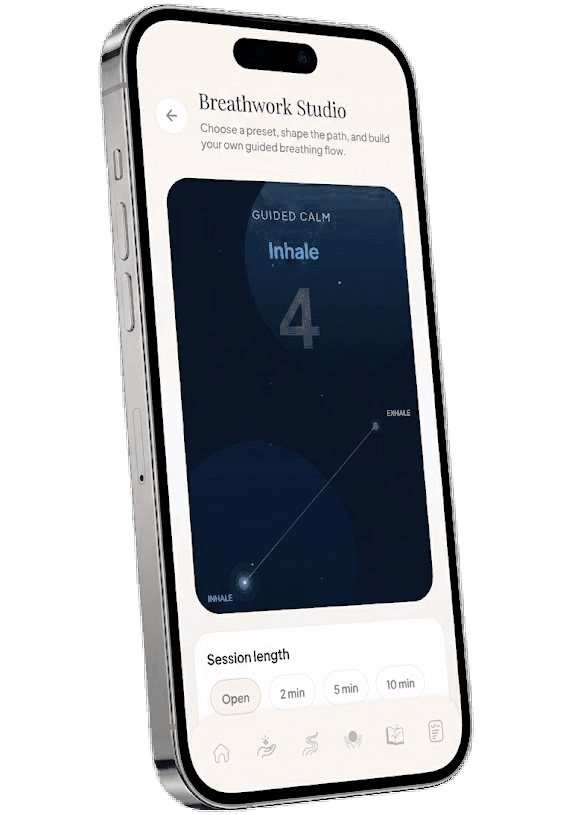
TIPP Skill: Calm Your Body Down in Minutes (DBT)
The fastest-acting DBT skill: four body-based techniques that lower overwhelming emotion in minutes, explained step by step.
Read
Distress Tolerance Skills: Surviving a Crisis Without Making It Worse
The DBT crisis survival toolkit (TIPP, STOP, ACCEPTS, self-soothing) and how to assemble them into a personal crisis plan.
Read
Emotion Regulation Skills: The DBT Toolkit for Intense Feelings
The DBT skills that reduce how often and how hard intense emotions hit: Check the Facts, opposite action, PLEASE, and more.
Read