PDF · 2 pages
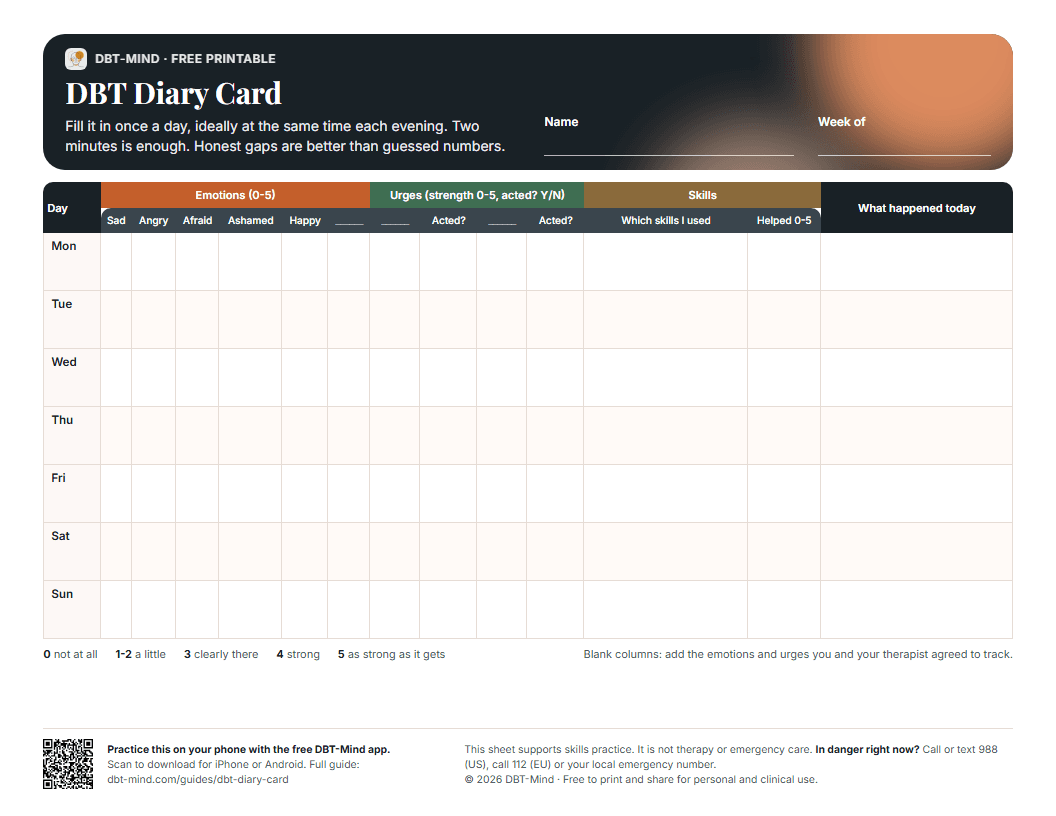
DBT Diary Card
A weekly diary card for emotions, urges and skills, plus a skills checklist for all four modules.
A diary card, a one-page skills cheat sheet, skills cards and worksheets for TIPP, STOP, crisis planning, emotion regulation, wise mind, chain analysis and radical acceptance. Written in plain language by the DBT-Mind team, free to print and share.
Short answer
There are 19 free DBT worksheets on this page, all PDFs with no sign-up. They cover mindfulness, distress tolerance and emotion regulation, plus a diary card, a chain analysis sheet and a cheat sheet for all four DBT modules. New to DBT? Start with the cheat sheet and the diary card. If you are learning alone, our guide to doing DBT on your own shows how to use them.
PDF · 2 pages
A weekly diary card for emotions, urges and skills, plus a skills checklist for all four modules.
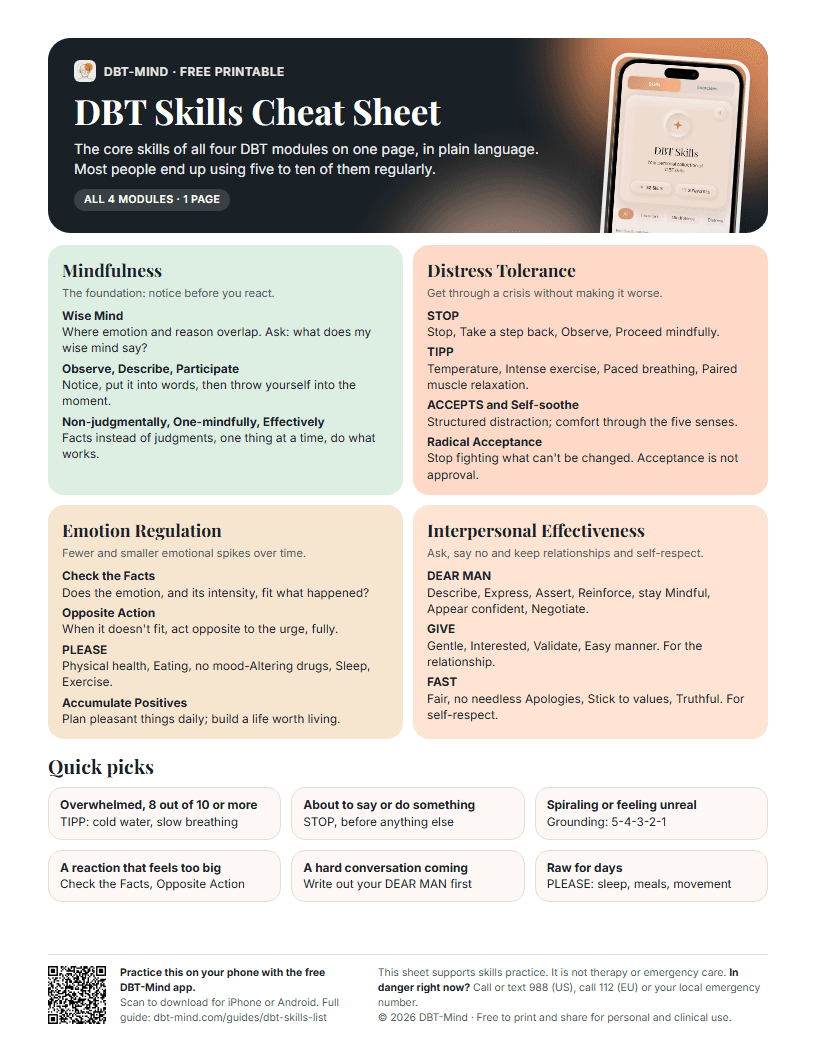
PDF · 1 page
The core skills of mindfulness, distress tolerance, emotion regulation and interpersonal effectiveness on one page.
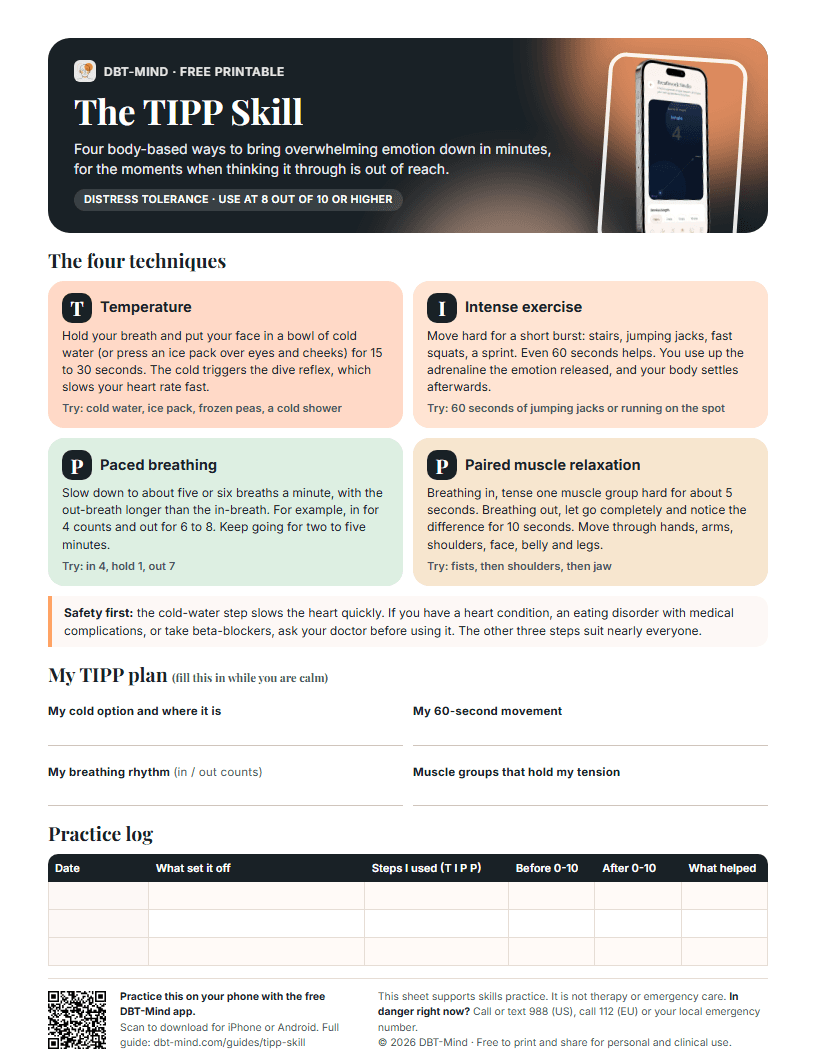
PDF · 1 page
The four TIPP techniques step by step, a personal TIPP plan and a practice log.
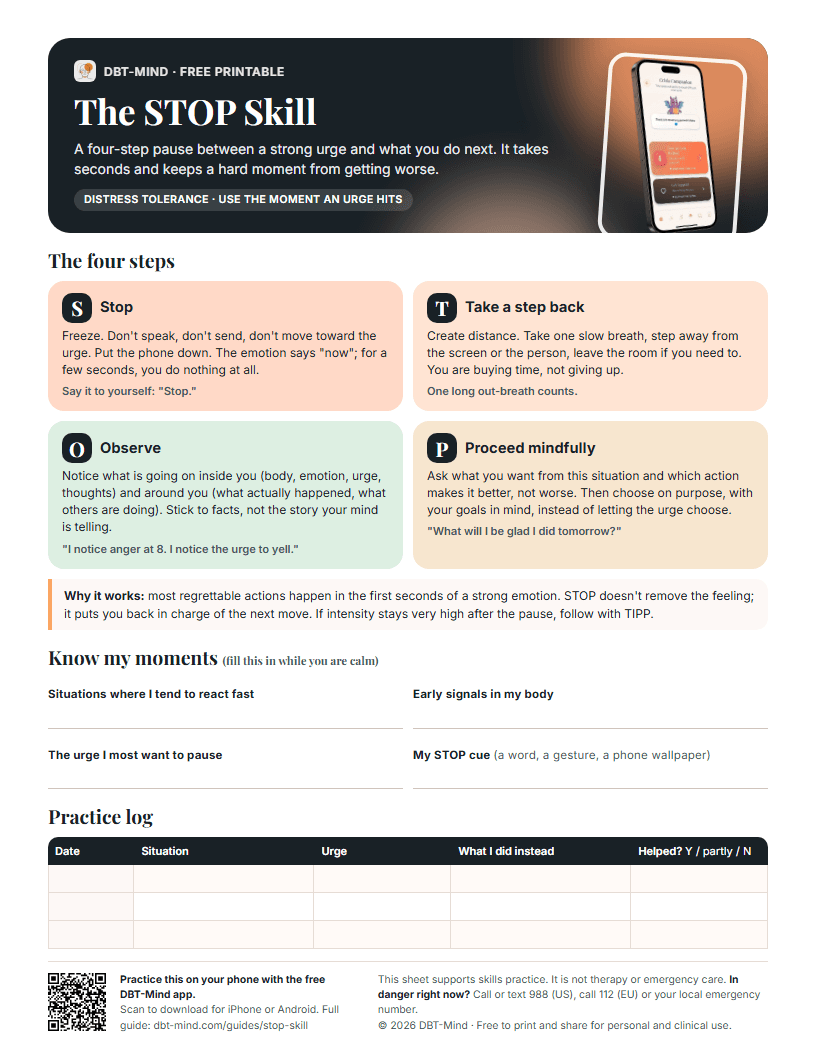
PDF · 1 page
Stop, Take a step back, Observe, Proceed mindfully: the steps, your personal triggers and a practice log.
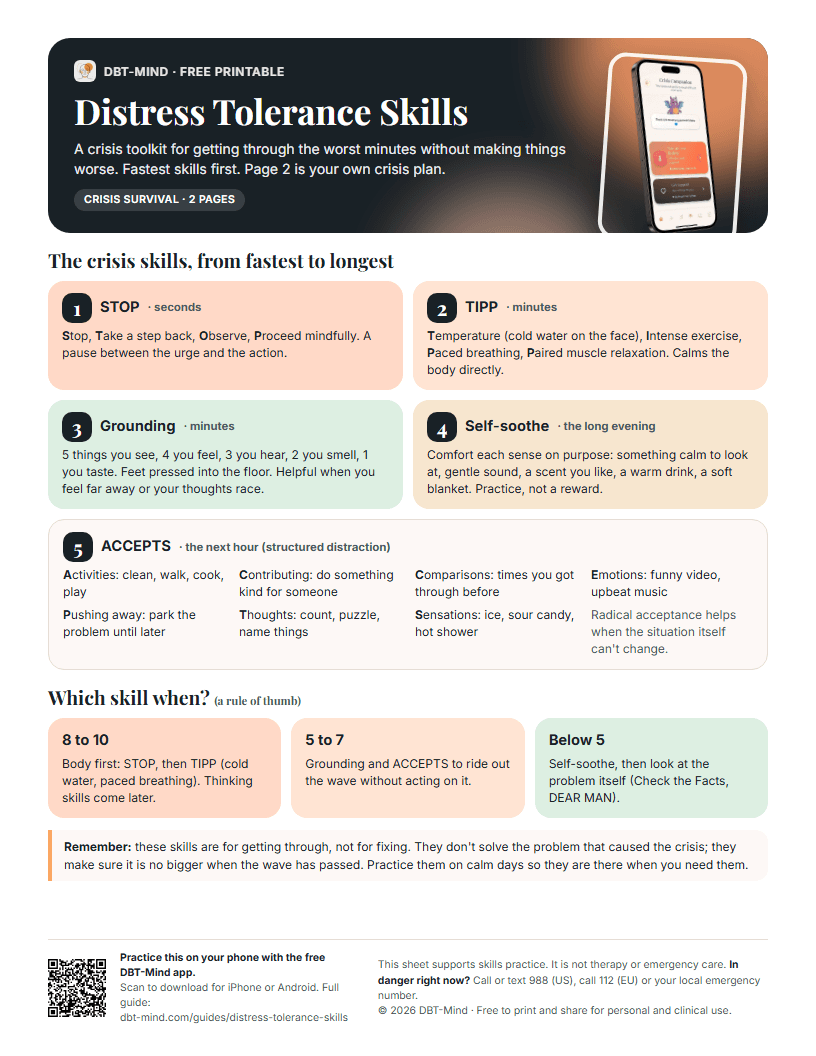
PDF · 2 pages
STOP, TIPP, grounding, self-soothe and ACCEPTS ranked by speed, plus a crisis plan to fill in while calm.
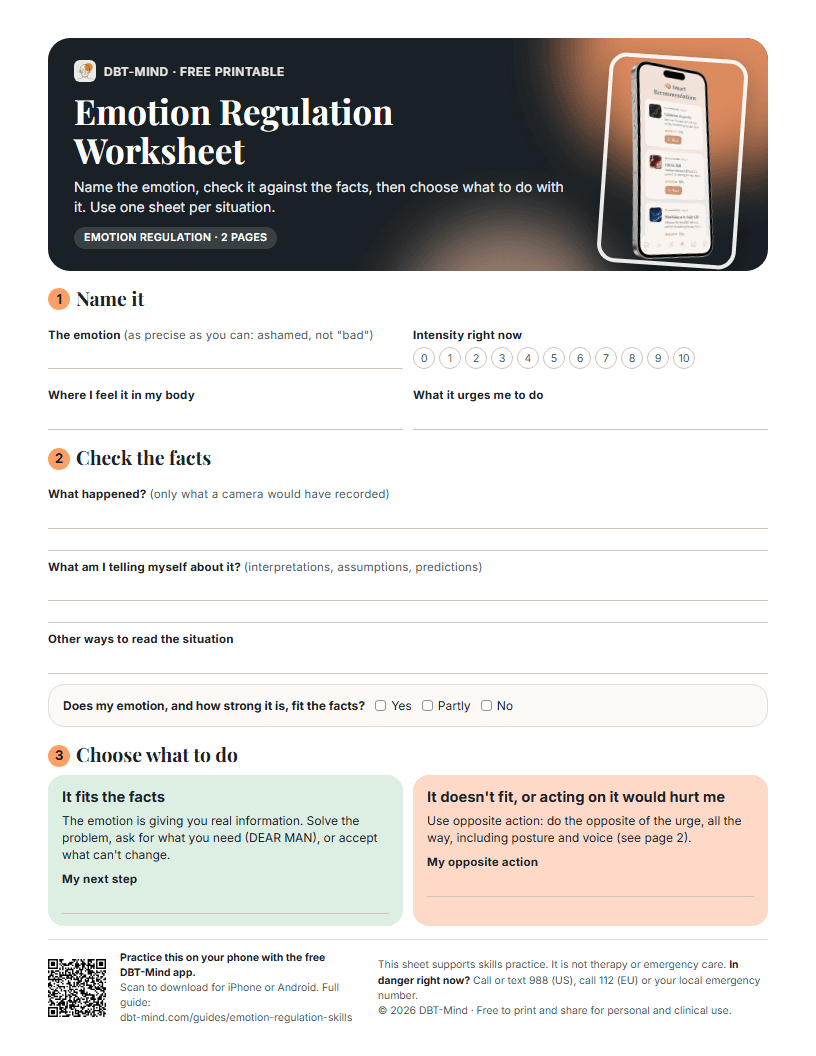
PDF · 2 pages
Name the emotion, Check the Facts, choose opposite action or problem solving, and track PLEASE for a week.
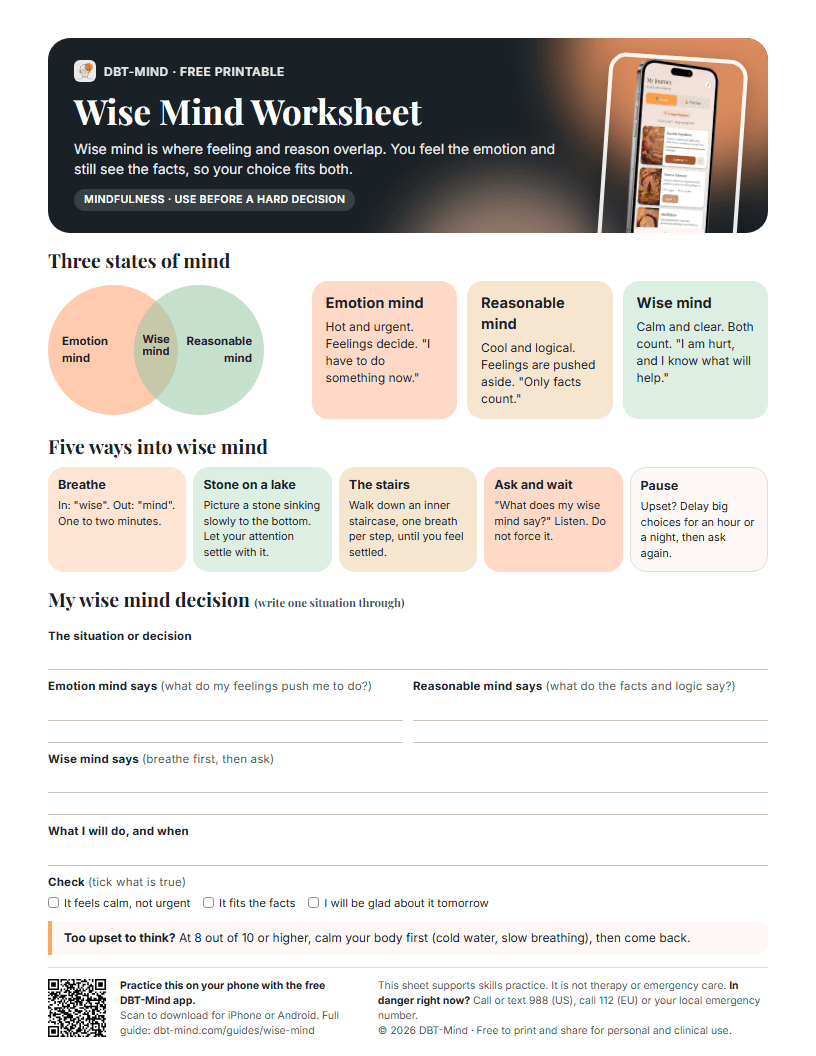
PDF · 1 page
The three states of mind, five ways into wise mind and a page to work through one decision from wise mind.
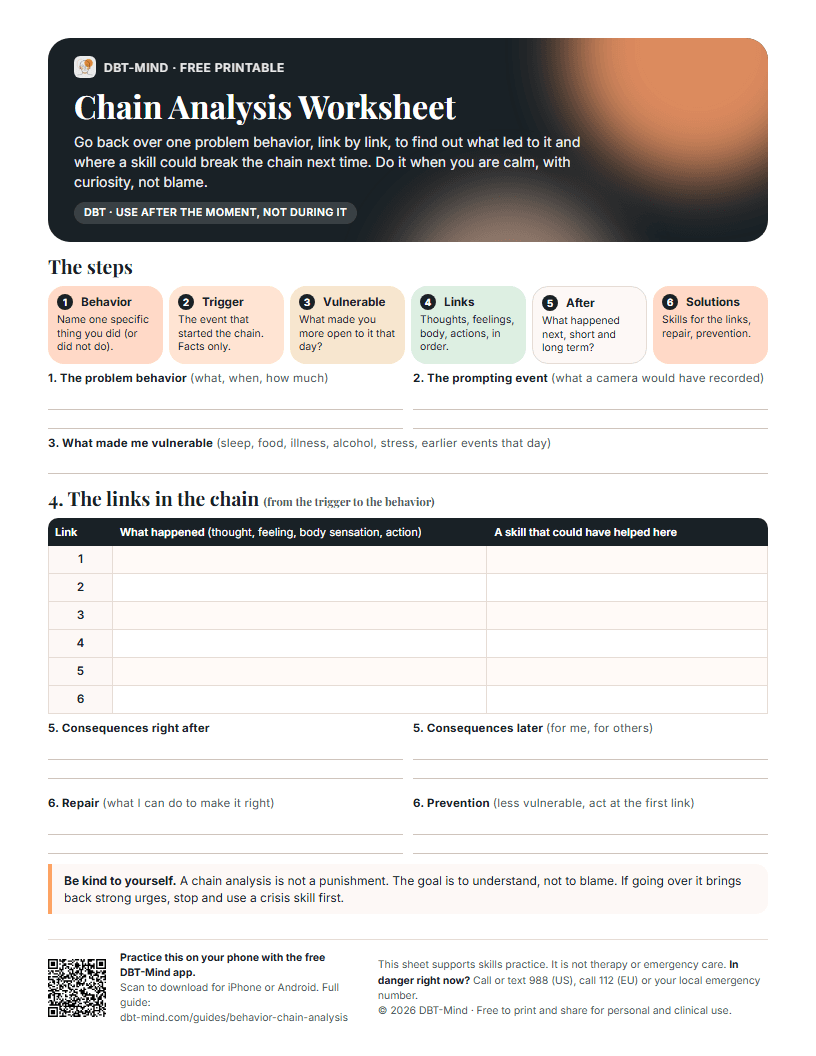
PDF · 1 page
Work through one problem behavior link by link, mark where a skill could help, and plan repair and prevention.
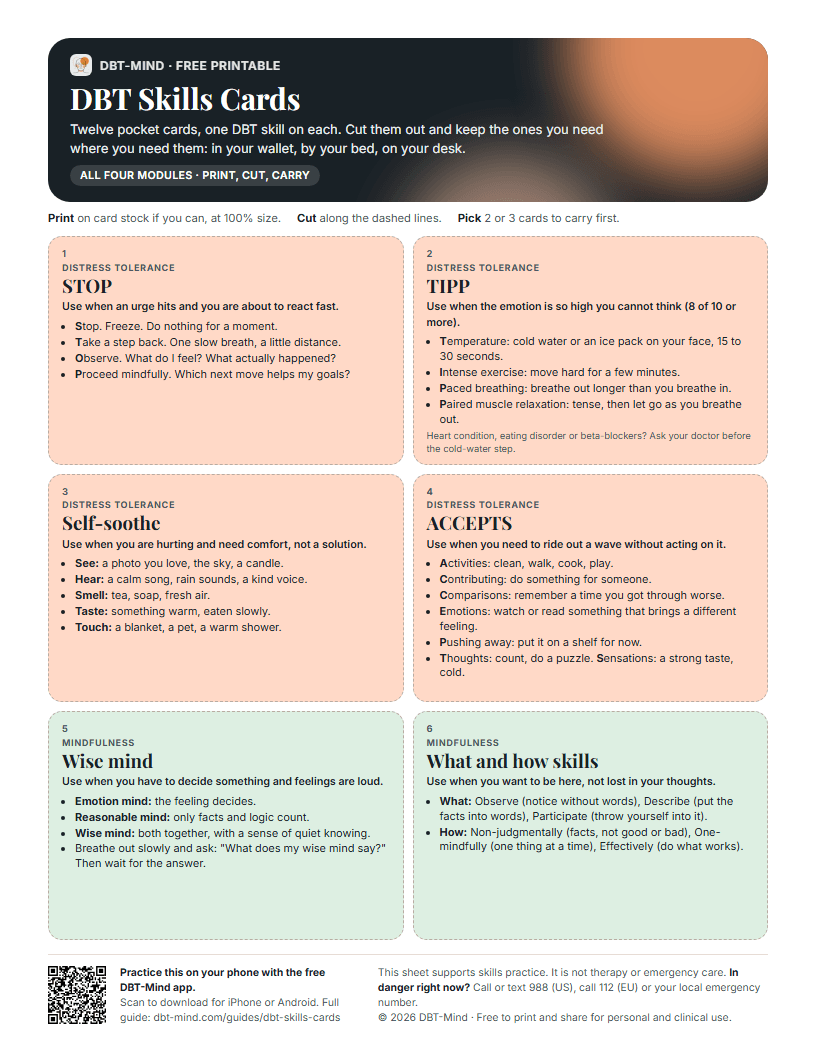
PDF · 2 pages
Twelve pocket cards to cut out, one DBT skill each, covering all four modules.
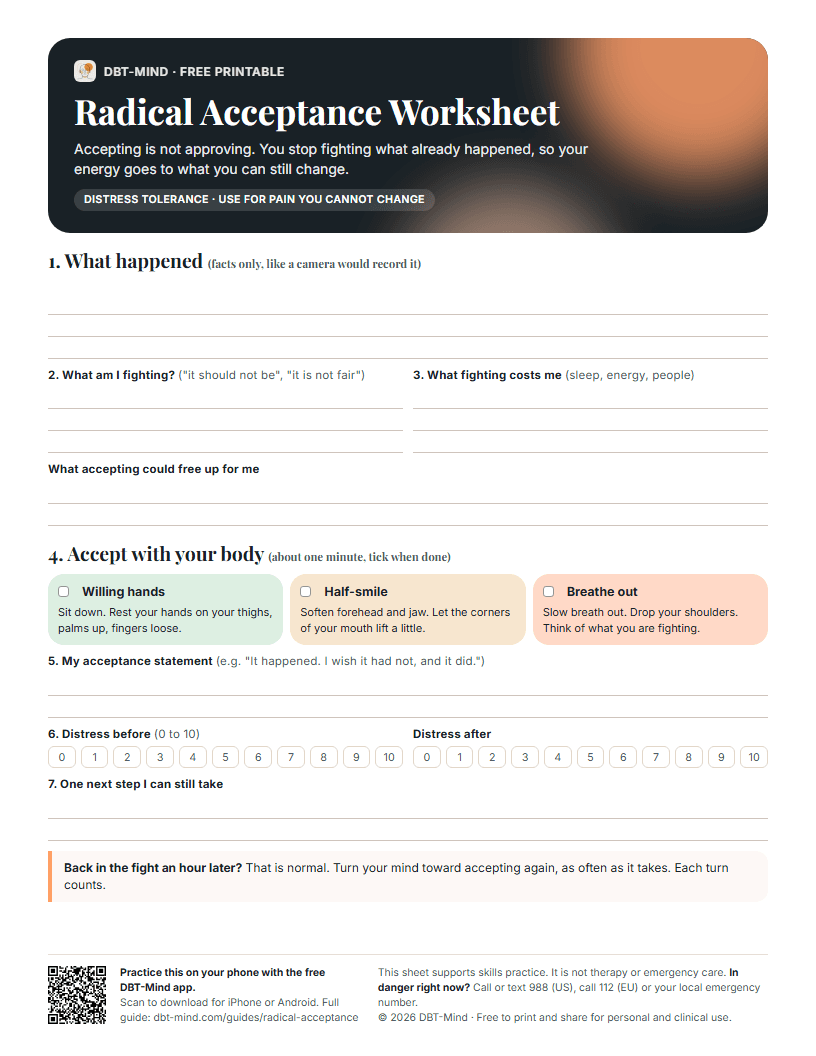
PDF · 1 page
Work through one painful reality: the facts, what fighting costs you, willing hands and half-smile, and your own acceptance statement.
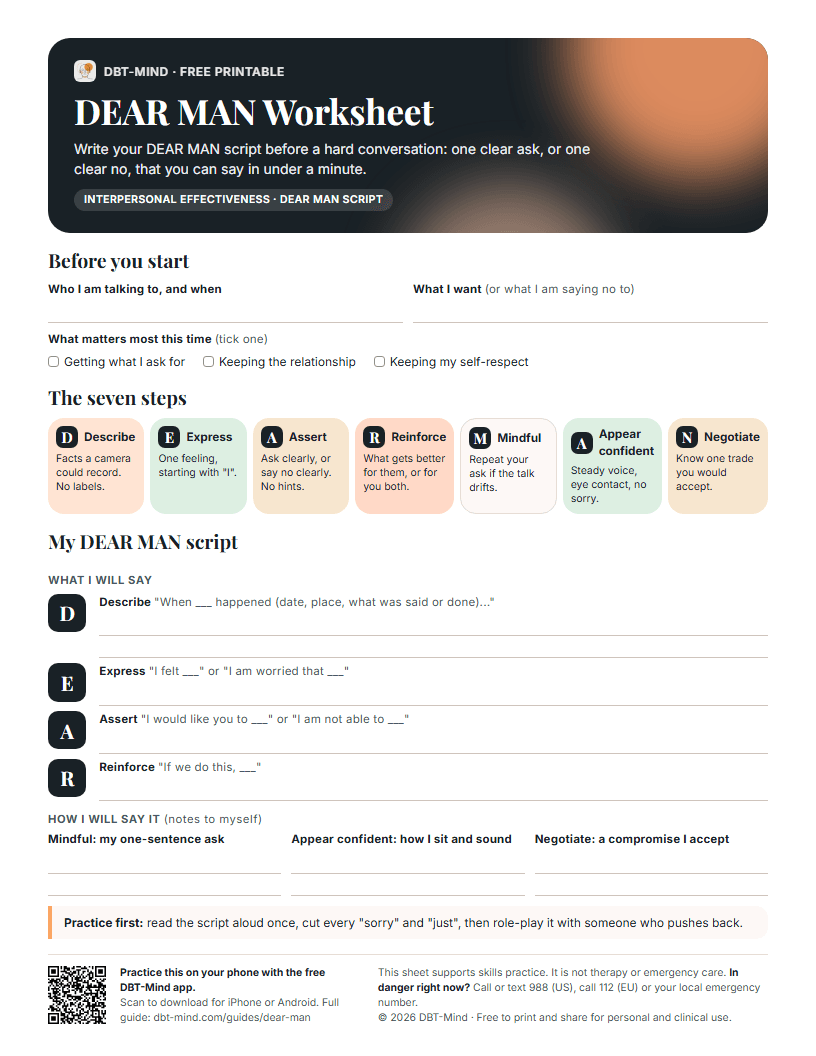
PDF · 2 pages
Write your DEAR MAN script for one hard ask or one clear no, then practice it and reflect on how the talk went.
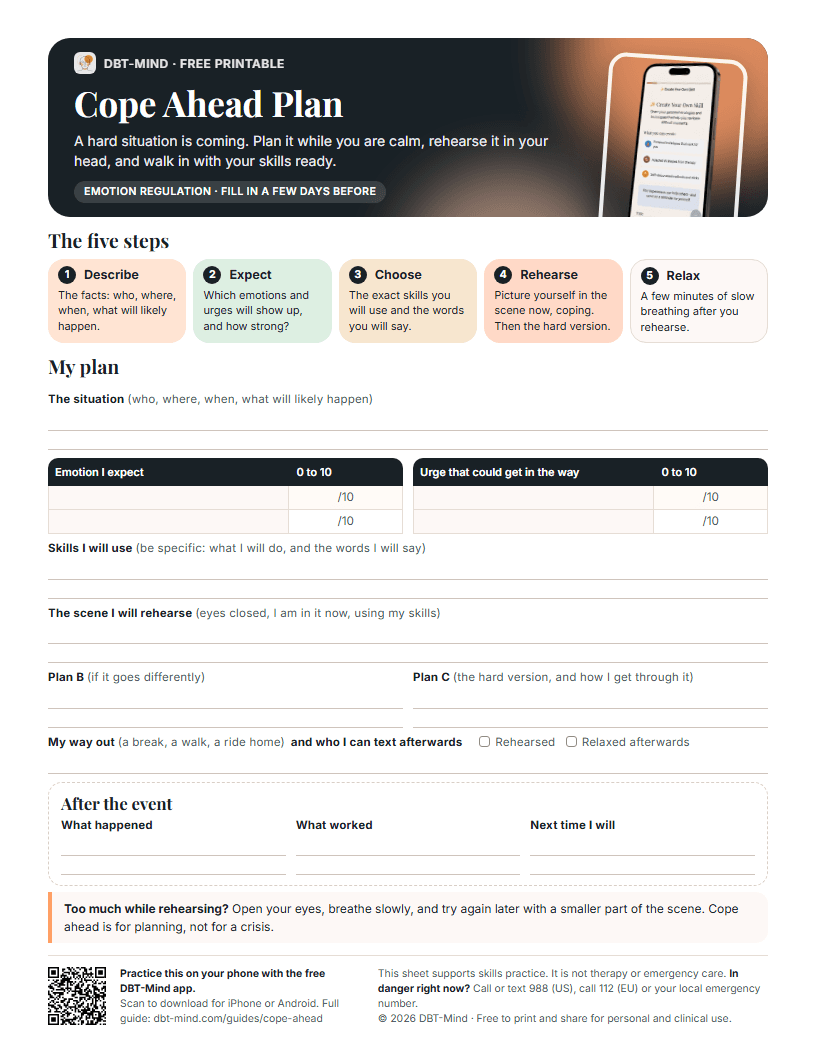
PDF · 1 page
Plan and rehearse a hard situation before it happens: expected emotions, your skills, plan B and C, and what worked afterwards.
PDF · 1 page
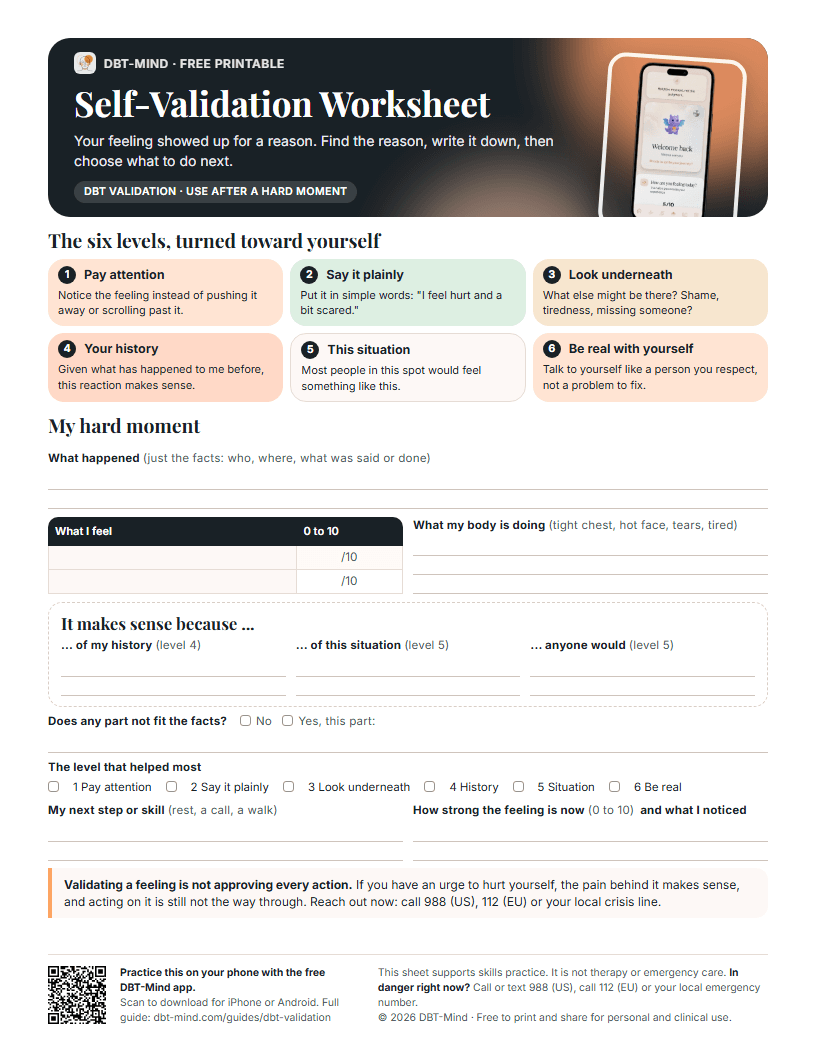
Make sense of one hard feeling: what happened, what you feel, why it makes sense, and the next skill to use.
PDF · 1 page
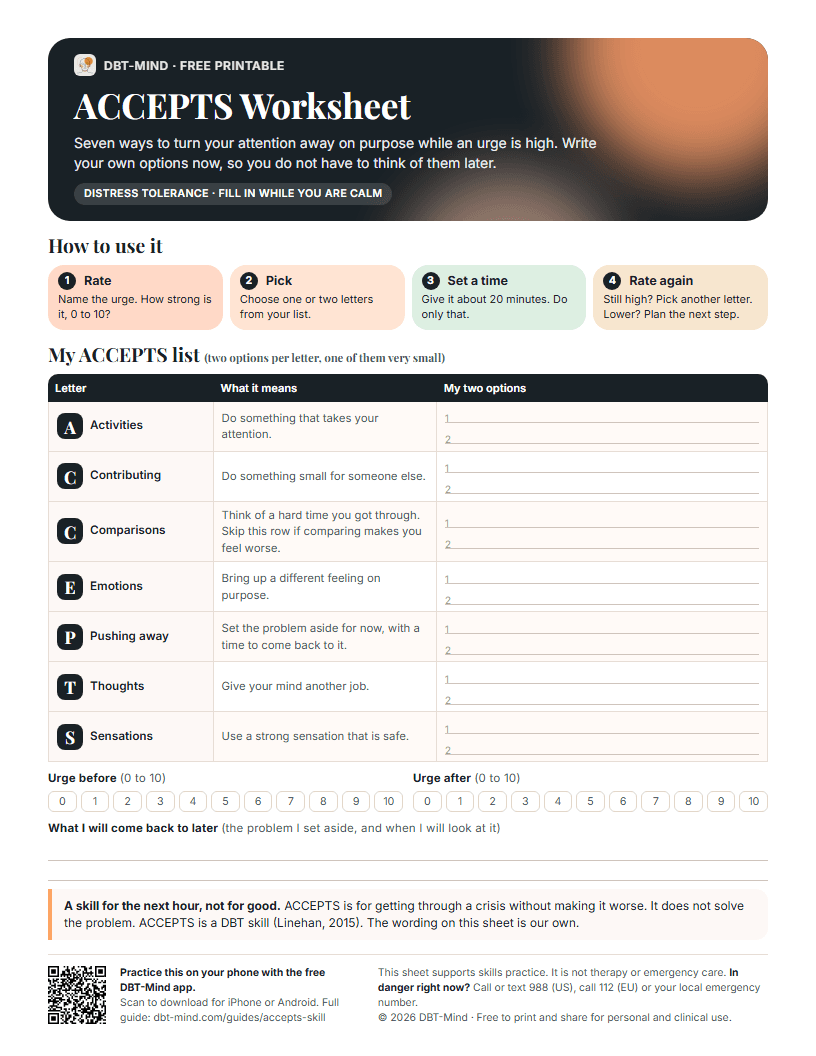
Build your own ACCEPTS list while calm: two options for each of the seven letters, an urge rating before and after, and what you will come back to.
PDF · 1 page
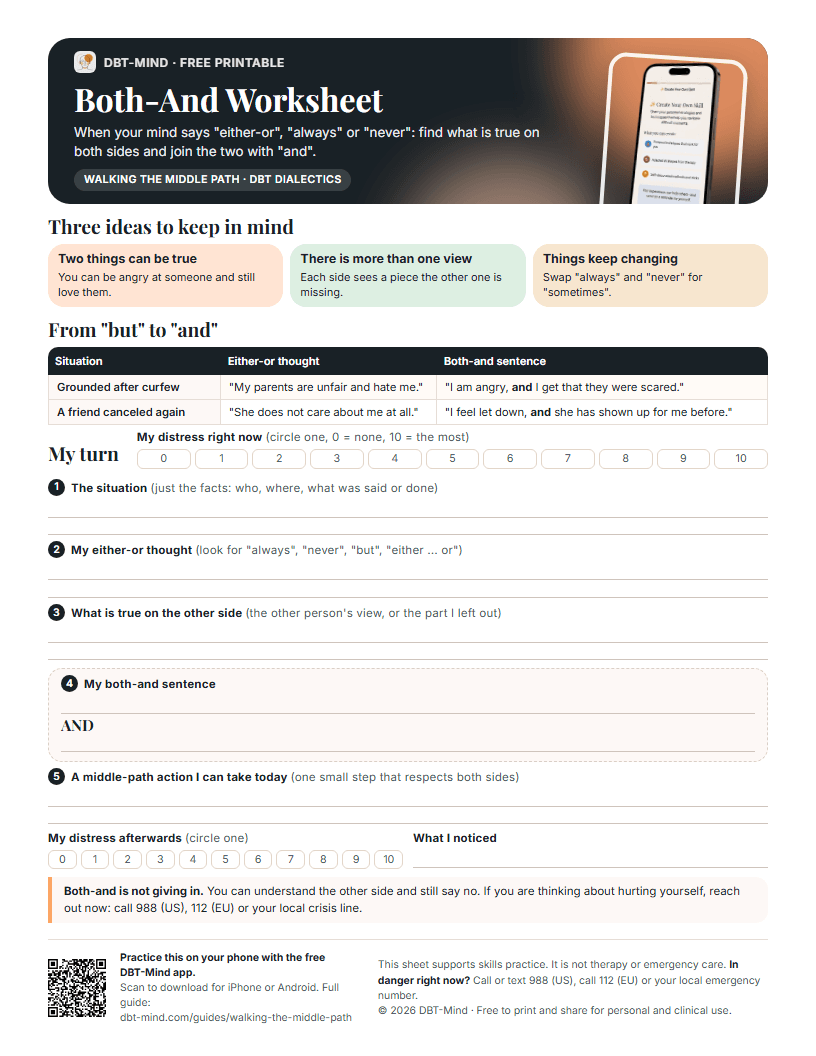
Turn one either-or thought into a both-and sentence: the situation, what is true on the other side, and one middle-path action for today.
PDF · 1 page
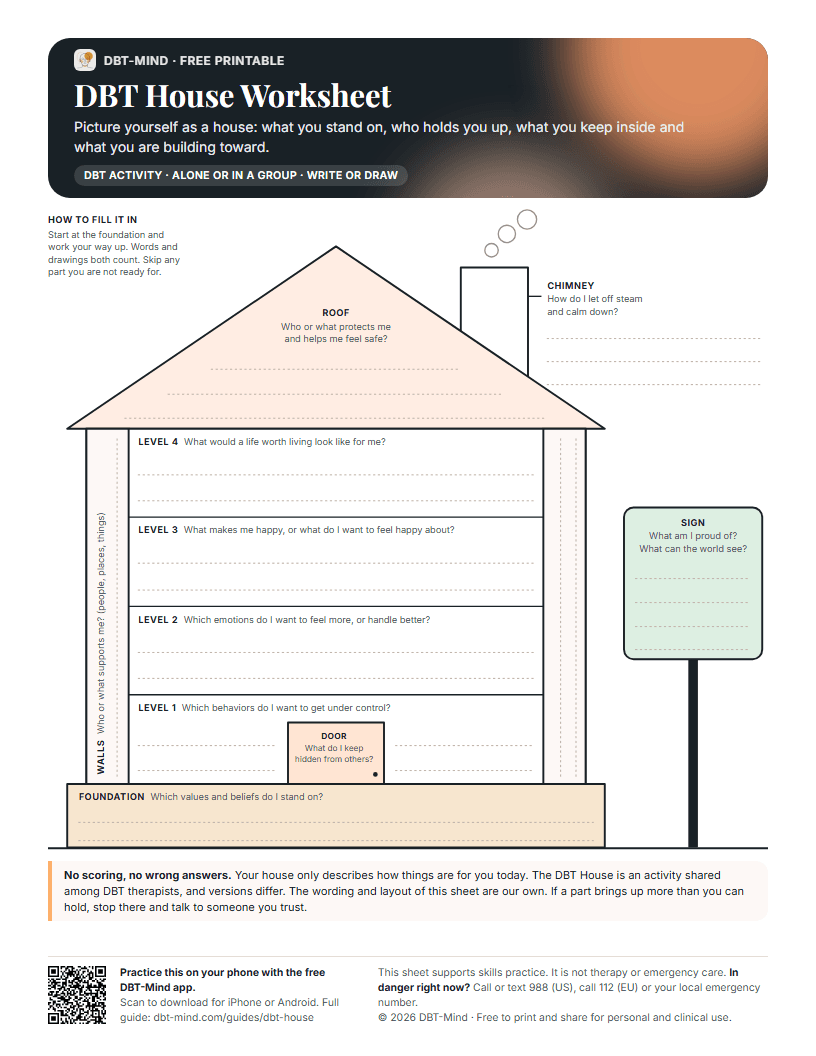
A house outline with a short question in each part: foundation, walls, roof, door, chimney, four levels and a sign, with room to write or draw.
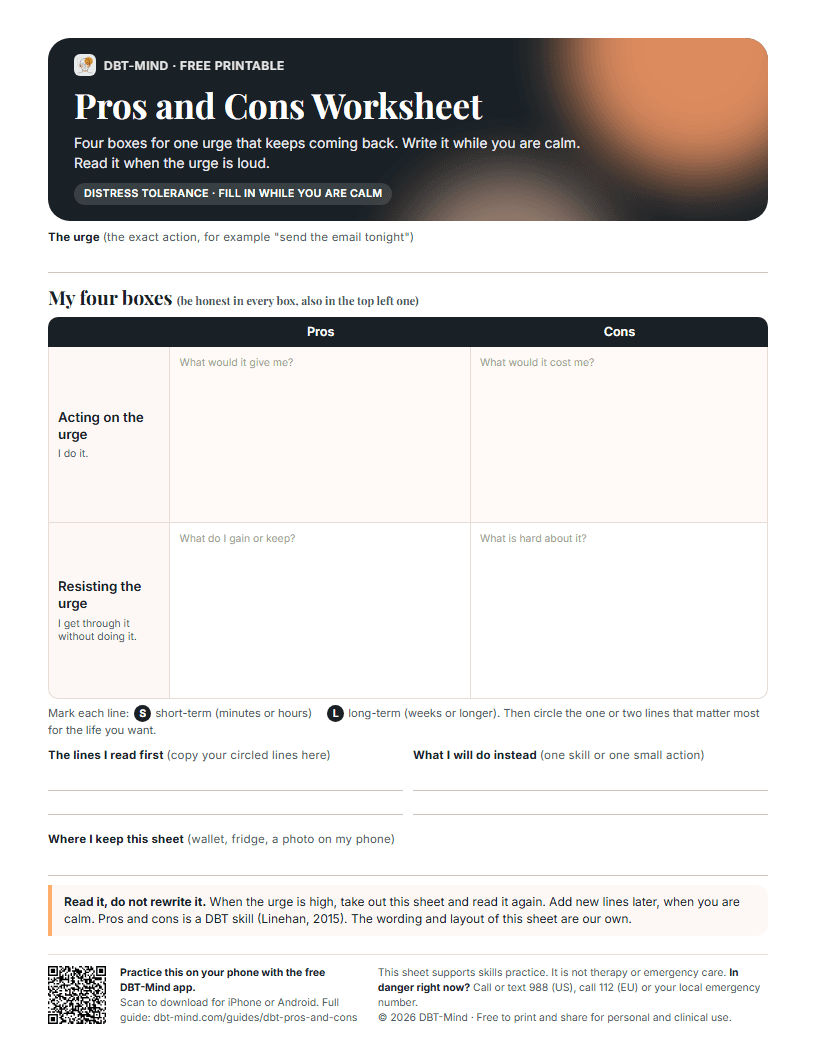
PDF · 1 page
Four boxes for one urge: the pros and cons of acting on it and of resisting it, a short-term and long-term key, and what you will do instead.
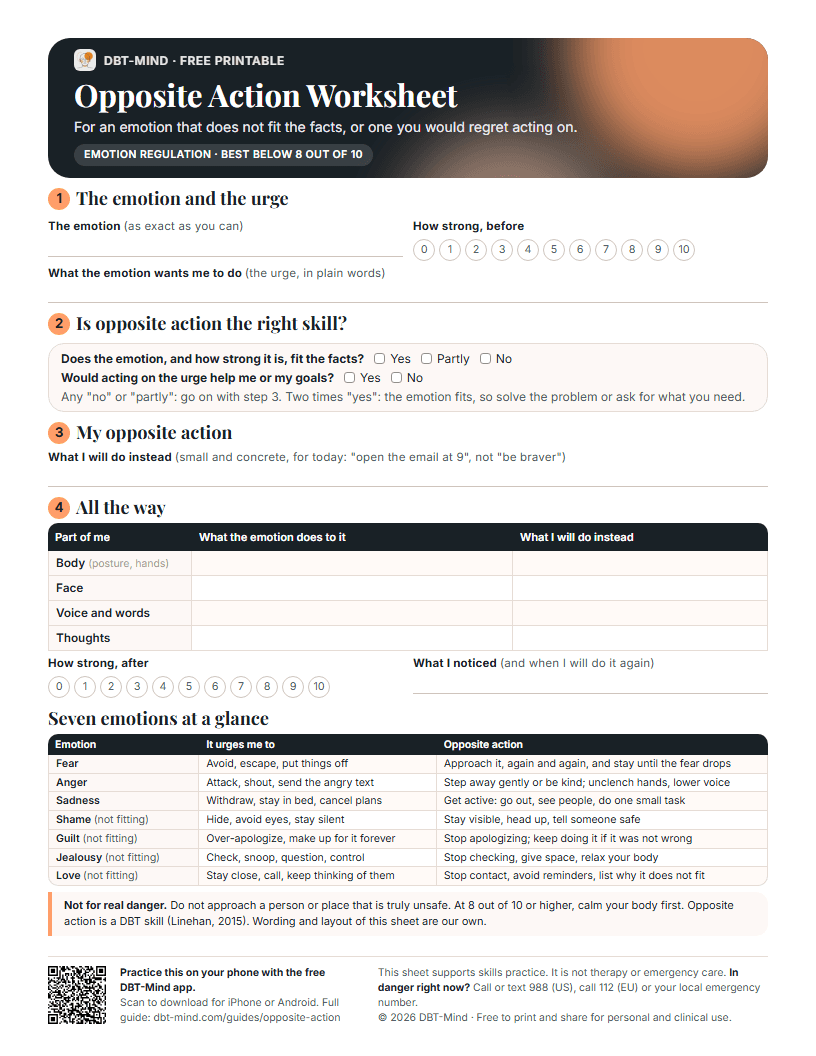
PDF · 1 page
Work through one emotion: the urge, whether it fits the facts, your opposite action, and how to do it all the way with body, face, voice and thoughts.
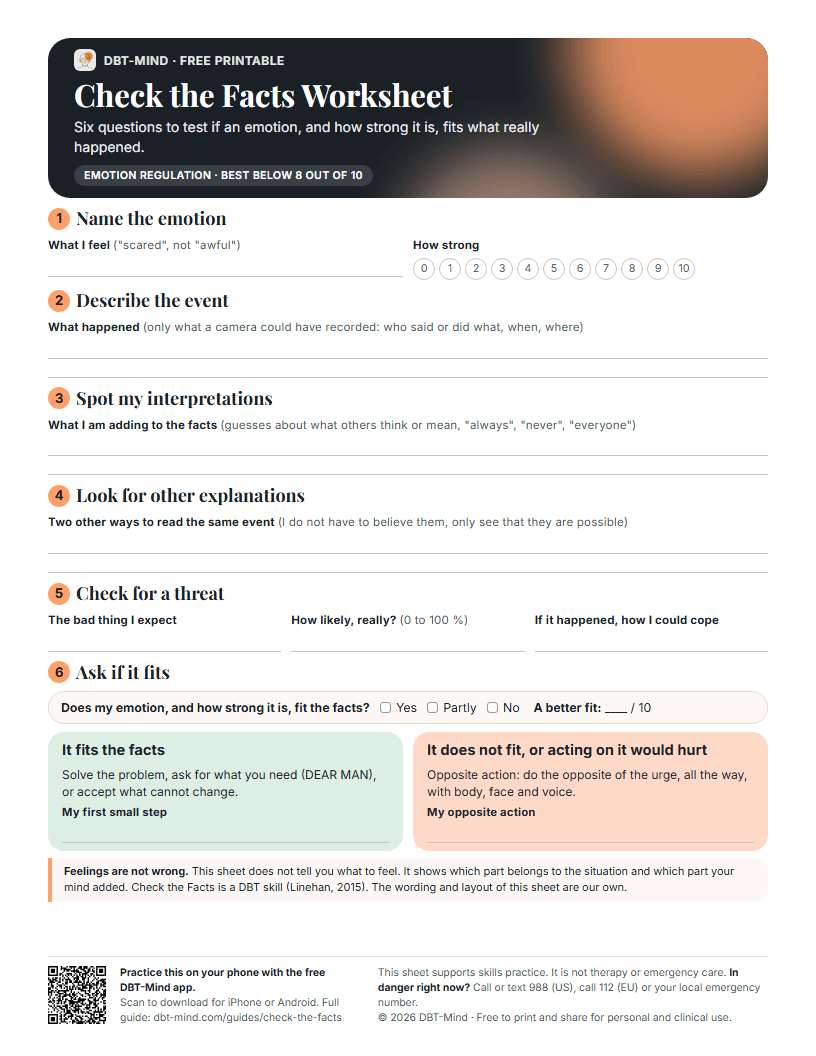
PDF · 1 page
The six Check the Facts steps as fill-in fields for one situation, with a next step for when the emotion fits and when it does not.
Prefer your phone?
DBT-Mind is free to download. The skills library with 50+ DBT skills, the crisis companion and SOS sheet are free, and so are two guided breathing presets. The TIPP worksheet is free in the app; the other four worksheets are Premium (called Plus in the app). Chain analysis, free 3 times a month, turns the paper sheet into a step-by-step flow you can share as a PDF.
| If this is you | Worksheet | Learn the skill |
|---|---|---|
| A crisis is building and you need to cool down fast | TIPP Skill Worksheet, STOP Skill Worksheet | TIPP skill, STOP skill |
| You want a plan ready for your worst moments | Distress Tolerance Skills and Crisis Plan | Distress tolerance skills |
| The same blow-up keeps happening | Chain Analysis Worksheet | Behavior chain analysis |
| You are not sure your reaction fits the situation | Wise Mind Worksheet, Emotion Regulation Worksheet | Wise mind, Emotion regulation skills |
| You want to test one strong feeling against what really happened | Check the Facts Worksheet | Check the Facts |
| A feeling pushes you to do something you would regret | Opposite Action Worksheet | Opposite action |
| You keep fighting something you cannot change | Radical Acceptance Worksheet | Radical acceptance |
| You are new to DBT | DBT Skills Cheat Sheet, DBT Diary Card | DBT skills list, DBT diary card |
| You want the skills in your bag or wallet | DBT Skills Cards | DBT skills cards |
Fill the plans in while calm
The TIPP plan, STOP triggers and crisis plan are written for your worst moments, so write them on a good day. In a crisis, memory narrows.
Keep them where hard moments happen
On the fridge, in a bag, or as a photo on your phone. A plan in a drawer does little at midnight.
Bring them to therapy
The diary card and practice logs are made to be discussed. Blank columns let you track what your therapist asks for.
Expect to practice
Skills work best when rehearsed at low intensity first. A skill you used at 3 out of 10 is there for you at 8.
These worksheets support skills practice. They do not replace therapy or emergency care. If you are in danger, call or text 988 (US), call 112 (EU) or your local emergency number.
Want the background first? Read the DBT guides
