Quick answer
Emotion regulation skills are DBT techniques for understanding, reducing, and changing intense emotions. The core skills are: naming the emotion accurately, Check the Facts (does the emotion fit the situation?), Opposite Action (acting against the emotion’s urge when it doesn’t fit), and PLEASE (protecting sleep, eating, exercise, and health so emotions start from a stable baseline).
General information about DBT skills. It does not replace therapy, and in an emergency contact your local emergency number or crisis line.
If distress tolerance skills are the fire extinguisher, emotion regulation skills are the fire prevention. They will not make you feel less (that is not the goal), but they reliably reduce how often emotions escalate past the point of usefulness, and how long they stay there.
Free printable PDF
Emotion Regulation Worksheet
Name the emotion, Check the Facts, choose opposite action or problem solving, and track PLEASE for a week.
- Check the Facts
- Opposite action
- PLEASE tracker
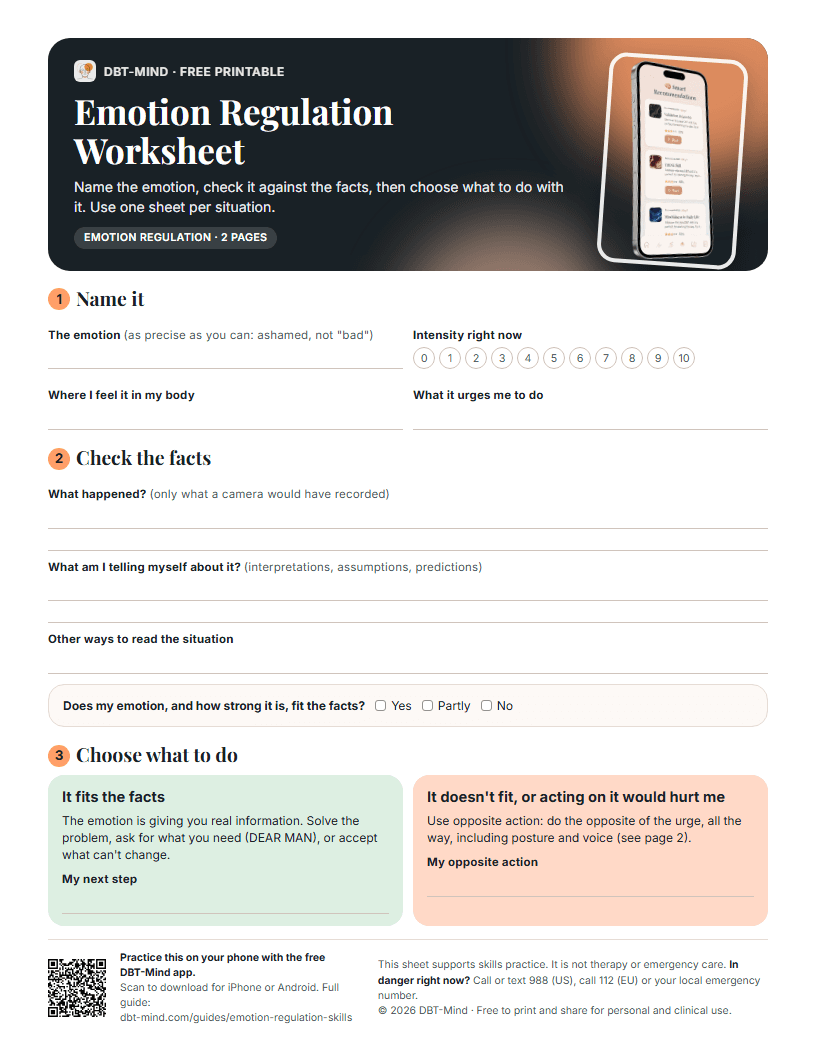
Step 1: Name it accurately
Emotion regulation starts with identification, because "I feel awful" is untreatable while "I feel ashamed, about 7 out of 10, since the meeting" is workable. Research on affect labeling shows that accurately naming an emotion measurably reduces its intensity. The naming is itself regulation.
A practical habit: three times a day, pause and name the strongest emotion present and rate it 0-10. That is the entire exercise, and it builds the noticing muscle everything else depends on.
Step 2: Check the Facts
Emotions are triggered by interpretations, not just events. Check the Facts asks: What actually happened? What am I assuming? Does the intensity of my emotion fit the verifiable facts? Sometimes the answer is yes: fear before a genuinely risky decision fits the facts, and the right move is problem-solving. Often the answer is partly no. The abandonment panic after a short text reply rests on an assumption, not a fact.
Step 3: Opposite Action
When an emotion does not fit the facts (or acting on it would make things worse), opposite action means doing the exact opposite of the emotion’s urge, fully and with your whole body:
Fear says avoid → approach, repeatedly, until the fear curve drops.
Anger says attack → gently avoid, or be decent; unclench your hands and soften your voice.
Sadness says withdraw → get active, engage, reach out.
Shame (unjustified) says hide → share the thing with someone safe.
Opposite action is arguably the most powerful skill in DBT. It is essentially exposure therapy in daily-life form.
Step 4: Lower your vulnerability with PLEASE
The same trigger hits differently after eight hours of sleep versus four. The PLEASE skills (treat PhysicaL illness, balanced Eating, avoid mood-Altering substances, balanced Sleep, Exercise) are unglamorous and do more for emotional stability than any single technique. If your emotions have been unusually raw lately, audit these five before anything else. And when a feeling is about something you cannot change, radical acceptance is the better tool.
Practice it in DBT-Mind
Practicing emotion regulation in DBT-Mind
Emotion regulation is a daily practice, not a concept. DBT-Mind gives it the structure that makes it stick.
- 1Log emotions with intensity in the mood journal: the naming practice, built into a two-minute daily habit.
- 2Work through interactive worksheets for Check the Facts and opposite action when a specific situation is eating at you.
- 3Get smart skill recommendations tuned to your patterns. The app notices your recurring morning anxiety or evening rumination and suggests the matching skill.
- 4Build PLEASE habits with the daily routine planner: sleep, meals, movement, and mindfulness scheduled like the treatment they are.

Frequently asked questions
- What are the main emotion regulation skills in DBT?
- Identifying and naming emotions, Check the Facts, Opposite Action, problem solving, PLEASE (physical vulnerability reduction), and accumulating positive experiences. Together they reduce both the frequency and intensity of emotional spikes.
- How is emotion regulation different from distress tolerance?
- Distress tolerance is for surviving the acute spike without making it worse (minutes to hours); emotion regulation reduces how often and how hard spikes happen (weeks to months). You need both: one is the emergency room, the other is the training program.
- How long does it take for emotion regulation skills to work?
- Naming and Check the Facts help immediately. Opposite action typically shows results within days to weeks of repeated practice for a specific emotion. Baseline changes from PLEASE habits build over several weeks. Tracking it on a diary card is how you actually see the trend.
- Is there a free emotion regulation worksheet PDF?
- Yes. The free DBT-Mind emotion regulation worksheet (PDF, two pages) walks you through naming the emotion, Check the Facts and choosing opposite action or problem solving, and includes a weekly PLEASE tracker. It is free to print and share.
Keep learning
All guides
DBT Skills List: All 4 Modules Explained Simply
Every core DBT skill across the four modules, explained in plain language, with guidance on which module to start with.
Read
Radical Acceptance: 7 DBT Exercises for Pain You Can’t Change
What radical acceptance means (and doesn’t), seven exercises to practice it, examples from everyday life and statements you can use when you are stuck fighting reality.
Read
DBT Diary Card: What It Is, a Filled-Out Example and How to Fill It Out
What a diary card tracks, a filled-out example week, how to rate emotions and urges, and how to keep the habit in under two minutes a day.
Read