Quick answer
A DBT diary card is a daily tracking sheet used in Dialectical Behavior Therapy to record your emotions, urges, target behaviors, and which DBT skills you used. You fill it out once a day (usually in the evening), and bring it to your therapy session so you and your therapist can spot patterns and choose what to work on.
General information about DBT skills. It does not replace therapy, and in an emergency contact your local emergency number or crisis line.
If you have just started DBT, the diary card is probably the first homework you were given, and the first thing people give up on. Paper cards get lost, forgotten, or left blank until the night before a session. This guide covers what belongs on a diary card, what a filled-out week looks like, how to rate emotions and urges, how to build the habit, and your options on paper or in an app.
Free printable PDF
DBT Diary Card
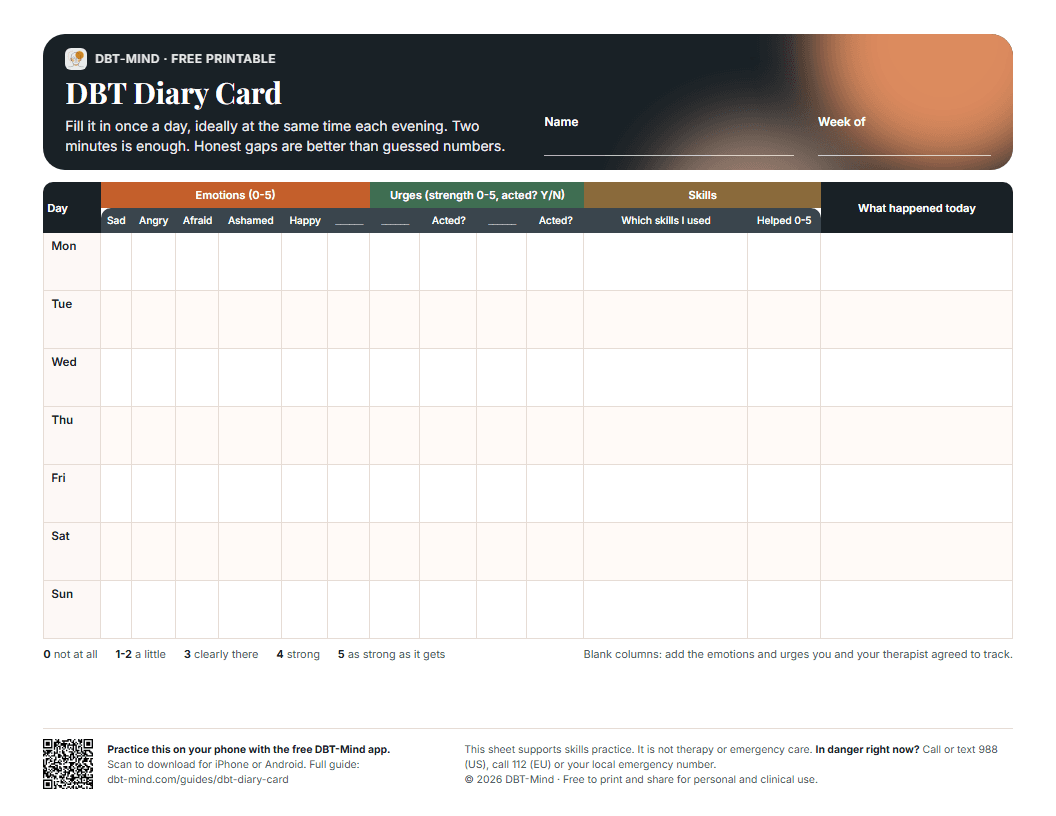
A weekly diary card for emotions, urges and skills, plus a skills checklist for all four modules.
- Emotions 0-5
- Urges and actions
- Skills used
- Weekly skills checklist
- Notes for therapy
What goes on a DBT diary card?
Standard diary cards, based on Marsha Linehan’s original design, track four things every day:
Emotions with intensity
Rate feelings like sadness, anger, fear, shame, or joy on a 0-5 scale. The rating matters more than the label. It is what reveals patterns over weeks.
Urges
Record urges relevant to your treatment (for example self-harm, substance use, bingeing, or quitting therapy), how strong they were, and whether you acted on them.
Target behaviors
The specific behaviors you and your therapist agreed to reduce or increase. These are individual. No two diary cards look the same.
Skills used
Which DBT skills you practiced that day (from mindfulness, distress tolerance, emotion regulation, or interpersonal effectiveness) and how much they helped.
How to rate emotions and urges
Most diary cards use a 0-5 scale. Your therapist may use a different one (some use 0-10 for urges). Whatever the scale, keep the meaning of each number the same every day, so a 4 in March means what a 4 meant in January.
0: not there
You did not notice the emotion or urge at all today.
1-2: mild
Present, but it did not change what you did or how you thought for long.
3: moderate
Clearly there, it took effort to keep going as planned or to not act on it.
4-5: intense
It dominated part of your day, or you came close to acting on it (or did). These are the days to bring up first in session.
A filled-out DBT diary card example
Here is a made-up week, shortened to five days, to show what an honest card looks like. Notice that it is not perfect: there is a missed skill, an urge that was acted on and a blank note. That is exactly the kind of card that gives a session something to work with.
| Day | Strongest emotions | Urge (acted on?) | Skills used | Note |
|---|---|---|---|---|
| Mon | Sadness 3, shame 2 | Isolate 3 (no) | Self-soothe | Quiet day at home |
| Tue | Shame 5, anger 3 | Self-harm 4 (no) | TIPP, STOP | Argument on the phone, cold water helped |
| Wed | Fear 2 | Skip class 2 (no) | Opposite action | Went anyway |
| Thu | Anger 4, sadness 3 | Binge 4 (yes) | None | Too tired to think of anything |
| Fri | Joy 3, sadness 1 | None (0) | Mindful breathing |
Fictional example by the DBT-Mind team. Your card should track the urges and target behaviors you and your therapist agreed on.
A therapist reading this card would likely start with Tuesday (the skills worked under a 5) and Thursday (what got in the way). The skills in the example are explained in the guides on TIPP, the STOP skill and emotion regulation skills such as opposite action.
Why diary cards work (when you actually keep them)
The diary card is not busywork. It does three jobs at once: it turns vague weeks ("it was bad") into concrete data ("shame spiked to 5 on Tuesday after the phone call"), it forces one moment of mindful self-observation per day, and it lets your therapist spend session time on treatment instead of reconstruction.
Research on DBT consistently treats the diary card as a core component of therapy, not an optional extra. Session agendas in standard DBT are literally set from the card. An incomplete card usually means the most important events of the week never get discussed.
How to fill out a diary card in under 2 minutes
- 1
Pick a fixed time. For most people that is right before bed, attached to an existing habit like brushing your teeth.
- 2
Rate your strongest emotions of the day (0-5). Do not overthink the numbers; consistency beats precision.
- 3
Log any urges and mark whether you acted on them. Honesty here is what makes the card useful. It is data, not a report card.
- 4
Tick the skills you used, even imperfect attempts. A skill you tried and "failed" is still information worth discussing.
- 5
Add one line of context if something notable happened. One sentence is enough to jog your memory in session.
If you miss a day, do not backfill from memory. Just resume. A card with honest gaps beats a card full of guessed numbers. If high ratings for self-harm urges keep showing up, tell your therapist before the next session, and if you are in danger of acting on them, call 988 (US), 112 (EU) or your local crisis line.
Paper, printable PDF or app?
Your therapist’s card
If your therapist hands you a card, use that one. It is set up for the behaviors you agreed to work on, and they know how to read it.
Printable PDF
Good if you like writing by hand or want a weekly overview on the fridge. The free DBT-Mind diary card PDF on this page has a weekly grid and blank columns for your own targets.
Diary card app
Good if paper cards get lost or forgotten. Apps can remind you each evening and chart your ratings over weeks. Our comparison of DBT apps with a diary card lists the options, including DBT-Mind.
Whichever you choose, the format matters less than filling it out every day. If you are working through DBT without a therapist, the diary card is still useful; see doing DBT on your own.
Practice it in DBT-Mind
Keeping your diary card in DBT-Mind
DBT-Mind has a mood journal for everyday tracking and a structured daily diary card that your therapist can assign through the DBT-Mind therapist portal.
- 1Log moods and Journal entries any day. The app charts them over time so patterns become visible.
- 2If your therapist assigns a daily diary card, you rate emotions (0-5), distress and urges before and after (0-10), target behaviors, skills used and what got in the way.
- 3Turn on diary reminders so the evening entry becomes automatic.
- 4With Premium, export your entries as a PDF report to bring to your session.

Frequently asked questions
- How often should I fill out a DBT diary card?
- Once a day, ideally at the same time each evening. Filling it out daily (rather than reconstructing the week before a session) is what makes the data accurate and the habit stick.
- Do I need to be in therapy to use a diary card?
- No. Tracking emotions, urges, and skill use is valuable self-knowledge even without a therapist, and a core part of doing DBT on your own. If you start therapy later, an existing diary card history gives your therapist a massive head start.
- Can I share my diary card with my therapist digitally?
- Yes. DBT-Mind Premium exports your journal entries and skill history as a PDF report you can email or show in session. If your therapist uses the DBT-Mind therapist portal, they can also assign a daily diary card in the app.
- What scale is used on a DBT diary card?
- Most DBT diary cards rate emotions and urges from 0 (not present) to 5 (very intense), once a day. Some therapists use 0-10 for urges or distress. The exact scale matters less than using it the same way every day, so changes over weeks are real and not caused by shifting numbers.
- Is there a free printable DBT diary card?
- Yes. The free DBT-Mind diary card (PDF, two pages, US Letter landscape) has a weekly grid for emotions, urges and skills, blank columns for what your therapist asks you to track, and a skills checklist for all four modules. It is free to print and share.
Keep learning
All guides
DBT Skills List: All 4 Modules Explained Simply
Every core DBT skill across the four modules, explained in plain language, with guidance on which module to start with.
Read
Can You Do DBT on Your Own? A Realistic Guide to Self-Guided DBT
What self-guided DBT realistically can and cannot do, and how to structure learning DBT skills while waiting for (or instead of) therapy.
Read
Best DBT Apps in 2026: DBT Coach, DBT-Mind, DBT Pal and More Compared
An honest side-by-side of four DBT apps: what each one costs, what it does best, where it falls short, and how to choose.
Read