Quick answer
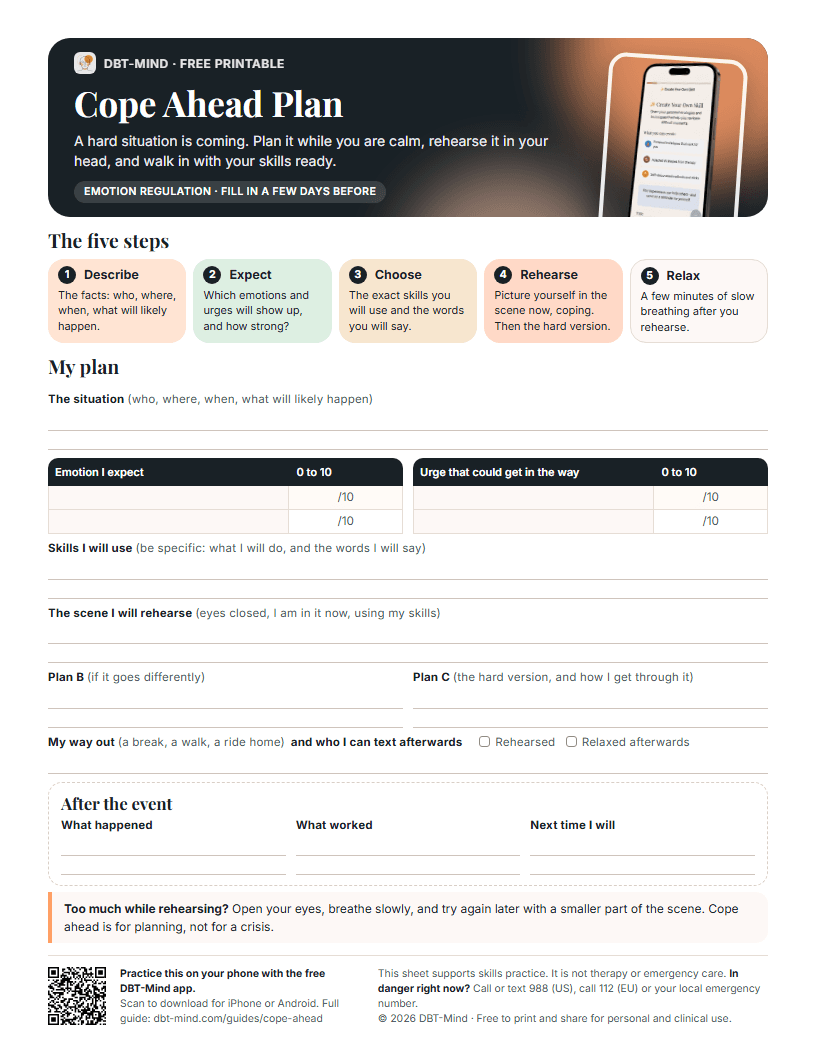
Cope ahead is a DBT emotion regulation skill for rehearsing a hard situation before it happens. You describe the situation, name the emotions and urges you expect, choose the skills you will use, picture the scene in detail while you practice coping with it, and then relax afterwards (Linehan, DBT Skills Training Manual, 2nd edition, 2015). A free one-page cope ahead plan is on this page.
General information about DBT skills. It does not replace therapy, and in an emergency contact your local emergency number or crisis line.
Some hard moments come with a date on them: a holiday dinner with a relative who picks at you, a talk with your boss, a hospital visit, the anniversary of a loss. You know your emotions will run high. Cope ahead uses the time before that day, while you are still calm, to decide what you will do and to practice it in your head.
Below: the five steps with a running example, three worked examples, what to do when you do not know how the day will go, and a free plan to print. It is written by the team behind DBT-Mind, an app for practicing DBT skills.
Free printable PDF
Cope Ahead Plan
Plan and rehearse a hard situation before it happens: expected emotions, your skills, plan B and C, and what worked afterwards.
- 5 steps
- Plan B and C
- After the event
The cope ahead steps
Running example: next week you meet your ex to give back their things. Last time you ended up crying and begging them to stay.
- 1
Describe the situation. Write down the facts: who, where, when, what is likely to happen. Stick to what you know. "Saturday, 2 pm, at the café near their flat. They will probably be with their new partner."
- 2
Name the emotions and urges you expect. Which feelings will show up, and how strong (0 to 10)? Which urges could get in the way of your skills? "Sadness 8, shame 6. Urge to beg, or to say something cruel and leave."
- 3
Choose your skills. Decide exactly what you will do and say. Be specific. "Hand over the box, say one kind sentence, leave after ten minutes. Slow breathing on the walk there. Text my sister when I am back in the car."
- 4
Picture it and rehearse. Close your eyes and imagine you are in the scene now, not watching it from outside. See yourself using your skills. Then rehearse what you will do if it goes worse than planned, for example if they bring up the breakup.
- 5
Relax afterwards. Rehearsing stirs up feelings. Finish with a few minutes of slow breathing or another calming skill, so you leave the practice settled.
These steps follow the cope ahead skill in Marsha Linehan’s DBT Skills Training Manual (2nd edition, Guilford Press, 2015). It belongs to the emotion regulation module, where it is the C in ABC PLEASE: Accumulate positive emotions, Build mastery, Cope ahead. The wording here is ours. For the rest of that module, see the emotion regulation skills guide.
Three worked examples
A holiday dinner with a critical relative
Expected: anger 7, urge to snap back or walk out. Skills: one prepared line ("Let’s talk about something else"), slow breathing at the table, a planned walk outside after the main course. Rehearse: your aunt comments on your job, you notice the heat in your face, you breathe, you say your line.
Asking your boss for a day off
Expected: fear 6, urge to drop the request halfway. Skills: a short script written with the DEAR MAN skill. Rehearse: your boss says "That is a busy week." You repeat your ask calmly and offer a trade, such as finishing a task early.
A medical appointment that scares you
Expected: fear 8, urge to cancel the night before. Skills: questions written on a card, a friend who comes along, slow breathing in the waiting room. Rehearse: the doctor gives news you did not want, and you still ask your three questions.
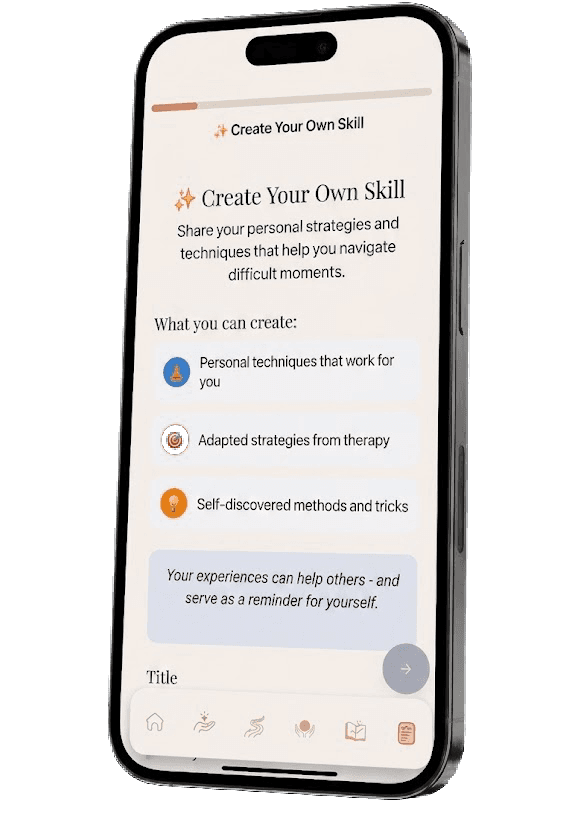
If you use the DBT-Mind app, you can save your plan as your own custom skill and mark it as an emergency skill, so it shows up in the crisis tab and the SOS sheet on the day. Both are free.
When you do not know what will happen
A common worry: "How can I cope ahead when I have no idea how it will go?" You do not need to predict the day. Plan for a few versions instead.
Plan two or three versions
A good version, a likely version and a hard version. Write one line for each: what happens and what you will do.
Pick one skill per version
Keep it to one. In the hard version, a short skill you can do anywhere works best, such as slow breathing or the STOP skill.
Rehearse the hard version too
Linehan’s manual includes rehearsing how you would cope if your worst fear came true. You picture yourself getting through it, not just the disaster.
Have a way out
Know how you can leave or take a break: a bathroom break, a walk, a ride home. Knowing the exit is part of the plan.
Cope ahead vs other DBT skills
Cope ahead is for before. Other skills help in the moment. If you are unsure whether your feeling fits the situation, Check the Facts comes first. If a feeling does not fit and its urge would make things worse, opposite action is the tool. If your emotion is already very high, the TIPP skill brings your body down fast.
| Skill | Module | Use it when | Example |
|---|---|---|---|
| Cope ahead | Emotion regulation | A hard situation is coming and you are calm enough to plan | Rehearsing a talk with your landlord two days before |
| Check the Facts | Emotion regulation | You are not sure your emotion fits what actually happened | A short text from a friend feels like rejection |
| Opposite action | Emotion regulation | An emotion does not fit the facts and its urge would make things worse | Fear tells you to skip a class you need |
| TIPP | Distress tolerance | Your emotion is so high you cannot think clearly | Panic before a meeting that starts in five minutes |
Source: Marsha Linehan, DBT Skills Training Manual, 2nd edition (Guilford Press, 2015). Descriptions and examples in our own words.
When cope ahead is not the right skill
Cope ahead is practice for a calm moment before an event. It is not a crisis plan. If you are already overwhelmed, use a fast skill first and plan later. And if picturing the scene gets too intense while you rehearse, many people find it helps to stop, open their eyes and breathe slowly before they try again with a smaller piece of the scene.
If you are thinking about hurting yourself or feel unsafe, do not wait for a plan. Call 988 (US), 112 (EU) or your local crisis line.
Free cope ahead plan (PDF)
The free cope ahead plan fits on one page. Fill in the top a few days before the event, rehearse once or twice, and fill in the bottom afterwards.
Before
The situation, the emotions and urges you expect (0 to 10), the skills you will use and the scene you will rehearse.
Plan B and plan C
What you will do if it goes differently, and your way out.
After
What happened, what worked and what you would change next time.
Practice it in DBT-Mind
Coping ahead with DBT-Mind
DBT-Mind is a free DBT app for iOS and Android. It has no cope ahead worksheet, but these free features help you keep your plan close.
- 1Write your plan as your own custom skill: give it a title, a short description and your steps. Custom skills are free.
- 2Mark it as an emergency skill (free), so it shows up in the crisis tab and the SOS sheet when the day comes.
- 3For the relax step, use Guided Calm or Box Breathing in the Breathwork Studio. Both presets are free.
- 4Afterwards, write in the journal what happened and what worked. The text journal is free.
Frequently asked questions
- What is a cope ahead plan in DBT?
- A cope ahead plan is a short written plan for a hard situation you can see coming. It names the situation, the emotions and urges you expect, the skills you will use and a scene you will rehearse in your head. The free plan on this page has space for all of that plus a plan B.
- Which DBT module is cope ahead in?
- Emotion regulation. In Linehan’s DBT Skills Training Manual (2nd edition, 2015) it is the C in ABC PLEASE, next to accumulating positive emotions and building mastery.
- How is cope ahead different from worrying?
- Worrying replays what could go wrong, often for hours, with no plan at the end. Cope ahead is short and ends with a choice: the skills you will use, a rehearsal of yourself using them and a few minutes of relaxing. If you notice you are only replaying the bad version, stop and pick one skill for it.
- Can cope ahead make anxiety worse?
- Picturing a hard scene can bring up strong feelings. That is why the last step is to relax. If it gets too much, stop, breathe slowly and try again later with a smaller part of the scene. If anxiety keeps you from daily life, talk to a doctor or therapist.
- Is there a free cope ahead worksheet PDF?
- Yes. The free DBT-Mind cope ahead plan (PDF, one page) has space for the situation, expected emotions and urges, your skills, the scene to rehearse, plan B and plan C, and what worked afterwards. It is free to print and share.
Keep learning
All guides
Emotion Regulation Skills: The DBT Toolkit for Intense Feelings
The DBT skills that reduce how often and how hard intense emotions hit: Check the Facts, opposite action, PLEASE, and more.
Read
Check the Facts (DBT): 6 Steps to Test If an Emotion Fits
The six questions of the DBT skill Check the Facts, worked examples, and what to do next when your emotion fits the facts and when it does not.
Read
Opposite Action DBT: How to Act Against an Emotion’s Urge
What opposite action means in DBT, the opposite action for seven emotions, how to do it all the way, and when it is the wrong tool.
Read