Quick answer
TIPP is a DBT distress tolerance skill for moments of overwhelming emotion or panic. It stands for Temperature (cold water on your face), Intense exercise (a short burst of movement), Paced breathing (exhaling longer than you inhale), and Paired muscle relaxation (tensing and releasing muscles). TIPP works on your body’s physiology directly, which is why it can lower emotional intensity within minutes when thinking-based skills are out of reach.
General information about DBT skills. It does not replace therapy, and in an emergency contact your local emergency number or crisis line.
When emotional arousal is at a 9 out of 10, nobody can "challenge their thoughts." TIPP exists for exactly those moments: it flips body-level switches (the dive reflex, the vagus nerve, muscle tension) that force your nervous system to downshift whether your mind cooperates or not.
Free printable PDF
TIPP Skill Worksheet
The four TIPP techniques step by step, a personal TIPP plan and a practice log.
- Step-by-step TIPP
- Safety note
- My TIPP plan
- Practice log
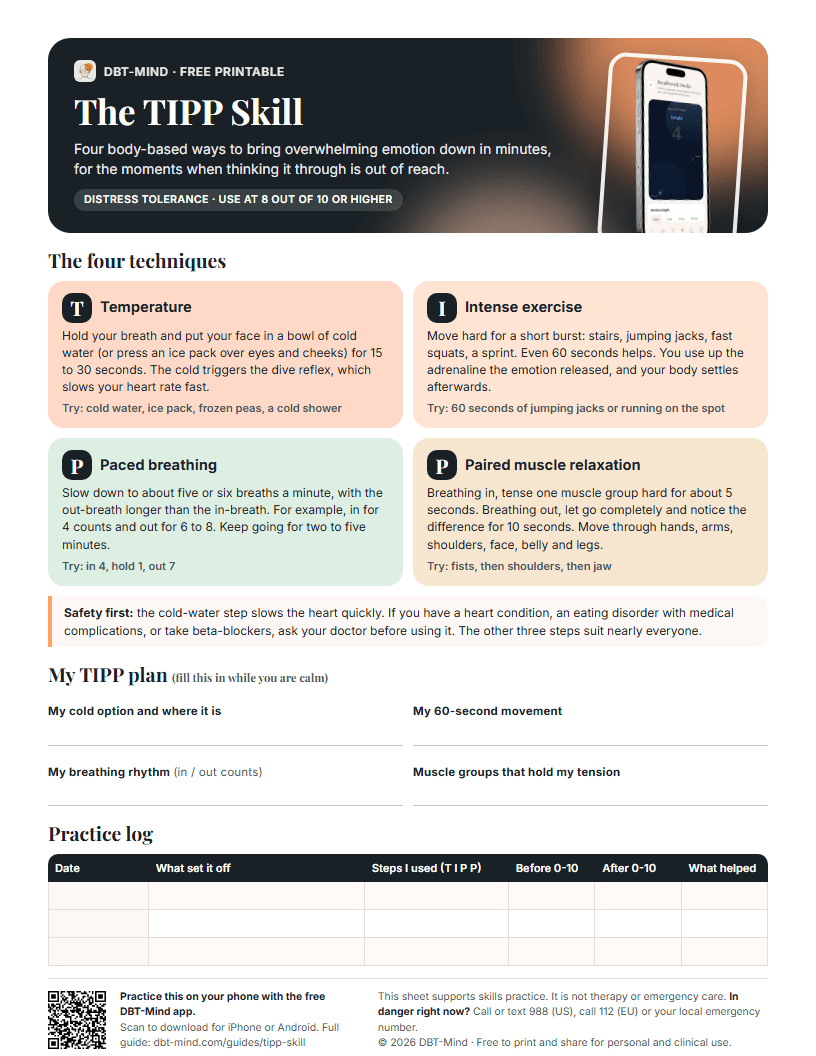
The four TIPP techniques, step by step
- 1
T: Temperature. Fill a bowl with cold water (or hold an ice pack) and submerge your face from temples to chin for 15-30 seconds while holding your breath. This triggers the mammalian dive reflex, which rapidly slows your heart rate. A cold shower or ice cubes on your cheeks and eyes work too. (If you have a heart condition, check with your doctor first. The dive reflex slows the heart quickly.)
- 2
I: Intense exercise. Do 10-20 minutes (even 60 seconds helps) of hard physical effort: sprint the stairs, do jumping jacks, fast push-ups. The point is to burn off the adrenaline your emotion has already dumped into your body, then let the natural comedown carry your arousal lower.
- 3
P: Paced breathing. Slow your breath to five to six breaths per minute with the exhale longer than the inhale, for example in for 4 counts, out for 6-8. The extended exhale activates the parasympathetic nervous system. Two to five minutes is usually enough to feel a shift.
- 4
P: Paired muscle relaxation. While exhaling, tense one muscle group hard for 5 seconds, then release completely and notice the difference for 10 seconds. Work through your body: fists, arms, shoulders, face, stomach, legs.
When to use TIPP (and when not to)
Use TIPP when emotion is so high that you are about to do something that makes things worse: self-harm urges, rage texts, panic spirals, dissociation setting in. It is a crisis survival skill: its job is to get you from a 9 down to a 6, where your other skills become usable again.
TIPP is not a treatment for the underlying problem. Once the wave has passed, skills like Check the Facts, problem solving, or a conversation using DEAR MAN address what triggered the spike. If you find yourself needing TIPP daily, that is a signal to work on emotion regulation skills, or bring the pattern to a therapist.
Practice it in DBT-Mind
Using TIPP with DBT-Mind
In a real spike you will not remember four acronym letters. DBT-Mind’s crisis hub walks you through them so you do not have to.
- 1Open the Crisis section. The crisis thermometer helps you rate your current intensity in seconds.
- 2Follow the guided paced-breathing exercise in the breath studio: visual pacing with extended exhales, no counting required.
- 3Work through step-by-step emergency skills, including TIPP, exactly when you need them, even offline.
- 4If you need more, the AI-powered crisis chat guides you through grounding and next steps in the moment.

Frequently asked questions
- How fast does the TIPP skill work?
- The temperature technique can lower heart rate within about 30 seconds, and paced breathing shifts most people within two to five minutes. TIPP is the fastest-acting skill set in DBT because it targets physiology directly rather than thoughts.
- Is TIPP safe for everyone?
- Mostly yes, with one caution: the cold-water dive reflex rapidly slows heart rate, so people with heart conditions, eating disorders with medical complications, or on beta-blockers should ask a doctor before using the temperature technique. The other three techniques are safe for nearly everyone.
- What is the difference between TIPP and STOP in DBT?
- STOP is a behavioral pause (Stop, Take a step back, Observe, Proceed mindfully) that interrupts impulsive action; TIPP changes your body chemistry to lower the emotion itself. They chain well: STOP first to not act, TIPP to bring the intensity down.
- Is there a free TIPP skill PDF?
- Yes. The free DBT-Mind TIPP worksheet (PDF, one page) explains all four techniques with a safety note and has space for your personal TIPP plan and a practice log. It is free to print and share.
Keep learning
All guides
STOP Skill: How to Pause Before You React (DBT)
Stop, Take a step back, Observe, Proceed mindfully: the few seconds between a strong urge and what you do next, explained with an example.
ReadDistress Tolerance Skills: Surviving a Crisis Without Making It Worse
The DBT crisis survival toolkit (TIPP, STOP, ACCEPTS, self-soothing) and how to assemble them into a personal crisis plan.
Read
Grounding Techniques for Anxiety, Panic, and Dissociation
How to get out of your head and back into the room: 5-4-3-2-1, physical grounding, and mental anchoring, explained properly.
Read