Quick answer
Walking the middle path is a set of DBT skills for finding a balanced position between two extremes, such as acceptance and change, or too strict and too loose. Jill Rathus and Alec Miller developed it as a skills module for teens and their families. It teaches three things: dialectical thinking, validation and ways to change behavior, such as reinforcement. A free both-and worksheet (PDF) is on this page.
General information about DBT skills. It does not replace therapy, and in an emergency contact your local emergency number or crisis line.
Your skills group handed out the middle path pages, and the word "dialectics" did not help. Or you are a parent in a family group, stuck between giving in and cracking down. Or you are learning DBT alone and keep hearing "both-and".
Below: what the middle path means, how to turn "but" into "and", the dilemmas that pull teens and parents to opposite ends, and how validation and behavior change fit in. For the therapy as a whole, see what DBT is. This guide is written by the team behind DBT-Mind, an app for practicing DBT skills.
Free printable PDF
Both-And Worksheet (Dialectics)
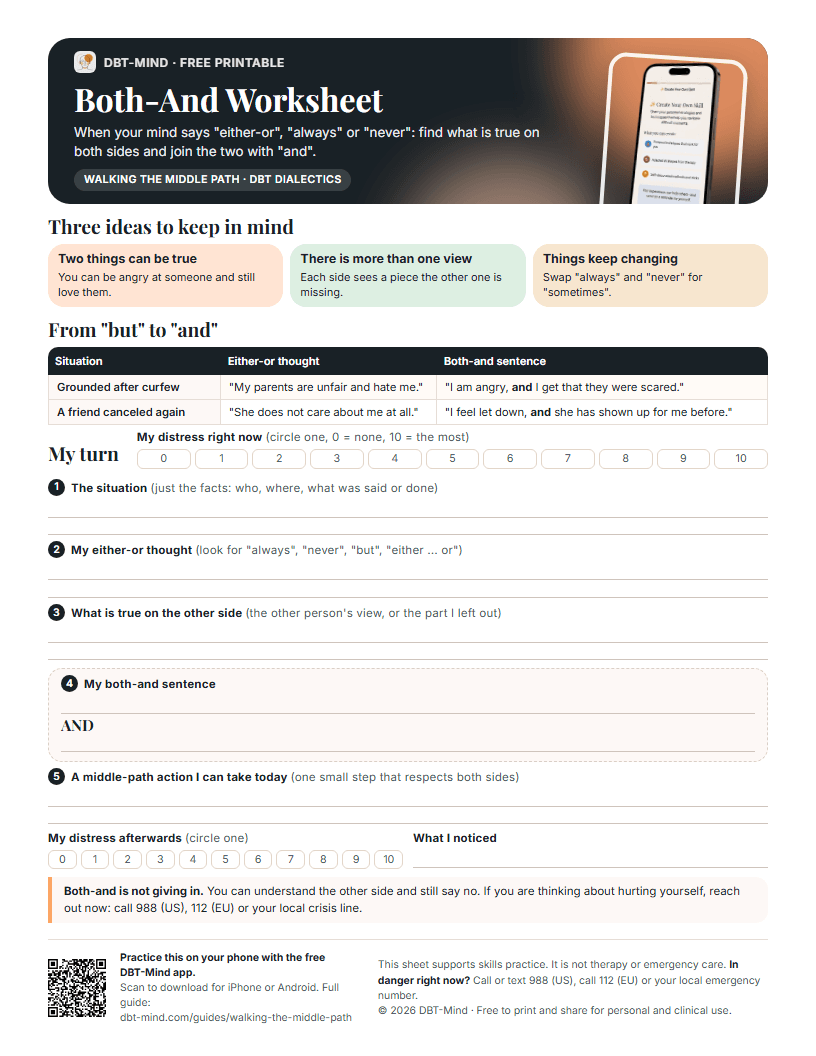
Turn one either-or thought into a both-and sentence: the situation, what is true on the other side, and one middle-path action for today.
- 3 ideas of dialectics
- From "but" to "and"
- Distress before and after
What walking the middle path means
Walking the middle path means you stop picking one extreme and look for a position that keeps what is true on both sides. DBT calls this way of thinking dialectics. Marsha Linehan’s handouts on dialectics (DBT Skills Training Handouts and Worksheets, second edition, Guilford Press, 2015) list a few core ideas. Here are three of them in our own words.
Two things can be true at once
Opposites do not cancel each other out. You can be doing your best and still need to do better. A teen can be furious with her mom and love her.
There is more than one way to see it
A dad sees a messy room as disrespect. His son sees it as his own space. Each view holds a piece that makes sense, and neither is the whole picture.
Change is the one constant
People, rules and relationships keep changing, and what you do changes the people around you. The friend group that fit at 14 may not fit at 17.
The module comes from DBT for teens. Guilford Press describes it as a family-based module that Jill Rathus and Alec Miller developed for teens (DBT Skills Manual for Adolescents, 2015). In the sample chapter of the manual’s second edition, the authors write that it teaches dialectical thinking and acting, validation and behavior change principles, to reduce family conflict and inflexible thinking. The same chapter says parts of it were later built into the adult skills manual. Our guide to DBT workbooks lists these books.
Dialectical thinking: from but to and
Many people only hear what comes after "but". "I love you, but you never listen" lands as "you never listen". Swap in "and", and both halves stay standing. Linehan’s handout on how to think dialectically puts it this way: change "either-or" to "both-and", and "always" or "never" to "sometimes".
| Situation | Either-or thought | Both-and sentence |
|---|---|---|
| Teen, grounded after missing curfew | "My parents are unfair and they hate me." | "I am angry about being grounded, and I get that they were scared when I did not pick up." |
| Teen, failed a math test | "I am stupid. I will never get this." | "I failed this test, and I can ask for help before the next one." |
| Parent, teen stays in their room all day | "Either I take the door off or I give up." | "I am worried and want to see my kid more, and a teen needs some privacy." |
| Parent, teen yelled in an argument | "She is disrespectful. I have to come down hard." | "Yelling at me is not okay, and she is clearly hurting about something." |
| Adult, friend canceled plans again | "She does not care about me at all." | "I feel let down, and she has shown up for me many times before." |
| Adult, slipped back into an old habit | "I slipped, so the whole week is ruined." | "I slipped on Tuesday, and I used my skills on the other six days." |
Fictional examples by the DBT-Mind team. The step from "either-or" to "both-and" follows Linehan’s handout on how to think and act dialectically (DBT Skills Training Handouts and Worksheets, second edition, Guilford Press, 2015). The wording is our own.
Many people find that one both-and sentence a day sticks better when it is written down. The text journal in the DBT-Mind app is free for that, and a sentence that helps can be saved as your own custom skill, which is free too.
If a both-and sentence feels fake, test both halves. Check the Facts is the skill for a thought that may not fit what happened, and radical acceptance is the skill for the half you cannot change.
The dialectical dilemmas for teens and families
A dialectical dilemma is a pair of extremes that a person or a family swings between. Rathus and Miller describe three for teens and their families, based on the 2007 book Dialectical Behavior Therapy with Suicidal Adolescents by Miller, Rathus and Linehan. The second edition of their manual adds a fourth. For each one, the manual lists a middle path for parents and one for teens.
| Dilemma | One extreme | The other extreme | A middle path |
|---|---|---|---|
| Too loose versus too strict | No rules, or rules nobody enforces | Rigid rules and harsh punishment for small things | Clear rules that are enforced, with warmth and room to negotiate some of them |
| Making light of problem behavior versus making too much of normal teen behavior | Calling skipped school or self-harm "just a phase" | Treating moodiness or wanting time alone as a sign that something is badly wrong | Get help for behavior that gets in the way of daily life, and let normal teen behavior be |
| Forcing independence versus fostering dependence | "You are 16, figure it out yourself." | Stepping in to solve every problem for the teen | Guide and coach, and hand over more responsibility step by step |
| Overprotecting in the real world versus underprotecting online (added in the second edition) | Little freedom to go out or see friends without an adult | No limits on phones, screens and social media | More freedom in person, and clear limits on screen time |
Source: Rathus and Miller, DBT Skills for Adolescents, second edition (Guilford Press), chapter 1. It bases the first three dilemmas on Miller, Rathus and Linehan (2007) and the fourth on Jonathan Haidt (2024). The manual’s own names are "permissiveness versus strictness", "normalizing problem behaviors versus pathologizing normative adolescent behavior", "forcing independence versus fostering dependence" and "overprotection in the real world versus underprotection in the virtual world". The plain names and the examples are ours.
These are not the only dilemmas in DBT. The same chapter lists three from standard DBT with adults: emotional vulnerability versus self-invalidation, active passivity versus apparent competence, and unrelenting crises versus inhibited experiencing. A therapist works on those in treatment, so this guide does not go into them.
If you or your teen are thinking about self-harm or suicide, do not wait for a worksheet. Call 988 (US), 112 (EU) or your local crisis line.
Validation and behavior change in the middle path
The other two skill sets are the two sides of the main balance in DBT. Validation is the acceptance side. Behavior change is the change side. Linehan’s overview handout for walking the middle path puts dialectics, validation and behavior change strategies under one heading: balancing acceptance and change. In her handouts for adults, they are part of the interpersonal effectiveness skills.
Validation
Showing someone that their feeling makes sense, even when you disagree with what they did. "I get why the phone rule upsets you" does not mean the rule is gone. Our guide to DBT validation covers the six levels and how to validate yourself.
Positive reinforcement
A behavior grows when something the person wants follows it. Timing counts: thank your teen right after they unload the dishwasher, not three days later. You can use it on yourself too, like coffee with a friend after the phone call you dreaded.
Shaping
Rewarding small steps toward a goal, not only the finished result. If the goal is homework before dinner every day, start by noticing ten minutes of homework today.
Extinction
A behavior fades when the reward that kept it going stops. If whining used to win extra screen time, it stops paying off once the answer calmly stays no. Expect it to get louder first: the handout calls this a burst that comes before the decrease.
The definitions follow Linehan’s handouts on increasing and decreasing behaviors; the home examples are ours. The same handouts are careful about punishment: they say extinction and punishment do not teach new behavior, so reward the behavior you do want as well.
These are everyday examples, not a parenting program. If a pattern at home feels stuck or unsafe, talk to a therapist who knows your family.
Free both-and worksheet (PDF)
The free both-and worksheet fits on one page. Use it when you catch an "always", a "never" or an "either-or" in your head. It walks you through five steps.
- 1
Name the situation. Write down the facts only: who, where, what was said or done. Rate your distress from 0 to 10.
- 2
Write your either-or thought. Put it down the way your mind says it, with the "always", "never" or "but" left in.
- 3
Look at the other side. What does the other person see? Which part did you leave out? You are looking for what is true there, not for who wins.
- 4
Write your both-and sentence. Join the two true halves with "and". Read it out loud. If one half sounds false, go back a step.
- 5
Pick one middle-path action. One small thing you can do today that respects both sides. Then rate your distress again and note what you noticed.
Practice it in DBT-Mind
Practicing both-and thinking with DBT-Mind
DBT-Mind is a free DBT app for iOS and Android with a skills library, a journal and a crisis hub. It has no middle path or dialectics lesson and no both-and worksheet, but these free features help you practice.
- 1Write one both-and sentence a day in the Journal. The text journal is free.
- 2Save a sentence that helps as a custom skill, with a title and your own words. Custom skills are free.
- 3Mark that skill as an emergency skill (free), so it shows up in the crisis tab and the SOS sheet.
- 4Browse the free skills library (50+ DBT skills) to find a skill for your middle-path action.
Frequently asked questions
- What DBT skill is walking the middle path?
- Walking the middle path is a group of DBT skills, not a single one. It covers dialectical thinking (two opposite things can both be true), validation, and ways to change behavior such as reinforcement, shaping and extinction. Jill Rathus and Alec Miller developed it as a module for teens and families, and Marsha Linehan’s handouts for adults include it in the interpersonal effectiveness module.
- What are the dialectical dilemmas in DBT?
- They are pairs of extremes that people swing between. For teens and families, Rathus and Miller name too loose versus too strict, making light of problem behavior versus making too much of normal teen behavior, and forcing independence versus fostering dependence. The second edition of their manual adds overprotecting in the real world versus underprotecting online. Standard DBT for adults has three others, such as emotional vulnerability versus self-invalidation.
- What is an example of dialectical thinking?
- "I am doing the best I can, and I need to do better." Or: "I am angry at my mom, and I love her." Dialectical thinking keeps both halves and joins them with "and", where an either-or thought would drop one of them.
- Is walking the middle path only for teens?
- No. Rathus and Miller developed it for teens and their families, but Marsha Linehan’s skills handouts for adults (second edition, 2015) have their own walking the middle path section with dialectics, validation and behavior change. The free both-and worksheet (PDF) on this page has examples for teens and adults.
- How is the middle path different from wise mind?
- Wise mind is one middle path: the balance between emotion mind and reasonable mind inside you. Walking the middle path uses the same idea more widely, for opposites such as acceptance and change or strict and loose, and often between two people. Linehan’s mindfulness handouts describe wise mind under the same name, as finding the synthesis between opposites.
Keep learning
All guides
DBT Validation: The 6 Levels, Self-Validation and What Validation Is Not
What validation means in DBT, the six levels with examples for someone else and for yourself, and a free one-page self-validation worksheet.
Read
Wise Mind DBT: How to Find the Balance Between Emotion and Reason
The three states of mind in DBT, five short practices to reach wise mind, and examples of what a wise mind choice looks like.
ReadDBT Interpersonal Effectiveness Skills: DEAR MAN, GIVE and FAST
The three goals of DBT interpersonal effectiveness, GIVE and FAST letter by letter with examples, and which skill to lead with in a hard conversation.
Read