Quick answer
Wise mind is the DBT mindfulness skill of finding the overlap between emotion mind, where feelings decide what you do, and reasonable mind, where logic decides. In wise mind you can feel the emotion and still see the facts, so your choice fits both. A quick way in: breathe in while saying "wise" to yourself, breathe out on "mind", then ask "What does my wise mind say?" and wait for the answer.
General information about DBT skills. It does not replace therapy, and in an emergency contact your local emergency number or crisis line.
You may have heard "check in with your wise mind" in therapy or a skills group and wondered what that actually means when you are upset. Wise mind is not a special talent or a calm personality. It is a state you can learn to find, the same way you learn to find your balance on a bike.
This guide explains the three states of mind, gives you five short practices, and shows what wise mind choices look like in real situations. It is written by the team behind DBT-Mind, an app for practicing DBT skills.
Free printable PDF
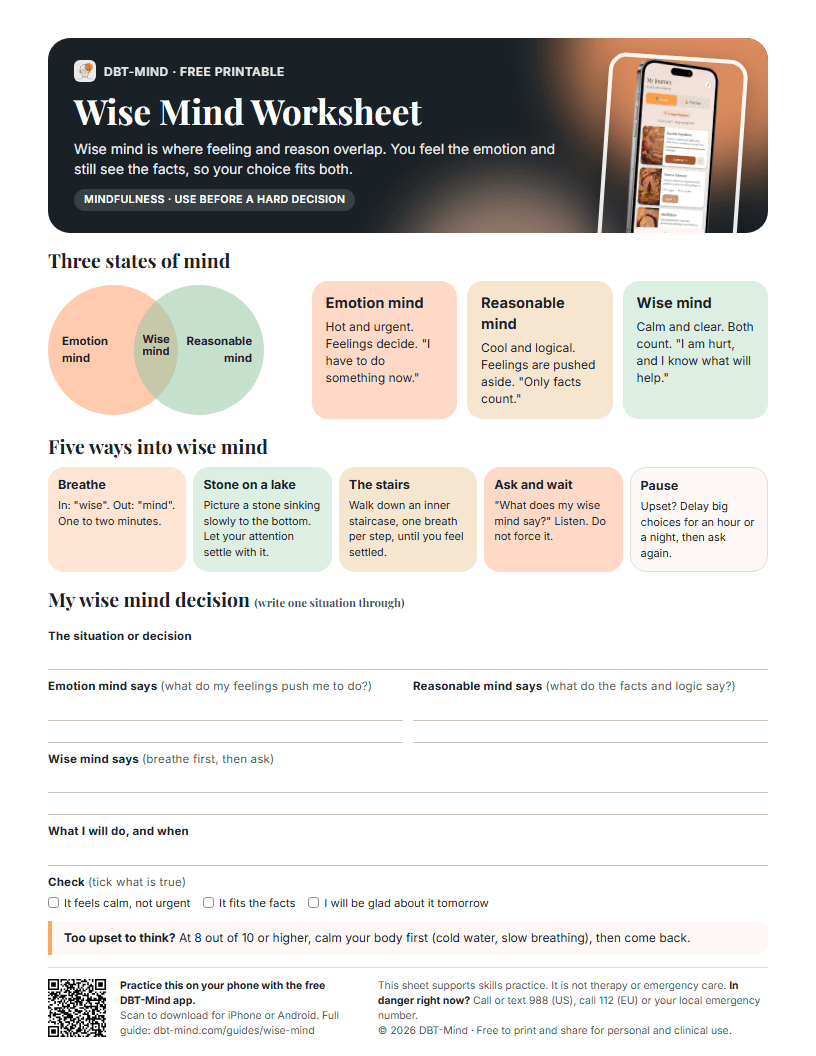
Wise Mind Worksheet
The three states of mind, five ways into wise mind and a page to work through one decision from wise mind.
- 3 states of mind
- 5 practices
- My wise mind decision
Emotion mind, reasonable mind and wise mind
DBT describes three states of mind (Linehan, DBT Skills Training Manual, 2nd edition, 2015). Most people move between all three during a single day. None of them is bad. Emotion mind gives you passion and care, reasonable mind gives you planning. Trouble starts when one of them takes over completely.
| State | What it feels like | Typical thought | Example |
|---|---|---|---|
| Emotion mind | Hot, urgent, all or nothing. Feelings decide what you do. | "I have to do something right now." | Sending an angry text the second you read a message. |
| Reasonable mind | Cool and logical. Feelings are pushed aside. | "Feelings do not matter, only the facts." | Making a plan that looks right on paper but ignores what you need. |
| Wise mind | Calm and clear. You feel the emotion and see the facts. | "I am hurt, and I know what will help." | Waiting until morning, then saying what you need calmly. |
Source: Marsha Linehan, DBT Skills Training Manual, 2nd edition (Guilford Press, 2015). Descriptions and examples in our own words.
How to get into wise mind: 5 practices
- 1
Breathe "wise" and "mind". Breathe in slowly and say "wise" in your head. Breathe out and say "mind". Repeat for one to two minutes. Let your attention rest low in your belly, not in your racing thoughts.
- 2
A stone on a lake. Picture a small, flat stone dropped onto a clear lake. Watch it drift slowly down through the water until it rests on the sandy bottom. Let your attention sink with it to a quiet center inside you.
- 3
Walk down the stairs. Imagine a staircase inside you. Walk down it one step at a time, slowly, breathing with each step. Stop at the step where you feel calm and settled. That is a good place to make a decision from.
- 4
Ask the question, then wait. Ask yourself "Is this wise mind?" or "What does my wise mind say?" Then listen. Do not force an answer. If nothing comes, that is fine. Try again later.
- 5
Pause before a big decision. When you are upset, delay any big choice. Use the STOP skill for the first seconds, then give it an hour or a night. Ask the wise mind question again once the wave has passed.
These practices are described in Linehan’s skills manual. The wording here is ours. Practice them when you are calm, a few minutes a day, so they are easier to reach when you are not.
If you want a guided version, the DBT-Mind app has a Wise Mind Worksheet that walks you through the situation, what emotion mind and reasonable mind say, your wise mind answer and your next step. The worksheet is part of Premium (called Plus in the app). The free printable worksheet on this page covers the same steps on paper.
Wise mind examples
Wise mind does not mean ignoring your feelings. It means the choice takes both your feelings and the facts into account. Here is what that looks like in a few common situations.
| Situation | Emotion mind urge | Reasonable mind take | Wise mind choice |
|---|---|---|---|
| Your ex posts a photo with someone new, late at night | Text them right away and tell them how much it hurts. | "It does not matter. Just forget about it." | Admit it hurts. Put the phone in another room and talk to a friend tomorrow. |
| A hard day at work after a mistake | Quit tonight and never go back. | "You cannot quit. Ignore how you feel." | Wait a week. If the job keeps feeling wrong, start looking calmly. |
| A fight with a parent over the phone | Hang up and say you are done with them. | Argue each point until you win. | Say "I need a break, can we talk Sunday?" and end the call kindly. |
| A friend cancels plans for the third time | "They hate me." Cancel the friendship. | "Friends cancel. It means nothing." | Feel the disappointment, then ask them honestly what is going on. |
Examples written by DBT-Mind for illustration.
How to tell if it is really wise mind
It feels calm, not urgent
Emotion mind says "now or never". Wise mind can usually wait an hour. If the answer feels like a pressure in your chest, it is probably emotion mind.
It fits the facts
A wise mind choice still makes sense when you look at what actually happened. The emotion regulation skill Check the Facts helps you test this.
It works for tomorrow you
Ask: "Will I be glad I did this tomorrow, or next week?" Wise mind thinks about the person you will be later, not only how you feel right now.
It may not feel good
Wise mind is not always the comfortable choice. Sometimes it means doing something hard, like having a difficult talk or saying no.
When wise mind is hard to reach
When your emotion is at 8 out of 10 or higher, finding wise mind is often not possible. That is normal, not a failure. Bring your body down first with the TIPP skill or slow breathing, then try the wise mind question again. If the situation itself cannot change, radical acceptance helps you stop fighting what already happened.
If you are thinking about hurting yourself or feel unsafe, wise mind is not the first step. Call 988 (US), 112 (EU) or your local crisis line.
Where wise mind fits in DBT
Wise mind is a core skill of the mindfulness module, and mindfulness is the base for the other three modules. The mindfulness "what" skills (observe, describe, participate) and "how" skills (without judging, one thing at a time, effectively) are the tools you use to get into wise mind. The DBT skills list shows how all the skills fit together.
You can practice wise mind on your own, with a workbook, worksheets or an app. If you do not have a therapist or skills group, how to do DBT on your own explains a good order to learn the skills in.
Practice it in DBT-Mind
Practicing wise mind with DBT-Mind
DBT-Mind is a free DBT app for iOS and Android with a skills library, diary card and journal, and a crisis hub. Wise mind shows up in a few places.
- 1Look up the mindfulness skills in the free skills library, which has 50+ DBT skills.
- 2Use the Wise Mind Worksheet when you face a decision: the situation, what emotion mind says, what reasonable mind says, your wise mind answer and a next step. It is part of Premium.
- 3Work through the Mindfulness learning path in Journey. Wise mind is part of stage 2, and stages 2 to 4 are part of Premium.
- 4Write in the journal and check in on your mood, so you can see which situations pull you into emotion mind.

Frequently asked questions
- What is wise mind in DBT?
- Wise mind is a DBT mindfulness skill. It is the state where emotion mind (feelings) and reasonable mind (logic) overlap, so you can feel what you feel and still see the facts. Decisions made from wise mind tend to fit both your needs and the situation.
- What are the 3 states of mind in DBT?
- Emotion mind, where feelings decide what you do. Reasonable mind, where logic decides and feelings are pushed aside. Wise mind, the overlap of the two, where you take both into account.
- How do I know if I am in wise mind?
- Wise mind usually feels calm and clear rather than urgent. The choice fits the facts, and you expect to be glad about it tomorrow. If an answer comes with strong pressure to act right now, it is more likely emotion mind.
- Is wise mind the same as intuition?
- Not quite. Wise mind can feel like a sense of knowing, but it also takes the facts into account. A gut feeling that is driven by fear or anger is emotion mind, even if it feels certain.
- Is there a free wise mind worksheet PDF?
- Yes. The free DBT-Mind wise mind worksheet (PDF, one page) explains the three states of mind and has space to write down a situation, what emotion mind and reasonable mind say, your wise mind answer and what you will do. It is free to print and share.
Keep learning
All guides
DBT Skills List: All 4 Modules Explained Simply
Every core DBT skill across the four modules, explained in plain language, with guidance on which module to start with.
Read
STOP Skill: How to Pause Before You React (DBT)
Stop, Take a step back, Observe, Proceed mindfully: the few seconds between a strong urge and what you do next, explained with an example.
Read
Emotion Regulation Skills: The DBT Toolkit for Intense Feelings
The DBT skills that reduce how often and how hard intense emotions hit: Check the Facts, opposite action, PLEASE, and more.
Read