Quick answer
In DBT, validation means letting someone know that their feeling, thought or action makes sense in their situation. It is not the same as agreeing or approving. Marsha Linehan, who developed DBT, described six levels, from paying close attention up to treating the person as a real equal (Linehan, 1997). Self-validation turns the same levels toward your own feelings. A free self-validation worksheet (PDF) is on this page.
General information about DBT skills. It does not replace therapy, and in an emergency contact your local emergency number or crisis line.
Maybe your therapist told you to "validate yourself" and you nodded, but you are not sure what that means in a hard moment. Or someone you love has intense emotions, and everything you say seems to make it worse. Validation is the DBT skill for both situations.
Below: what validation is, the six levels with an example for someone else and one for yourself, five steps to validate yourself, and what validation is not. It is written by the team behind DBT-Mind, an app for practicing DBT skills.
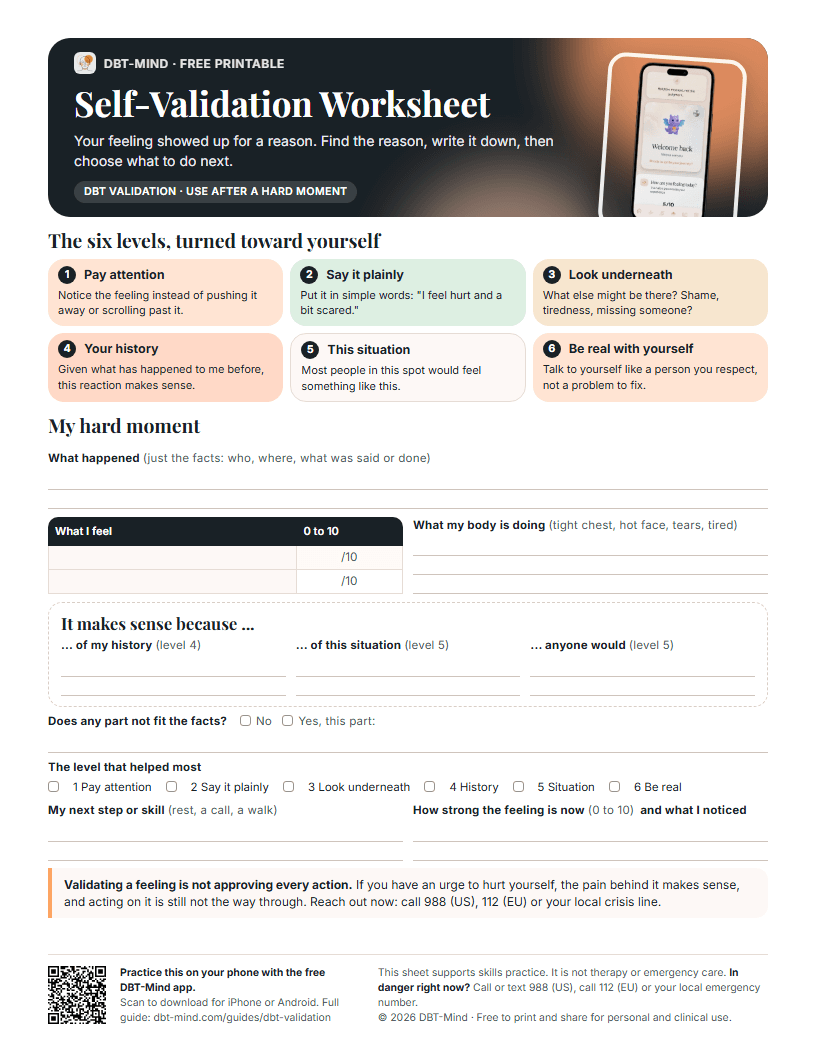
Free printable PDF
Self-Validation Worksheet
Make sense of one hard feeling: what happened, what you feel, why it makes sense, and the next skill to use.
- 6 levels turned inward
- "It makes sense because"
- Next step
What validation means in DBT
Behavioral Tech, the training organization founded by Linehan, describes DBT as adding acceptance strategies, such as validation, to the change strategies of cognitive behavioral therapy. In plain words: first show that the feeling makes sense, then work on what to do with it.
Validating is
Saying, with words or actions, "I see why you feel this way." It points to the part that makes sense, given what happened or what the person has been through.
It is not agreeing
You can understand why your sister is angry with you and still think she has the facts wrong.
It is not reassuring
"Don’t worry, you’ll be fine" skips the feeling. It can sound kind, but it often lands as "your fear is silly".
It is not fixing
Advice that comes before understanding tells the person you did not really listen. Validate first, ask if they want ideas second.
The 6 levels of validation
Each level shows a bit more understanding than the one before. You do not have to reach level 6 every time. In a lot of moments, level 1 or 2 is what the person needs.
| Level | What it looks like | To someone else | To yourself |
|---|---|---|---|
| 1. Pay attention | Put the phone down, look at them and listen to the whole story | "Go on, I am listening." | "Something is going on in me. I will notice it, not push it away." |
| 2. Say it back | Repeat what you heard in plain words, without adding your opinion | "So your boss moved the deadline again, and now you feel stuck." | "I feel hurt and a bit scared." |
| 3. Name what is unsaid | Gently guess a feeling or thought they have not said, and let them correct you | "I wonder if you are also worried about your job?" | "Under the anger, I think I feel left out." |
| 4. Make sense of it through the past | Show that the reaction fits their history or their body | "After how your last partner treated you, of course a late reply scares you." | "I was criticized a lot as a kid, so a sharp comment hits me hard." |
| 5. Make sense of it through now | Show that most people would react this way in this situation | "Anyone would be nervous the night before surgery." | "Of course I am short-tempered. I slept four hours." |
| 6. Be real, as an equal | Treat the person as capable, not fragile, and respond the way you would to a friend you respect | "That sounds awful. I would be furious too. What do you want to do?" | "This is hard, and I can handle hard things. I deserve the same kindness I give my friends." |
Levels from Marsha Linehan, "Validation and psychotherapy" (1997), a chapter in Empathy Reconsidered, edited by Bohart and Greenberg (APA). Level names, descriptions and examples are our own wording.
How to validate yourself in 5 steps
- 1
Notice. Stop for a moment and turn toward the feeling. Where is it in your body? You are not trying to change it yet.
- 2
Name it. Use plain words and a number: "Shame, about 7 out of 10." If there are two feelings, name both.
- 3
Find the "because". Finish the sentence "It makes sense that I feel this because ..." Look at your history, this situation, and whether most people would feel something like it.
- 4
Let your body react. Tears, a tight throat or shaky hands are part of the feeling. You do not need to argue with them.
- 5
Choose your next skill. If part of the feeling does not fit what actually happened, use Check the Facts. If you cannot change the situation, radical acceptance is the next step. If you are unsure what to do, ask your wise mind.
Many people find it easier when they write the "because" sentence down. The text journal in the DBT-Mind app is free for that, and a person you trust can send you a handwritten Support Note that shows up in the app and on a home-screen widget (free for one supporter and three notes a month).
What validation is not
Approving harmful actions
You can validate the pain behind an urge to self-harm and still say that acting on it is not the way through. "The feeling makes sense. Hurting yourself would not help." If you or someone you know is in danger, call 988 (US), 112 (EU) or your local crisis line.
Pretending
Only validate what really makes sense. If a friend says everyone hates them, you can validate the loneliness without agreeing that everyone hates them.
Giving in to end a fight
Validation is not saying "fine, you are right" to make the conflict stop. You can validate and still ask for what you need, for example with DEAR MAN.
Only for other people
Many people who are kind to friends are harsh with themselves. Self-validation is the same skill, pointed inward.
Why validation matters
A lab study
In a study of reactions to stress, people who heard invalidating responses had more negative emotion, a higher heart rate and higher skin conductance over time than people who heard validating responses (Shenk and Fruzzetti, Journal of Social and Clinical Psychology, 2011). It tested responses from another person, not self-validation.
Where it sits in DBT skills
Validation is one of the interpersonal effectiveness skills, together with GIVE, DEAR MAN and FAST. The V in the GIVE skill stands for validate. It is also one of the three skill sets in walking the middle path.
What people notice
Many people find that once a feeling is understood, by someone else or by themselves, it is easier to calm down and think about the next step.
Free self-validation worksheet (PDF)
The free self-validation worksheet fits on one page. Use it after a hard moment, when you are calm enough to write.
The six levels
Each level in one line, turned toward yourself.
My hard moment
What happened, what you feel (0 to 10) and what your body is doing.
It makes sense because
Three boxes: your history, this situation, and what anyone would feel.
Next step
Whether any part does not fit the facts, the level that helped most, your next skill and how strong the feeling is now.
Practice it in DBT-Mind
Practicing self-validation with DBT-Mind
DBT-Mind is a free DBT app for iOS and Android with a skills library, a journal and a crisis hub. It has no validation worksheet, but these free features help you practice.
- 1Check in with your mood on the Home screen and rate how you feel. Mood tracking is free.
- 2Open the Journal and write your "It makes sense because ..." sentence. The text journal and its guided journal conversation (scripted prompts) are free; voice journaling comes with Premium (called Plus in the app).
- 3Invite one person you trust to send you handwritten Support Notes. The free tier includes one supporter and three notes a month; Premium allows up to five supporters.
- 4Browse the free skills library (50+ DBT skills) to pick your next skill once the feeling makes sense.

Frequently asked questions
- What are the 6 levels of validation in DBT?
- In Marsha Linehan’s model (1997), in our own words: 1) pay attention, 2) say back what you heard, 3) name what is unsaid, 4) show that the reaction makes sense given the person’s past or body, 5) show that most people would react this way now, and 6) be real and treat the person as an equal.
- What is self-validation in DBT?
- Self-validation means using the same levels on your own feelings: notice the feeling, name it, and find the reason it makes sense, instead of telling yourself you are overreacting. The free self-validation worksheet (PDF) on this page walks you through it in one page.
- Which DBT module is validation in?
- Validation is part of the interpersonal effectiveness skills. It is the V in GIVE, the skill for keeping a relationship healthy during a hard conversation. Therapists in DBT also use validation in sessions, as one of the treatment’s acceptance strategies.
- Is validation the same as agreeing?
- No. Validating says "I understand why you feel this way". Agreeing says "you are right". You can validate someone’s anger and still disagree with what they want to do about it.
- How do I validate someone without agreeing with them?
- Point to the part that makes sense and leave out the rest. For example: "I can see why you felt ignored when I was late. I don’t think I did it on purpose, and I want to fix it." Name the feeling, give the reason it fits, then say your view calmly.
Keep learning
All guides
DBT Interpersonal Effectiveness Skills: DEAR MAN, GIVE and FAST
The three goals of DBT interpersonal effectiveness, GIVE and FAST letter by letter with examples, and which skill to lead with in a hard conversation.
Read
Radical Acceptance: 7 DBT Exercises for Pain You Can’t Change
What radical acceptance means (and doesn’t), seven exercises to practice it, examples from everyday life and statements you can use when you are stuck fighting reality.
Read
DEAR MAN DBT Skill: Script Template, Examples and Role Play
DBT’s seven-step script for difficult conversations, with a fill-in template, examples for work, family and saying no, and a role-play plan.
Read
Walking the Middle Path in DBT: Dialectics, Validation and Behavior Change
What walking the middle path means in DBT, both-and examples for teens, parents and adults, the dialectical dilemmas, and a free one-page both-and worksheet.
Read
The GIVE Skill in DBT: How to Keep the Relationship in a Hard Talk
Gentle, Interested, Validate, Easy manner: what each letter sounds like, one conversation written twice, and how to use GIVE when you are angry or texting.
Read