Quick answer
ACCEPTS is a DBT distress tolerance skill for getting through a crisis by distracting yourself on purpose. The letters stand for Activities, Contributing, Comparisons, Emotions, Pushing away, Thoughts and Sensations (Linehan, DBT Skills Training Handouts and Worksheets, 2015). You pick one or two and use them for a while, then come back to the problem when you can think clearly. It is a short-term skill, not a way to avoid problems for good. A free one-page ACCEPTS worksheet (PDF) is on this page.
General information about DBT skills. It does not replace therapy, and in an emergency contact your local emergency number or crisis line.
It is 9 pm. Something went wrong today, the urge to do the thing you are trying not to do is loud, and nothing about the problem can be fixed before tomorrow. ACCEPTS is for that stretch of time. It gives you seven kinds of things to do with your attention while you wait.
Marsha Linehan, who developed DBT, lists it with the crisis survival skills under the name "Wise Mind ACCEPTS" (DBT Skills Training Handouts and Worksheets, 2nd edition, Guilford Press, 2015). Below: the seven letters, how to use them tonight, examples for each one, the limits, and a free worksheet. It is written by the team behind DBT-Mind, an app for practicing DBT skills.
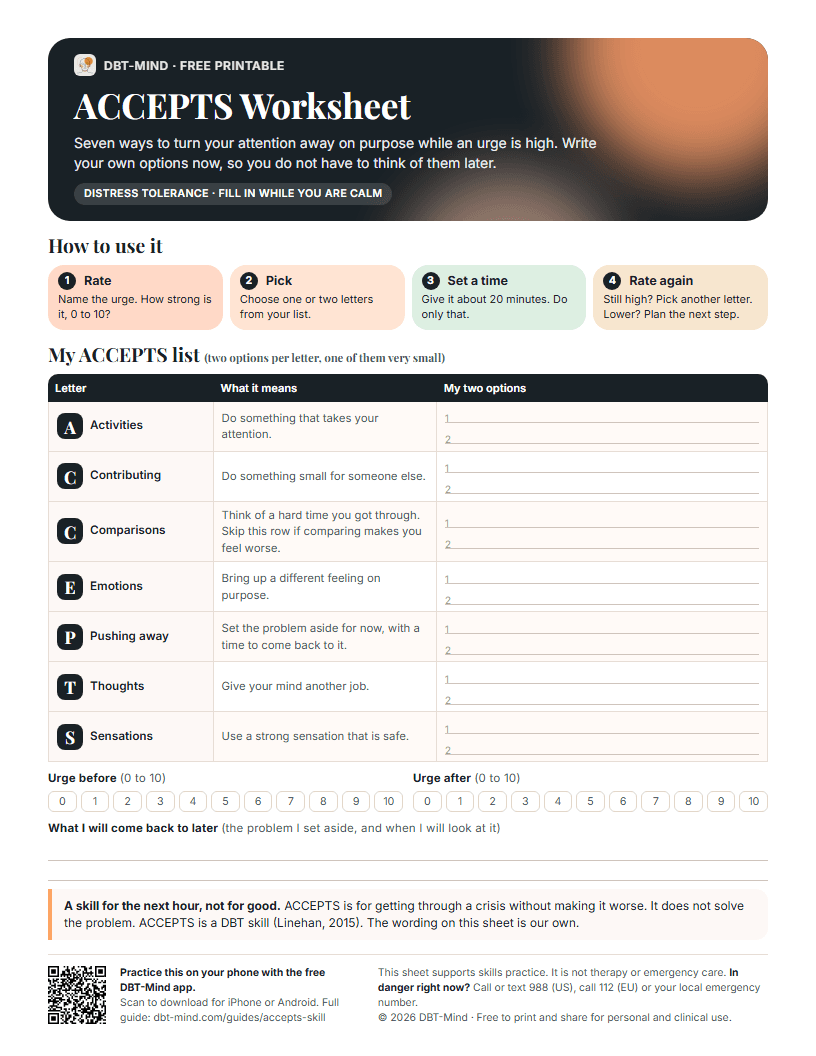
Free printable PDF
ACCEPTS Worksheet
Build your own ACCEPTS list while calm: two options for each of the seven letters, an urge rating before and after, and what you will come back to.
- The 7 letters
- My two options per letter
- Urge before and after
What ACCEPTS stands for
Each letter is one kind of distraction. You do not need all seven. Two or three favorites are enough.
| Letter | What it means | One example |
|---|---|---|
| A: Activities | Do something that needs your attention | Wash the one pan in the sink, then walk around the block |
| C: Contributing | Do something for someone else | Send a voice note to a friend who had a rough week |
| C: Comparisons | Put this moment next to another one | "Two years ago I could not have waited ten minutes. Tonight I have." |
| E: Emotions | Bring up a different feeling on purpose | A stand-up special you know by heart |
| P: Pushing away | Set the problem aside for a while | "Not tonight. I will look at this at 10 am with a coffee." |
| T: Thoughts | Give your mind another job | Say the words of a song in your head, line by line |
| S: Sensations | Use a strong sensation that is safe | Squeeze a stress ball hard, or step out into cold air |
Letters and their order: Distress Tolerance Handout 7 ("Distracting") in Marsha Linehan, DBT Skills Training Handouts and Worksheets, 2nd edition (Guilford Press, 2015). Descriptions and examples are our own.
How to use ACCEPTS in the moment
- 1
Name the urge and rate it. Say what the urge is and how strong it is, from 0 to 10. "Urge to text him, 8." The number gives you something to compare with later.
- 2
Pick one or two letters. Not all seven. Choose what you can do where you are, with the energy you have. On a worn-out night, Thoughts and Sensations ask the least of you.
- 3
Set a time. For example 20 minutes on a timer. Until it rings, your only job is the thing you picked. When your mind goes back to the problem, notice it and return to the task.
- 4
Rate the urge again. Same scale, 0 to 10. Many people find the number is lower. If it is not, pick a different letter and set the timer again.
- 5
Decide the next step. When you can think more clearly, choose one: something you can solve now, something to plan for tomorrow, or sleep.
This order fits what the skill is for. Linehan describes crisis survival skills as skills for tolerating painful events, urges and emotions when you cannot make things better right away (Distress Tolerance Handout 2, 2015).
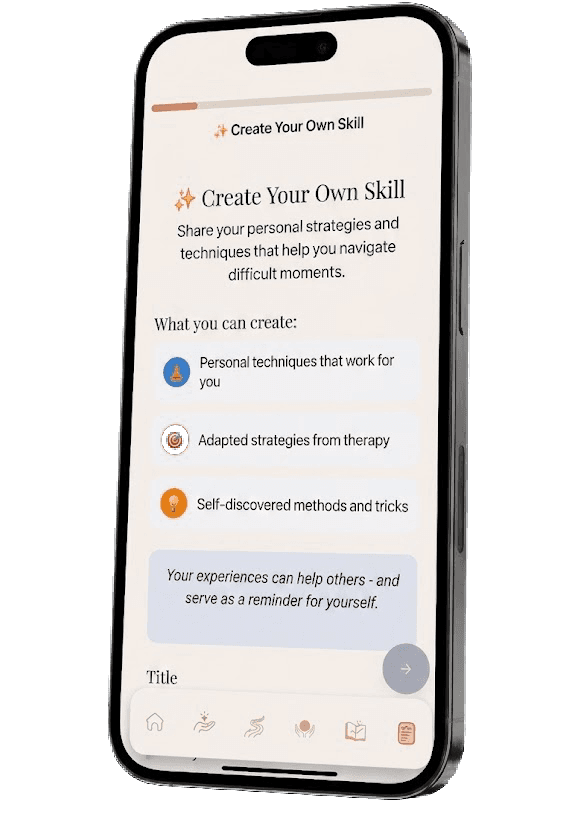
So you do not have to remember your options in the moment, you can write your own ACCEPTS list on an Emergency Card in the DBT-Mind app and pin it. You find your cards in the SOS sheet, and Emergency Cards are free.
Each letter with examples
Two or more options per letter, including one for a day with no energy. Swap in your own.
A: Activities
Pick something with a clear end. With energy: cook a recipe that needs chopping, or walk a fixed loop. With none: play one level of a phone game, or sort last month’s photos.
C: Contributing
A few minutes turned toward someone else. Answer the message you have been putting off, or write a kind review for a small shop you like. If people feel like too much right now, water a plant or feed the birds.
C: Comparisons
Handle this letter with care. Linehan’s list includes comparing yourself with people who cope less well or who are less fortunate. Some people find that this leaves them feeling guilty or ashamed. A kinder version is to compare with yourself: "Last year I would have sent that text by now." Or read an old journal entry from a hard time you got through. If comparing makes you feel worse, skip this letter. Six are enough.
E: Emotions
The aim is a feeling that is different from the one you are in. Linehan’s handout says so too: be sure that what you pick creates a different emotion. Heavy and sad? A comedy you have seen ten times. Angry? Slow music or a nature video. A sad film on a sad night does not count.
P: Pushing away
Put the problem down on purpose, with a time to pick it up again. Tell yourself "not now, tomorrow at 10", and put the letter, the bill or the phone that set it off in another room. Or picture a shelf and set the problem on it. Without a return time this is just avoiding. With one, it is a pause.
T: Thoughts
Fill the space the worry is using. Go through the alphabet with one food for each letter, or name one film for every year since you were born. Too tired for that? Count the books on the shelf, the tiles on the wall or the cars that pass.
S: Sensations
Something your body cannot ignore and that does not hurt you. Hold a cold can from the fridge in both hands, or bite into a lemon wedge. Milder: very minty gum, or a cold washcloth on the back of your neck.
When ACCEPTS helps and when it does not
Linehan draws the line for all crisis survival skills in the same place. Use them when pain cannot be helped quickly, or when acting on the emotion would only make things worse. Do not use them for everyday problems or to solve all your life problems (Distress Tolerance Handout 3, 2015).
Best for
A strong urge you do not want to act on. A problem that cannot be solved tonight. The wait before a call, a test result or a hard talk.
Limits
Not for problems you can solve right now, and not as your only skill for weeks. If you never come back to the problem, or the same problem needs distraction every day, it has turned into avoidance.
Some pain does not pass with the evening: a loss, a breakup, a fact you cannot change. Distraction is not the tool for that. Radical acceptance is.
ACCEPTS with the other crisis skills
ACCEPTS is one of six crisis survival skills in Linehan’s handouts. Each has its own job, so it helps to know which comes when.
First, do not act: STOP
The STOP skill is the few seconds in which you freeze and step back. ACCEPTS is what you do with the time after that.
Body at a 9: TIPP
If the emotion is so high that you cannot even choose a letter, start with the TIPP skill: cold water, movement, slow breathing. Then come back to your list.
Feeling unreal or far away: grounding
Grounding techniques such as 5-4-3-2-1 point your attention at the room you are in. ACCEPTS points it away from the trigger. Those are two different jobs.
The next hour: ACCEPTS
Once you are not about to act and your body has come down a little, pick your letters and set the timer.
The whole toolkit
The distress tolerance skills guide covers the rest, including pros and cons, self-soothe and a crisis plan.
If the urge is to hurt yourself and it does not pass, or you do not feel safe, do not stay alone with a list. Call 988 (US), 112 (EU) or your local crisis line.
Build your ACCEPTS list while calm
In the moment it can be hard to think of even one thing to do. The free ACCEPTS worksheet has a row for each letter, so the thinking is done before you need it.
Write two options per letter
One for a normal day and one for a day with no energy. Be exact: "walk to the mailbox and back", not "exercise".
Test them against 11 pm
Options that need a store, a car or another person may not be there when the urge is.
Keep the list where the urge happens
On the fridge, in your bag, as a photo on your phone.
Update it after each use
Rate the urge before and after. Cross out what did not help and keep what did.
Plan for the evenings you can see coming
An anniversary, a night alone, a visit you dread. The cope ahead skill is for rehearsing a day like that, with your list as part of the plan.
Practice it in DBT-Mind
Keeping your ACCEPTS list in DBT-Mind
DBT-Mind is a free DBT app for iOS and Android. It has no ACCEPTS worksheet (the printable on this page is the worksheet), but these free features keep your own list within reach.
- 1Write your ACCEPTS list on an Emergency Card: a title, your options as the note, and a category. Emergency Cards are free.
- 2Pin the card. You find your cards in the SOS sheet, under Cards.
- 3Or save the list as your own custom skill and mark it as an emergency skill, so it shows up in the Emergency tab and the SOS sheet. Custom skills and emergency skills are free.
- 4For ideas, the free skills library has 50+ DBT skills. The 5-4-3-2-1 senses audio is one of three guided audio exercises that are free; the other audio exercises come with Premium (called Plus in the app).
Frequently asked questions
- What does ACCEPTS stand for in DBT?
- Activities, Contributing, Comparisons, Emotions, Pushing away, Thoughts and Sensations. They are seven ways to distract yourself on purpose during a crisis. ACCEPTS is one of the crisis survival skills in the distress tolerance module (Linehan, DBT Skills Training Handouts and Worksheets, 2015).
- What is Wise Mind ACCEPTS?
- It is the same skill. Linehan’s handout gives the phrase "Wise Mind ACCEPTS" as a way to remember the seven kinds of distraction. Wise mind itself is a DBT mindfulness skill: the balance of emotion mind and reasonable mind.
- Is distraction the same as avoidance?
- Not when it has an end. With ACCEPTS you set the problem aside for a set time and then come back to it. Avoidance has no return time. Linehan’s handouts say crisis survival skills are for short-term crises, not for everyday problems or for solving all your life problems.
- How long should I use ACCEPTS?
- Linehan’s handout does not set a time. A practical way is a timer, for example 20 minutes, then rate the urge again and pick another letter if you need to. If you need ACCEPTS every day for the same problem, talk to your therapist about a skill that works on the problem itself.
- Is there a free ACCEPTS worksheet?
- Yes. The free DBT-Mind ACCEPTS worksheet (PDF, one page) has a row for each letter with space for your own two options, an urge rating before and after, and a line for what you will come back to later. It is free to print and share.
Keep learning
All guides
Distress Tolerance Skills: Surviving a Crisis Without Making It Worse
The DBT crisis survival toolkit (TIPP, STOP, ACCEPTS, self-soothing) and how to assemble them into a personal crisis plan.
ReadSTOP Skill: How to Pause Before You React (DBT)
Stop, Take a step back, Observe, Proceed mindfully: the few seconds between a strong urge and what you do next, explained with an example.
Read
TIPP Skill: Calm Your Body Down in Minutes (DBT)
The fastest-acting DBT skill: four body-based techniques that lower overwhelming emotion in minutes, explained step by step.
Read