Quick answer
The DBT pros and cons skill is a distress tolerance skill for deciding whether to act on a crisis urge. Unlike a normal list, it has four boxes: the pros and cons of acting on the urge, and the pros and cons of resisting it (Linehan, DBT Skills Training Handouts and Worksheets, 2015). You fill it in while you are calm, keep it with you, and reread it when the urge comes back. A free one-page pros and cons worksheet (PDF) is on this page.
General information about DBT skills. It does not replace therapy, and in an emergency contact your local emergency number or crisis line.
The meeting went badly. Your manager took your work apart in front of the team, your face is hot, and one thought is very loud: quit. Today. An urge like that feels like the only option. Pros and cons is a way to hold it up against what you want next month, before you act.
Marsha Linehan, who developed DBT, lists pros and cons with the crisis survival skills (Distress Tolerance Handouts 2 and 5 in DBT Skills Training Handouts and Worksheets, 2nd edition, Guilford Press, 2015). Below: how the four boxes work, how to fill them in, a full example, what to do with the list when the urge is back, and a free worksheet. This page is about the skill, not about the pros and cons of DBT as a therapy. It is written by the team behind DBT-Mind, an app for practicing DBT skills.
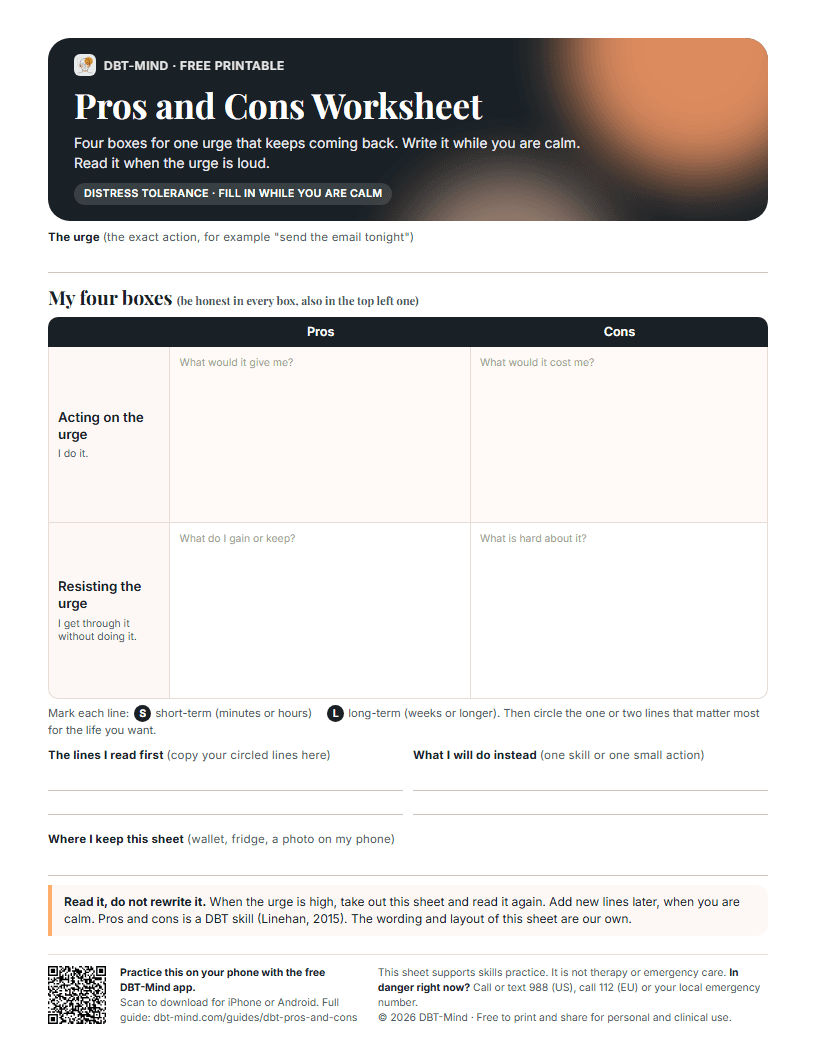
Free printable PDF
DBT Pros and Cons Worksheet
Four boxes for one urge: the pros and cons of acting on it and of resisting it, a short-term and long-term key, and what you will do instead.
- The four boxes
- Short-term and long-term key
- What I will do instead
How the four boxes work
A normal pros and cons list has two columns. This one looks at two choices: acting on the urge and resisting it. Each choice gets its own pros and cons, so you end up with four boxes.
| Pros | Cons | |
|---|---|---|
| Acting on the urge | What acting on it would give you | What acting on it would cost you |
| Resisting the urge | What you gain or keep by not acting on it | What is hard about not acting on it |
Four-box format: Distress Tolerance Handout 5 ("Pros and Cons") in Marsha Linehan, DBT Skills Training Handouts and Worksheets, 2nd edition (Guilford Press, 2015). The wording in the boxes is our own.
Why four and not two? The boxes are not mirror images. The "cons of resisting" box is where the hard part of holding out gets written down: the restless evening, the feeling that does not go away at once. If you leave it empty, the list can feel one-sided, and a list you do not believe is easy to ignore.
Linehan’s handout says you can use pros and cons any time you have to decide between two courses of action. It calls an urge a crisis when it is very strong and acting on it would make things worse in the long term. Its examples are dangerous, addictive or harmful behavior, and also giving in, giving up or avoiding what needs to be done.
Fill it in step by step
The free pros and cons worksheet has the grid with room to write. A blank page with a cross drawn on it works too. Do this on a calm day. Linehan’s handout says to write the list before an overwhelming urge hits and to read it again when it does.
- 1
Name the urge exactly. Write the action, not the feeling. "Quit my job by email tonight", not "I am fed up". Use one sheet per urge.
- 2
Fill all four boxes. Start with the box that is easiest. Be honest in the "pros of acting" box. If acting on the urge gave you nothing, you would not have the urge. Keep that box short and true.
- 3
Mark short-term and long-term. Put an S next to anything that lasts minutes or hours, and an L next to anything that lasts weeks or longer. The letters are our own addition to the grid. They make visible what the handout says about crisis urges: acting on them makes things worse in the long term.
- 4
Circle what matters most to your goals. Look at the L lines. Which one or two matter most for the life you want? Circle them. These are the lines you read first when the urge comes back.
- 5
Decide where you keep it. A list in a drawer does not help at 11 pm. Linehan’s handout says to carry your pros and cons with you and to rehearse them. Fold the sheet into your wallet, or keep a photo of it on your phone.
To have the finished list on your phone, type it onto an Emergency Card in the DBT-Mind app or add a photo of the sheet to the card, then pin it. You find your cards in the SOS sheet, and Emergency Cards are free.
A filled-in example
The urge: send a resignation email tonight, after a manager criticized your work in front of the team. S marks short-term, L marks long-term.
| Pros | Cons | |
|---|---|---|
| Acting on the urge (sending the email tonight) | The knot in my stomach is gone for tonight (S). I feel in charge for a moment (S). I never sit in that meeting room again (L). | No pay from next month (L). Rent is due on the 1st (L). No reference from this job (L). I leave at my worst moment, not at my best (L). I cannot take the email back (L). |
| Resisting the urge (not sending it tonight) | I keep my pay while I decide (L). I can look for a new job without panic (L). I can still quit next week if I want to (L). I find out if one bad meeting is the whole story (L). | I feel angry and small tonight (S). I have to face my manager tomorrow (S). The urge may be back after the next bad meeting (S). |
Example written by the DBT-Mind team. Format based on Linehan (2015), Distress Tolerance Handout 5.
Count the letters. Almost everything that speaks for sending the email is short-term. Almost everything against it is long-term. Many people find the same pattern in their own lists, and it is the reason to mark the two.
Circled in this example: "I can still quit next week if I want to" and "Rent is due on the 1st".
Look at what the list does not say. It does not say "never quit". Resisting an urge tonight is not a promise to stay forever. It moves the decision to a day when wise mind, the balance of emotion mind and reasonable mind, can have a say.
Using it when the urge is back
This is the moment the sheet was written for. You do not have to think. You have to find the paper.
Read, do not rewrite
An urge at 8 or 9 out of 10 is not the time to write a new list. Take out the one you wrote while calm and read it, out loud if you can. Start with the circled lines.
Picture both endings
Linehan’s handout adds three things to do while you read. Imagine the good results of resisting. Think of the bad results of giving in. Remember what happened the last times you acted on this urge.
Too wound up to read
Freeze first with the STOP skill. If your body is at a 9, use the TIPP skill first (cold water, hard exercise, slow breathing), then come back to the sheet.
Then fill the time
The list is for the decision not to act. The next hour still has to pass. Pick a distraction or self-soothe skill from the distress tolerance skills guide and set a timer.
Add what you notice
Later, when you are calm again, add any new line that came up. That way the sheet stays up to date.
Pros and cons is for urges you can hold off for a while. If the urge is to hurt yourself and it does not pass, or you do not feel safe, do not stay alone with a list. Call 988 (US), 112 (EU) or your local crisis line.
When the list does not hold
Sometimes you read the list and act on the urge anyway. That is information about that moment, and you can use it.
Skip the shame spiral
Harsh self-talk after a slip does not undo anything, and it adds one more painful feeling to get through. State what happened in plain facts instead: "I sent the email at 11:40 pm."
Trace what led up to it
A behavior chain analysis goes through the hours before the action, link by link, and looks for places where a skill could fit next time.
Update the sheet
Write what really happened into the "cons of acting" box, in your own words and with the date. Linehan’s handout lists remembering past consequences as part of the skill.
Plan for the trigger you can see coming
If the same situation sets off the urge again and again, such as the weekly review meeting, rehearse it in advance with the cope ahead skill, with your list as part of the plan.
Bring it to therapy
If you have a therapist, take the sheet along. A list that keeps losing against the same urge is worth talking through together.
Practice it in DBT-Mind
Keeping your pros and cons list in DBT-Mind
DBT-Mind is a free DBT app for iOS and Android. It has no pros and cons worksheet (the printable on this page is the worksheet), but these features keep your list within reach and help after a slip.
- 1Put your list on an Emergency Card: the urge as the title, your circled lines as the note, and a photo of the sheet as the image if you like. Emergency Cards are free.
- 2Pin the card. You find your cards in the SOS sheet, under Cards.
- 3When the urge is high, the Crisis Companion in the Emergency tab starts with a check-in on how intense your distress is, then shows pre-written steps. It is free.
- 4If you acted on the urge, the chain analysis takes you through what led up to it, step by step. Three chain analyses per month are free; unlimited analyses are part of Premium (called Plus in the app).

Frequently asked questions
- What is the pros and cons skill in DBT?
- It is a distress tolerance skill for deciding whether to act on a crisis urge. You write down the pros and cons of acting on the urge and the pros and cons of resisting it, then use the list when the urge is strong. It is one of the crisis survival skills in Linehan’s DBT Skills Training Handouts and Worksheets (2015).
- Why four boxes instead of two?
- Because there are two choices, and each has good and bad sides. A two-column list only looks at acting on the urge. The four boxes also show what you gain by resisting and what is hard about it, so the list covers both sides of both choices.
- When should I fill in a pros and cons list?
- While you are calm. Linehan’s handout says to write out your pros and cons before an overwhelming urge hits, carry them with you and rehearse them. When the urge hits, you take the list out and read it again.
- Is there a free DBT pros and cons worksheet?
- Yes. The free DBT-Mind pros and cons worksheet (PDF, one page) has a line for the urge, the four boxes with room to write, a short-term and long-term key, and space for the lines you read first and for what you will do instead. It is free to print and share.
- What are the pros and cons of DBT itself?
- That is a different question from this skill. In short: a 2020 Cochrane review (Storebø et al.) found that DBT appeared better than usual treatment at reducing borderline symptoms and self-harm, with evidence the authors rated as low quality. The cost is time: Behavioral Tech describes the skills curriculum as 24 weeks of weekly groups, with individual therapy alongside. The what is DBT guide covers both sides.
Keep learning
All guides
Distress Tolerance Skills: Surviving a Crisis Without Making It Worse
The DBT crisis survival toolkit (TIPP, STOP, ACCEPTS, self-soothing) and how to assemble them into a personal crisis plan.
ReadSTOP Skill: How to Pause Before You React (DBT)
Stop, Take a step back, Observe, Proceed mindfully: the few seconds between a strong urge and what you do next, explained with an example.
Read
Behavior Chain Analysis (DBT): Steps, Example and Free Worksheet
The steps of a DBT chain analysis, a filled-out example chain, how to find where a skill could have helped, and a free one-page worksheet.
Read