Quick answer
A behavior chain analysis is a DBT tool for working out, step by step, what led to a problem behavior: what made you vulnerable that day, the event that set it off, the links in between (thoughts, feelings, body sensations, actions) and the consequences. Then you mark where a skill could have broken the chain and plan for next time. You do it afterwards, when you are calm, without blame.
General information about DBT skills. It does not replace therapy, and in an emergency contact your local emergency number or crisis line.
Maybe you sent the message you regret, had a binge, hurt yourself or walked out of work, and your therapist said "let’s do a chain analysis". Or you are learning DBT on your own and keep ending up in the same place. A chain analysis turns "it just happened" into a sequence you can actually change, one link at a time.
This guide covers the steps, a filled-out example, how to find the solutions, common mistakes and a free one-page worksheet. It is written by the team behind DBT-Mind, an app for practicing DBT skills. One note on the name: this is the DBT chain analysis, not "behavior chaining" from applied behavior analysis (ABA), which is a way of teaching a skill in small steps.
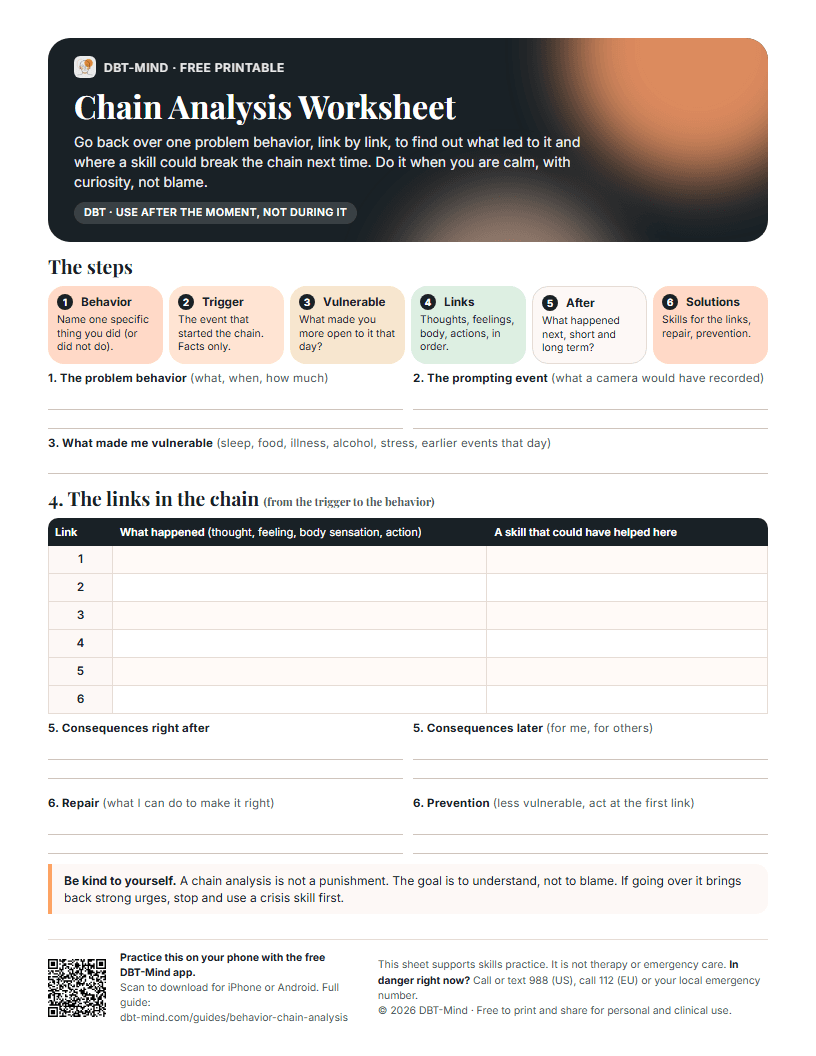
Free printable PDF
Chain Analysis Worksheet
Work through one problem behavior link by link, mark where a skill could help, and plan repair and prevention.
- The 6 steps
- Links table
- Repair and prevention
What a chain analysis is for
In DBT, a chain analysis is the main way to understand a behavior you want to stop, and therapists do one in nearly every individual session (Rizvi and Ritschel, Cognitive and Behavioral Practice, 2014). The idea is simple: a behavior does not come out of nowhere. It is the last link in a chain of small events, and every link is a place where you could do something different.
You do it after the behavior, not during it. In the moment, the job is to get through safely with a crisis skill such as TIPP. A chain analysis needs a calm mind and some distance. Most people do it within a day or two, while the details are still fresh.
The steps of a chain analysis
- 1
Name the problem behavior. Be specific: what you did, when, and how much. "I sent my sister a harsh text and blocked her at 6:30 pm" works. "I was awful" does not.
- 2
Find the prompting event. What happened right before the chain started? Describe it the way a camera would. It is often small: a text, a look, a sound, a memory.
- 3
List your vulnerabilities. What made you more open to the trigger that day? Little sleep, skipped meals, illness, alcohol, stress or an earlier conflict all count.
- 4
Write out the links. Go from the prompting event to the behavior in small steps: each thought, feeling, body sensation and action, in order. Smaller links are more useful than big jumps.
- 5
Note the consequences. What happened right after, and later? Include the short-term relief the behavior gave you. That relief is often why it keeps happening.
- 6
Mark where skills could help. Go back through the chain and write a skill next to as many links as you can. Any link you change can stop the chain.
- 7
Plan repair and prevention. How can you make things right with anyone affected? What will you do differently at the first link next time?
These steps follow Linehan’s DBT Skills Training Manual (2nd edition, 2015) and Shireen Rizvi’s book Chain Analysis in Dialectical Behavior Therapy (Guilford Press, 2019), in our own words.
If you prefer to do it on your phone, the DBT-Mind app has a chain analysis that walks you through the same steps. Three analyses a month are free, and you can share a finished one as a PDF with your therapist.
A filled-out chain analysis example
Problem behavior: sending a harsh text to a sister and blocking her number. Vulnerabilities that day: four hours of sleep, no lunch, a deadline at work. Prompting event: at 6 pm the sister texts "Can’t make Sunday, sorry."
| Link | What happened | Type | A skill that could have helped |
|---|---|---|---|
| 1 | "She always cancels on me." | Thought | Check the Facts: did she really always cancel? |
| 2 | Hurt, then anger at 8 out of 10 | Feeling | Name the emotion and its strength |
| 3 | Hot face, tight chest, typing fast | Body | TIPP: cold water on the face, slow breathing |
| 4 | "I’ll show her how it feels." | Thought | Ask what wise mind wants for this relationship |
| 5 | Writes a long, harsh message | Action | STOP: put the phone down before sending |
| 6 | Sends it and blocks her number | Problem behavior | Any skill above, earlier in the chain |
Fictional example written by the DBT-Mind team. Consequences: a few minutes of relief and feeling in control, then shame, a hurt sister and a lost Sunday anyway.
Solutions: where to break the chain
The analysis is only half the work. The solutions are what make the next chain different. Look for changes at three points: before the trigger, along the links and after the behavior.
Lower your vulnerability
Sleep, food, movement and less alcohol make every trigger hit softer. DBT calls this PLEASE, part of the emotion regulation skills.
Plan for the prompting event
If cancellations, criticism or a certain time of day often start your chains, decide in advance what you will do when it happens.
Swap one link for a skill
Pick the link where a skill is easiest to use. For many people that is the body link (TIPP), the moment before acting (the STOP skill) or a thought you can test with Check the Facts.
Repair the harm
Make it right with the people affected, in a way that fits what happened: an honest apology, fixing what you can, unblocking a number.
Rehearse the new chain
Imagine the same trigger and walk through the new links in your head. Practicing it while calm makes it easier to reach when you are not.
Common mistakes
Too vague
"I got upset and it happened" skips the links where change is possible. Slow down and write each step.
Starting too late
Many chains start hours before the behavior, with poor sleep or an earlier conflict. Look further back than feels necessary.
Using it to punish yourself
A chain analysis is about understanding, not blame. If it turns into a list of everything wrong with you, take a break and come back with curiosity.
Skipping the solutions
Knowing why it happened is not enough. Write at least one concrete thing you will do differently.
Doing it in the middle of a crisis
Going over a chain can bring urges back. If that happens, stop and use a crisis skill. If you are in danger of hurting yourself, call 988 (US), 112 (EU) or your local crisis line.
Free chain analysis worksheet
The free DBT-Mind chain analysis worksheet fits on one page. It has a six-step summary at the top (it groups skills, repair and prevention into one "Solutions" step), fields for the behavior, the prompting event and your vulnerabilities, a table for the links with a column for the skill that could have helped, and space for consequences, repair and prevention.
Many DBT programs use a diary card to flag the behaviors that get a chain analysis: when a target behavior shows up on the card, you analyze it before or in the next session. If you are learning DBT without a therapist, one chain a week on your most common problem behavior is a good start.
Practice it in DBT-Mind
Doing a chain analysis in DBT-Mind
DBT-Mind is a free DBT app for iOS and Android with a skills library, diary card and journal, and a crisis hub. Its chain analysis follows the same steps as this guide.
- 1Start a chain analysis after a hard moment. The app takes you through vulnerability, the prompting event, the links, the behavior, the consequences and the solutions.
- 2Three chain analyses a month are free. Unlimited analyses and pattern insights are part of Premium (called Plus in the app).
- 3Share a finished analysis as a PDF, for example with your therapist. Sharing a single analysis is free.
- 4If you connect your therapist in the app, chain analyses are shared by default. You can turn that off in the share permissions or disconnect at any time.

Frequently asked questions
- What is a behavior chain analysis in DBT?
- It is a step-by-step review of one problem behavior: what made you vulnerable, the prompting event, the thoughts, feelings, body sensations and actions in between, and the consequences. The goal is to find the links where a skill could have changed the outcome, and to plan for next time.
- What is an example of a chain analysis?
- After little sleep and no lunch, a sister cancels plans by text. The thought "she always cancels" leads to hurt and anger, a hot face and fast typing, the thought "I’ll show her", and finally a harsh message and a blocked number. Skills like Check the Facts, TIPP or STOP could have broken the chain at different links.
- When should you do a chain analysis?
- After the behavior, once you are calm, ideally within a day or two while you still remember the details. Not during a crisis: then use a crisis skill first. In DBT therapy it is often done before or during the next individual session.
- How is a chain analysis different from a missing links analysis?
- A chain analysis looks at a behavior that happened and you want to stop. A missing links analysis looks at a helpful behavior that did not happen, such as skipped skills practice. It asks whether you knew what was needed, were willing, thought of it at the time and what got in the way (Linehan, 2015).
- Is there a free DBT chain analysis worksheet?
- Yes. The free DBT-Mind chain analysis worksheet (PDF, one page) has the steps, fields for the behavior, prompting event and vulnerabilities, a links table with a column for skills, and space for repair and prevention. It is free to print and share.
Keep learning
All guides
STOP Skill: How to Pause Before You React (DBT)
Stop, Take a step back, Observe, Proceed mindfully: the few seconds between a strong urge and what you do next, explained with an example.
Read
DBT Diary Card: What It Is, a Filled-Out Example and How to Fill It Out
What a diary card tracks, a filled-out example week, how to rate emotions and urges, and how to keep the habit in under two minutes a day.
Read
Emotion Regulation Skills: The DBT Toolkit for Intense Feelings
The DBT skills that reduce how often and how hard intense emotions hit: Check the Facts, opposite action, PLEASE, and more.
Read