Quick answer
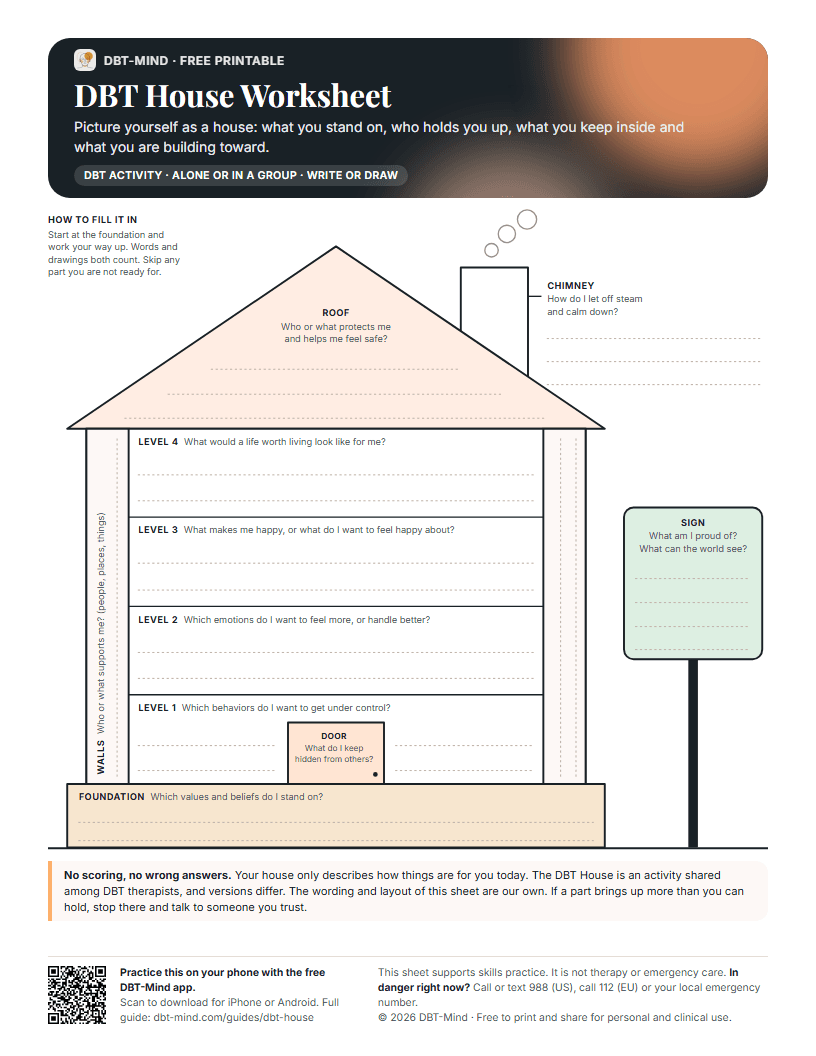
"DBT House" means two things. In the DBT House activity you draw a house and fill each part (foundation, walls, roof, door, chimney, four levels and a sign) with what you stand on, who supports and protects you, what you keep hidden and what you are working toward. The "house of treatment" is a picture for the stages of DBT, from getting life-threatening behavior under control at the bottom to more joy and meaning at the top. A free one-page DBT House worksheet (PDF) is on this page.
General information about DBT skills. It does not replace therapy, and in an emergency contact your local emergency number or crisis line.
Maybe your skills group leader handed you a sheet with a house on it. Maybe a therapist said you are "in the basement" or "on the first floor" of treatment. Both get called the DBT House, and they are not the same thing. One is an activity you fill in about your own life. The other is a way to picture where DBT treatment is heading.
Below: both meanings side by side, the activity part by part with the question each part asks, a filled-out example, how to use it alone, in a group or with teens, and the stages behind the house of treatment. It is written by the team behind DBT-Mind, an app for practicing DBT skills.
Free printable PDF
DBT House Worksheet
A house outline with a short question in each part: foundation, walls, roof, door, chimney, four levels and a sign, with room to write or draw.
- House outline
- A question per part
- Room to write or draw
Two things people mean by DBT House
If you searched for a template to print, you want the activity, and the free worksheet is on this page. If someone talked about floors or stages of treatment, you want the house of treatment further down.
| DBT House activity | DBT house of treatment | |
|---|---|---|
| What it is | A drawing and writing exercise about your own life | A picture of the stages of DBT treatment |
| Who uses it | Skills groups, therapists, school counselors, or you on your own | Therapists and programs, to explain where treatment starts and where it leads |
| What you do | Fill each part of a house with your own answers | Nothing to fill in. You look at which stage you are working on |
| What you end up with | One page with your values, supports, coping and goals | A shared map for you and your treatment team |
| Where it comes from | Shared among DBT therapists. We did not find an original published source | The stages are part of DBT. The house is a teaching picture for them |
Our summary after reading three published versions of the activity and two descriptions of the stages in November 2026. The sources are named in the sections below.
The DBT House activity, part by part
In the activity you picture yourself as a house. Every part of the house stands for one question about your life. We read three versions that are easy to find online: one by Charlie Health, one by Mental Health Center Kids and a template by Carepatron. They agree on six parts: foundation, walls, roof, door, chimney and a sign or billboard next to the house. The table shows those six parts plus the four levels inside the house, which follow the Mental Health Center Kids version.
Versions differ. The Carepatron template describes rooms and an attic where the Mental Health Center Kids version has four levels. None of the three pages names who first made the activity, and we did not find an original published source. So we do not credit it to Marsha Linehan’s manuals. Treat the questions below as a common version, not an official one.
| Part | The question it asks | Example answer |
|---|---|---|
| Foundation | Which values and beliefs do I stand on? | Honesty. Being there for my sister. My faith. |
| Walls | Who or what supports me? | My friend Sam, my skills group, my dog, the library. |
| Roof | Who or what protects me and helps me feel safe? | My aunt, my own room, my morning routine. |
| Door | What do I keep hidden from others? | How lonely I get on weekends. |
| Chimney | How do I let off steam and calm down? | Running, loud music, a cold shower, drawing. |
| Sign or billboard | What am I proud of? What can the world see? | I finished my course. I am a good listener. |
| Level 1 | Which behaviors do I want to get under control? | Sending angry texts at night. |
| Level 2 | Which emotions do I want to feel more, or handle better? | Less shame. More calm when plans change. |
| Level 3 | What makes me happy, or what do I want to feel happy about? | Cooking for friends. My job, one day. |
| Level 4 | What would a life worth living look like for me? | My own place, steady friendships, work that matters to me. |
Parts and questions follow the versions by Charlie Health ("DBT House"), Mental Health Center Kids ("DBT House") and Carepatron ("DBT House PDF"), read in November 2026. Wording and examples written by the DBT-Mind team.
A filled-out DBT House example
Here is how one house could look. Dana is 27 and made up for this example. She tends to go silent when there is conflict and then feels cut off for days.
Foundation
Fairness. Keeping my word. Looking after my little brother.
Walls
My friend Noor, who checks in without pushing. My Thursday skills group. My cat.
Roof
My apartment, where nobody shouts. My therapist. A walk before hard talks.
Door
That I rehearse arguments in my head for hours and then say nothing.
Chimney
Swimming, cleaning the kitchen, singing in the car.
Sign
I trained as a nurse while working nights. People trust me with their worries.
Levels 1 to 4
Level 1: stop going silent for days after a fight. Level 2: feel anger without freezing. Level 3: Sunday breakfast with friends. Level 4: a home where hard things can be said out loud.
One way to read a finished house is to look for what shows up in more than one part. Dana’s door and her level 1 point at the same thing: silence after conflict. For her, a next step could be to ask for one thing out loud with DEAR MAN.
If you want to keep what you wrote in your house where you can find it in a hard moment, the DBT-Mind app has free Emergency Cards (your own text and a photo, stored on your phone) and a free text journal.
How to use the DBT House: alone, in a group, with teens
You need the printed worksheet or a blank sheet of paper and a pen. Colored pencils help if you like to draw. The times below are our suggestions, not a rule.
On your own
Give yourself 20 to 30 minutes at a calm time. Start with the foundation and work your way up. Leave a part empty if nothing comes, and return to it another day. Afterward, pick one part and write about it for five minutes. These DBT journal prompts can keep you going.
In a group
Plan about 15 minutes of quiet filling in and 20 minutes of sharing. One rule keeps the round safe: everyone shares one part of their own choice, and anyone may pass. Nobody has to read out their door.
With teens
Keep the questions short, allow drawing in place of words, and let them decorate the house. The sign and the chimney are easier places to start than the door and level 1.
With a therapist
Bring the finished house to a session. The empty parts are as useful to talk about as the full ones.
Again, a few months later
Put the date on the sheet and fill in a new one after a few months. Two houses next to each other show what has changed in your supports, your coping and your goals.
The door and level 1 can touch painful things. If thoughts of hurting yourself come up while you fill in the house, stop and reach out: call 988 (US), 112 (EU) or your local crisis line.
The DBT house of treatment: the stages
The second meaning has nothing to fill in. DBT treatment is organized in stages, and DBT teachers often draw those stages as a house with several floors: you start at the bottom and work your way up. NHS Education for Scotland describes four stages of DBT in The Matrix, its guide to psychological therapies. The table uses that description.
The house picture itself varies. Evolve Treatment Centers, a treatment program for teens, puts stage 1 in the basement, stages 2 and 3 on the first and second floor, and stage 4 on the roof, which it describes as life after structured treatment. That page credits the picture to Marsha Linehan. We could not check that against one of her books, so we leave the origin of the drawing open.
| Stage | What it is about | In the house picture |
|---|---|---|
| Stage 1 | Behavioral stability: skills for immediate and severe life-threatening behaviors and for behaviors that get in the way of therapy. Quality of life behaviors can be addressed here too. | The basement |
| Stage 2 | Trauma-related memories and working through those experiences emotionally. | The first floor |
| Stage 3 | The self: self-respect, self-confidence and reaching your own goals. | The second floor |
| Stage 4 | Existential questions, and a greater capacity for joy and fulfillment. | The roof |
Stages: NHS Education for Scotland, The Matrix, "Dialectical Behaviour Therapy (DBT)", read in November 2026. House levels: Evolve Treatment Centers, "What is the DBT House of Treatment?" (2019). Wording ours.
The Matrix describes the four stages as non-chronological, so they are not a fixed timeline. What you work on first is decided with your therapist. And the stages describe the treatment, not you as a person. For what a full program includes, see what DBT therapy is.
The four levels in the activity loosely follow the same order: behavior first, then emotions, then happiness, then a life worth living.
What the DBT House is not
The activity is simple on purpose. A few limits keep it honest.
Not a test
There is no score and no right house. Nobody can read a diagnosis from your drawing, and no part of it says what is wrong with you.
Not a skill
The house is for taking stock. For a crisis or a strong emotion you need the skills themselves. The DBT skills list shows all four modules and where to start.
Not a replacement for therapy
A filled-in house can start a good conversation with a therapist. It does not do the work of treatment.
Not a one-time job
If you get stuck between what you feel and what you think you should write, pause and come back to it from wise mind.
Not official DBT material
It is an activity therapists share, in many versions. Marsha Linehan’s skills handouts are a separate, copyrighted set. Our own sheets, written in our own words, are in the free DBT worksheets collection.
Practice it in DBT-Mind
Keeping your DBT House in DBT-Mind
DBT-Mind is a free DBT app for iOS and Android. It has no DBT House and no drawing tool (the printable on this page is the worksheet), but these free features keep your house within reach.
- 1Take a photo of your finished house and add it to an Emergency Card, with a title and a short note. Emergency Cards are free and stored on your device.
- 2Pin the card. You find your cards in the SOS sheet, under Cards.
- 3Write about one part of your house in the journal, for example the door. The text journal is free; voice input is part of Premium (called Plus in the app).
- 4Look up the skills from your chimney in the Library tab, which has 50+ DBT skills in four categories, and mark the ones that help as emergency skills. Both are free.

Frequently asked questions
- What is the DBT House activity?
- The DBT House is a drawing and writing activity used in DBT groups and sessions. You draw a house, or print a template, and fill each part with answers about your own life. The foundation holds your values, the walls your supports, the roof what protects you, the door what you keep hidden, the chimney how you let off steam, and the sign what you are proud of. Many versions add four levels inside the house.
- What goes in each part of the DBT House?
- Foundation: the values and beliefs you stand on. Walls: who or what supports you. Roof: who or what protects you. Door: what you keep hidden from others. Chimney: how you let off steam. Sign or billboard: what you are proud of. In versions with four levels, level 1 is for behaviors you want to get under control, level 2 for emotions, level 3 for what makes you happy and level 4 for a life worth living.
- What is the DBT house of treatment?
- It is a picture for the stages of DBT treatment. NHS Education for Scotland describes four stages: behavioral stability first, then working through trauma-related memories, then self-respect and personal goals, then a greater capacity for joy and fulfillment. Programs draw these as floors of a house, for example from the basement up to the roof.
- Is the DBT House worksheet free to print?
- Yes. The DBT House worksheet on this page is a free one-page PDF in US Letter format. It shows the outline of a house with a short question in each part and room to write or draw. You may print and share it for personal and clinical use.
- Can I use the DBT House in a group?
- Yes. We suggest about 15 minutes of quiet time to fill it in, then a round in which each person shares one part of their own choice. Anyone may pass, and nobody has to read out their door. The worksheet may be printed for skills groups and classes.
Keep learning
All guides
What Is DBT Therapy? Dialectical Behavior Therapy in Plain Language
A plain-language explainer: where DBT comes from, the four parts of a full program, how long it takes and how it differs from CBT.
ReadDBT Journal Prompts: 24 Prompts by Skill Module, Plus How to Track Your Skills
Short writing prompts for each DBT skills module, a five-minute daily routine, and how to track which skills you used, on paper or in an app.
Read
DBT Skills List: All 4 Modules Explained Simply
Every core DBT skill across the four modules, explained in plain language, with guidance on which module to start with.
Read