Quick answer
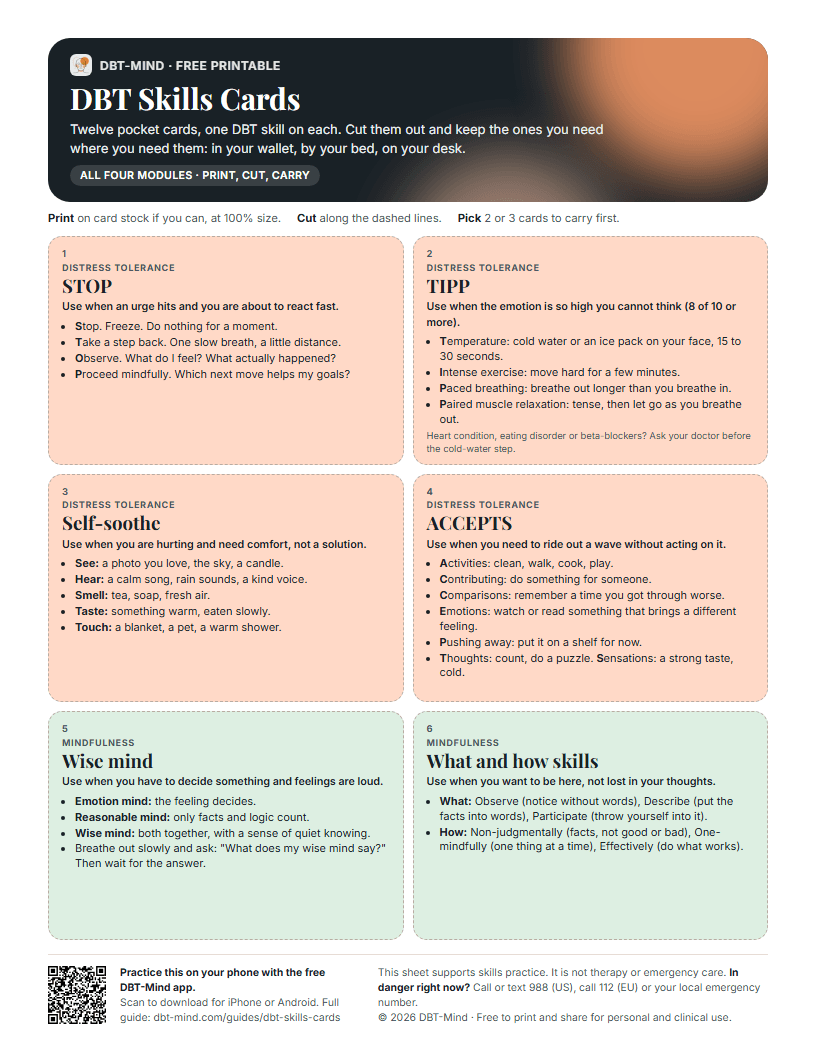
DBT skills cards are small cards with one skill each: its name, when to use it and the steps in a few words. You keep them in your wallet, by your bed or on your desk, so the skill is right there when stress makes it hard to remember. Our free printable set has 12 DBT skills cards covering all four modules, on two pages to cut out.
General information about DBT skills. It does not replace therapy, and in an emergency contact your local emergency number or crisis line.
Many people learn a DBT skill in a calm moment and then cannot recall it when they need it. That is not a lack of effort. Many people find that strong emotions make it harder to think clearly and remember what they learned. A card in your pocket does the remembering for you.
Below: what is on each of the 12 cards, how to print and use them, where to keep them, and how to write your own. It is written by the team behind DBT-Mind, an app for practicing DBT skills.
Free printable PDF
DBT Skills Cards
Twelve pocket cards to cut out, one DBT skill each, covering all four modules.
- 12 cards
- All 4 modules
- When to use each skill
What is on the 12 cards
Each card has the skill name, its module, one line on when to use it and the steps in short words. The set covers all four DBT modules. We put more crisis skills in it, because those are the moments when a reminder helps most.
| Card | Module | Use it when |
|---|---|---|
| STOP | Distress tolerance | An urge hits and you are about to react fast |
| TIPP | Distress tolerance | The emotion is so high you cannot think |
| Self-soothe | Distress tolerance | You are hurting and need comfort, not a solution |
| ACCEPTS | Distress tolerance | You need to ride out a wave without acting on it |
| Wise mind | Mindfulness | You have to decide something and feelings are loud |
| What and how skills | Mindfulness | You want to be present, not lost in thoughts |
| Radical acceptance | Distress tolerance | Something painful is real and cannot change |
| Check the Facts | Emotion regulation | A feeling seems bigger than the moment |
| Opposite action | Emotion regulation | An emotion does not fit the facts |
| PLEASE | Emotion regulation | Your emotions have felt raw for days |
| DEAR MAN | Interpersonal effectiveness | You need to ask for something or say no |
| GIVE and FAST | Interpersonal effectiveness | You want to keep the relationship and your self-respect |
Skills based on Linehan, DBT Skills Training Manual, 2nd edition (2015). Card wording written by the DBT-Mind team.
How to print and use the cards
The cards are made for US Letter paper. Each card is about 3.7 by 2.4 inches, a little bigger than a business card, so the text stays readable.
- 1
Print at 100% size. Card stock or thick paper lasts longest. Normal paper is fine if you fold the card once or keep it in a sleeve.
- 2
Cut along the dashed lines. Each page has six cards. The module is printed at the top of each card.
- 3
Pick two or three to carry. Twelve cards in your wallet is too many. Start with the skills for your hardest moments, for example STOP and TIPP if things escalate fast.
- 4
Read a card before you need it. Look at your cards once a day for a week while you are calm. That way the words feel familiar when you are not.
- 5
Swap cards as you learn. Once a skill comes to you without the card, put another one in its place.
If you would rather have your skills on your phone, the DBT-Mind app lets you mark any skill as an emergency skill so it shows up in the crisis tab, and write your own Emergency Cards. Both are free.
Where to keep your skills cards
A card only helps if it is where the hard moment happens. Think about where your strongest urges usually show up, and put a card there.
Wallet or phone case
For skills you need on the go, such as STOP or DEAR MAN before a difficult talk.
By your bed
Nights are hard for many people. Self-soothe and paced breathing from TIPP fit here.
Desk or locker
For stress at work or school: Check the Facts when an email or comment hits harder than it should.
Fridge or mirror
For daily habits like PLEASE, where a small reminder each morning helps more than a big plan.
Therapy folder
Bring the cards to skills group or therapy and talk about which ones you actually used.
How to make your own DBT coping cards
Ready-made cards are a start. Cards in your own words often work better, because you wrote them for your own life. A simple way to make one:
Front: the moment
Write the situation or feeling that tells you to use the card: "When I want to send an angry text".
Back: the skill
Name one skill and two or three steps in your own words. Short is better than complete.
Add a reason
One line on why it matters to you: "I want to keep this friendship".
Add a person
Someone you can call or text if the skill is not enough, with their number.
If a skill on a card stops working for you, that is useful information. Bring it to your therapist or look at it from wise mind: maybe it fits a different moment better.
Skills cards, cheat sheet or diary card?
People searching for "DBT cards" often mean one of three different things: pocket skills cards like these, the one-page cheat sheet on the DBT skills list, or the weekly form explained in the DBT diary card guide. All of them are in our free DBT worksheets collection. Here is how they differ.
| Printable | What it is | Best for |
|---|---|---|
| DBT skills cards (this page) | 12 small cards, one skill each, to cut out | Carrying a few skills with you for hard moments |
| DBT skills cheat sheet | One page with the core skills of all four modules | An overview on the wall or in a folder |
| DBT diary card | A weekly form for emotions, urges and skills used | Tracking your week and bringing it to therapy |
All three are free PDFs from DBT-Mind, free to print and share.
When cards are not enough
A card reminds you of a skill. It does not teach it. Learn each skill first, in a skills group, with a therapist or with a guide such as our distress tolerance skills overview, and practice it while you are calm. Then the card can do its job.
Some moments are bigger than any card. If you feel unsafe or think about hurting yourself, put the cards aside and reach out: call 988 (US), 112 (EU) or your local crisis line. A card with that number on it is a good card to carry.
Practice it in DBT-Mind
Keeping your skills on your phone with DBT-Mind
DBT-Mind is a free DBT app for iOS and Android with a skills library, diary card and journal, and a crisis hub. It works like a set of skills cards on your phone, sorted by module.
- 1Browse 50+ DBT skills in the free Library, sorted by the four modules.
- 2Mark the skills that help you most as emergency skills. They then show up in the crisis tab and the SOS sheet.
- 3Write your own Emergency Cards with a title, a note and an optional image. They are free and stored on your device.
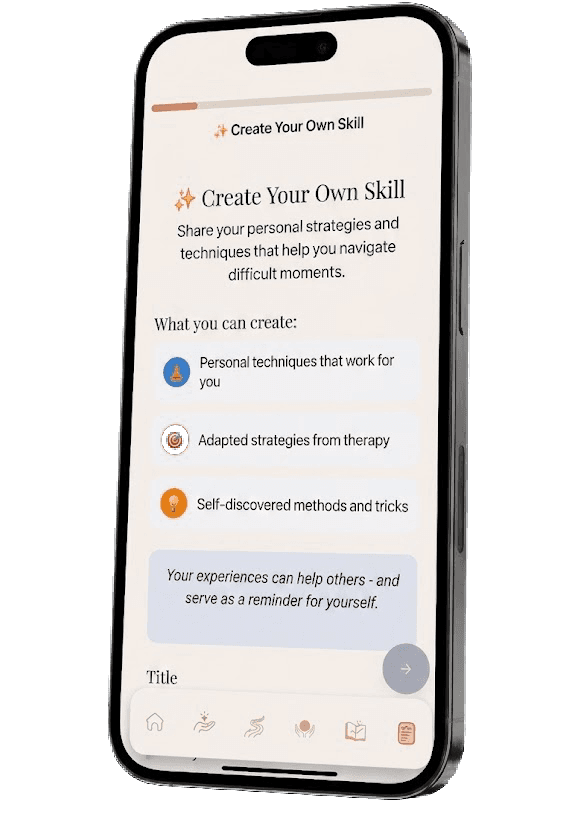
- 4Add your own skills in your own words, the same way you would write a personal coping card.
Frequently asked questions
- Are these DBT skills cards free?
- Yes. The DBT-Mind skills cards are a free PDF with 12 cards on two pages. They are free to print and share for personal and clinical use. You do not need an account or the app to download them.
- What should I write on a DBT coping card?
- On the front, the situation or feeling that tells you to use it. On the back, one skill with two or three steps in your own words, one line on why it matters to you, and the name and number of someone you can contact if the skill is not enough.
- Which DBT skills should I carry first?
- The ones for your hardest moments. If emotions rise fast, start with STOP and TIPP. If conflicts with people are the main problem, carry DEAR MAN. If you often feel more than the situation calls for, carry Check the Facts. Two or three cards are enough to begin.
- Is a DBT card the same as a DBT diary card?
- No. A skills card is a small reminder of one skill that you carry with you. A diary card is a weekly form where you rate emotions and urges and note which skills you used, usually to bring to therapy. Both are free printables on dbt-mind.com.
- Can I use the cards in a DBT group or with clients?
- Yes. The cards are free to print and share for personal and clinical use. The wording is our own and based on the DBT Skills Training Manual (Linehan, 2015), so they work well as a handout next to the materials your program already uses.
Keep learning
All guides
DBT Skills List: All 4 Modules Explained Simply
Every core DBT skill across the four modules, explained in plain language, with guidance on which module to start with.
Read
DBT Diary Card: What It Is, a Filled-Out Example and How to Fill It Out
What a diary card tracks, a filled-out example week, how to rate emotions and urges, and how to keep the habit in under two minutes a day.
Read
STOP Skill: How to Pause Before You React (DBT)
Stop, Take a step back, Observe, Proceed mindfully: the few seconds between a strong urge and what you do next, explained with an example.
Read