Grounding Apps: Which One Helps With Panic, Anxiety or Dissociation
By Timo, founder and developer of DBT-Mind
Quick answer
The right grounding app depends on the moment. For panic, pick one that starts with slow breathing, such as Rootd. For feeling unreal or far away, pick one with guided sensory grounding like 5-4-3-2-1, such as Ground: Anxiety Relief (free, iPhone) or Grounding Now. For grounding as part of DBT skills practice, DBT-Mind (our app) has a free guided 5-4-3-2-1 audio. In a crisis, call 988 (US), 112 (EU) or your local crisis line.
General information about DBT skills. It does not replace therapy, and in an emergency contact your local emergency number or crisis line.
When panic hits or the room starts to feel far away, it is hard to remember steps. A grounding app can talk you through them. This guide sorts apps by the moment they are for, not by a ranking. It is written by the team behind DBT-Mind, so we say that up front, and we name the cases where another app fits better.
App facts come from each app’s own US App Store listing or website, read in November 2026 unless a row says otherwise. Prices change, so check the store before you pay. An app is a practice tool, not treatment.
Which kind of grounding app you need
Grounding apps do different jobs. Start with the moment you want help with, then look for the feature that fits it.
| Moment | What you need first | App feature to look for |
|---|---|---|
| Panic: racing heart, fast breathing | Slow breathing. The NHS advice for a panic attack is to breathe slowly and deeply | Paced breathing you can start with one tap, with a visual or a voice |
| Feeling unreal, far away or numb | Something strong for your senses and body | Guided 5-4-3-2-1 or body-based steps, ideally as audio |
| Worry that keeps looping | Something to keep your mind busy | Short guided exercises you can do anywhere |
| Reminders of a past trauma | Tools you have planned with your therapist | An app made for trauma, with your own contacts and coping cards |
Our own summary for choosing an app. Breathing advice: NHS, Panic disorder page. Grounding for dissociation: SAMHSA TIP 57, Trauma-Informed Care in Behavioral Health Services (2014), Exhibit 1.4-1.
This page is about choosing an app. The techniques themselves, step by step, are in our guide to grounding techniques.
Grounding apps compared
These five apps cover the main types people find when they search. They are listed by type, not by rank.
| App | Made for | Grounding features (from its listing) | Price | Honest limit |
|---|---|---|---|---|
| Ground: Anxiety Relief | 5-4-3-2-1 practice | Learn and practice the 5-4-3-2-1 method, guided breathing, calming background colors | Free, no in-app purchases listed | iPhone and iPad only (we did not find an Android version), English only |
| Grounding Now | Strong feelings, cravings and urges | Three types of grounding: mental, physical and soothing. Based on the book Seeking Safety | Free to download, in-app purchases from $2.99 to $12.99 | iPhone and iPad only (we did not find an Android version); last listed update October 2023 |
| Rootd | Panic attacks | Panic button (the “Rootr”), guided breathing, visualizations and body scan, journal, emergency contact | Free to download; Full Access from $6.99 per month or $179.99 lifetime | Built for panic; we did not find a grounding section named in its listing |
| PTSD Coach | People who have, or may have, PTSD | Tools for stress symptoms, guided relaxation, soothing sounds and images, self-assessment, links to support | Free, no in-app purchases listed | We did not find grounding named in its listing or website. Made by the US Department of Veterans Affairs |
| DBT-Mind | DBT skills practice | Guided “5-4-3-2-1 senses” audio, Guided Calm and Box breathing, emergency skills one tap away (all free) | Free to download; Premium (called Plus in the app) $8.99 per month or $54.99 per year (October 2026) | A skills app, not a grounding app. Other breathing presets, including Grounding Breath, are Premium |
Sources: each app’s US App Store listing (apps.apple.com ids 6466813925 Ground, 1567451164 Grounding Now, 1289018369 Rootd, 430646302 PTSD Coach), read November 2026; rootd.io for Rootd on Google Play; mobile.va.gov/app/ptsd-coach for PTSD Coach on iOS, Android and web. DBT-Mind price from the US App Store, October 2026. “We did not find” means it was not in the listing or on the website, not that the app cannot do it.
For panic: breathing first
Rootd (rootd.io) is built for panic attacks. Its listing leads with a panic button, the Rootr, plus guided breathing, visualizations, a body scan and a journal. It is on iPhone, Apple Watch and Android. Ground: Anxiety Relief also has guided breathing if you want something simpler.
For more DBT skills matched to panic, worry and dread, see DBT for anxiety.
Best for
Rootd: people whose main problem is panic attacks and who want one button to press. Here it is a better fit than a DBT app.
Limits
More lessons need Full Access, a subscription or a $179.99 lifetime purchase. We did not find a grounding section named in its listing.
For feeling unreal or far away: guided senses
SAMHSA’s guide for clinicians (TIP 57, Exhibit 1.4-1) describes grounding as a way to help someone who is dissociating become aware of the here and now. When you feel unreal, a voice or a screen that walks you through each step can be easier than remembering them.
Ground: Anxiety Relief, by Deven Joshi on the App Store, is a small free app built around 5-4-3-2-1 and breathing. Grounding Now, from Treatment Innovations on the App Store, teaches mental, physical and soothing grounding, based on the book Seeking Safety.
Best for
Ground: Anxiety Relief if you want only 5-4-3-2-1, free, with nothing else to learn. Grounding Now if you also want physical and soothing grounding, or you struggle with cravings.
Limits
Both are iPhone and iPad only as far as we found. Ground is English only. Grounding Now’s listing shows its last update in October 2023.
For trauma reminders: an app made for PTSD
PTSD Coach (mobile.va.gov) comes from the US Department of Veterans Affairs and is free. It has information on PTSD, a self-assessment, tools for stress symptoms such as guided relaxation and soothing sounds, and links to support. You can add your own contacts, photos and music. There is also a web version for people without a smartphone.
Best for
People who have, or may have, PTSD, in or out of treatment. It is free on the US App Store, with no in-app purchases listed, and also on Android.
Limits
We did not find grounding named in its listing or website. The VA says it does not replace treatment with a healthcare professional.
For grounding as part of DBT practice
In DBT, grounding sits next to the distress tolerance skills for getting through a hard moment without making it worse. If you want grounding together with other DBT skills, a skills app fits better than a single-purpose one. Our apps for emotional regulation guide compares more of them.
Best for
DBT-Mind: people who want grounding, breathing and other DBT skills in one app, on iPhone or Android.
Limits
It is not a grounding app first. Only three guided audio exercises are free, and breathing presets beyond Guided Calm and Box are Premium. Its crisis tools are self-help, not a crisis service.
The free DBT-Mind app has a guided “5-4-3-2-1 senses” audio exercise and the Guided Calm and Box breathing presets, and you can mark the exercise as an emergency skill so it is one tap away.
When an app is not enough
Dissociation that happens often or lasts long
Talk to a doctor or therapist. The NHS says talking therapies are often recommended for dissociative disorders.
Panic attacks that keep coming
The NHS says to see a GP if you have symptoms of panic disorder. In the US, start with your doctor. Skills can help in between, see DBT for anxiety.
Urges to hurt yourself
Lower your body’s alarm first with the TIPP skill, and reach out to someone. If you are in danger, call 988 (US), 112 (EU) or your local crisis line.
You cannot reach your phone
Practice one grounding technique on calm days, so you can do it without an app when you need it.
Practice it in DBT-Mind
Try guided grounding in DBT-Mind
DBT-Mind is a free DBT app for iOS and Android with a skills library, guided exercises and a crisis hub. Its 5-4-3-2-1 audio is free.
- 1Download the app, create an account and pick English, German or Spanish.
- 2Open the Library, switch to Exercises and start the guided “5-4-3-2-1 senses” audio. It is one of three guided audio exercises that are free.
- 3When your body is in alarm, open the Breathwork Studio first. Guided Calm and Box are free; Grounding Breath and the other presets are Premium (called Plus in the app).
- 4Mark the exercises that help as emergency skills so they show in the Emergency tab. For crisis help in the US, call or text 988 directly.

Frequently asked questions
- Is there a free grounding app?
- Yes. Ground: Anxiety Relief is free with no in-app purchases listed (iPhone and iPad), and PTSD Coach is free on the US App Store and also on Android. Grounding Now, Rootd and DBT-Mind are free to download with paid upgrades. In DBT-Mind the guided 5-4-3-2-1 audio and two breathing presets are free (US App Store, November 2026).
- Which app has the 5-4-3-2-1 grounding exercise?
- Ground: Anxiety Relief is built around the 5-4-3-2-1 method. DBT-Mind has a free guided “5-4-3-2-1 senses” audio. You do not need an app for it, though: the steps are in our grounding techniques guide.
- Do grounding apps help with dissociation?
- SAMHSA (TIP 57, 2014) describes grounding as a way to help someone who is dissociating come back to the here and now. An app can guide you through the steps when they are hard to remember. That is guidance about grounding, not a test of the apps on this page. If dissociation happens often, talk to a doctor or therapist.
- Can I use a grounding app with DBT skills?
- Yes. Grounding fits next to the DBT distress tolerance skills: pause, lower your body’s alarm, ground yourself, then use a skill for what started it.
- Can a grounding app replace therapy?
- No. A grounding app helps you get through a moment. The VA says even PTSD Coach does not replace treatment with a healthcare professional. In a crisis, call 988 (US), 112 (EU) or your local crisis line.
Keep learning
All guides
Grounding Techniques for Anxiety, Panic, and Dissociation
Which grounding technique fits anxiety, panic, dissociation or rumination, plus 5-4-3-2-1 step by step and a one-week practice plan.
Read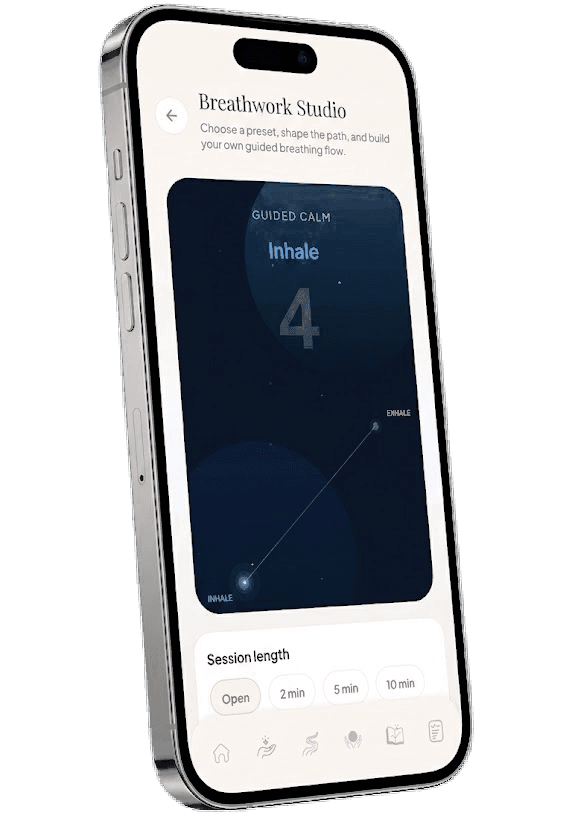
DBT for Anxiety: Which Skills Help in Which Anxious Moment
Which DBT skill fits a panic surge, a worry spiral, dread before an event or the urge to avoid, plus a 3-minute panic routine and honest limits.
Read
Apps for Emotional Regulation: How to Choose One That Actually Helps
Five apps sorted by what they actually do for intense emotions: name the feeling, change it with a skill, track patterns, or get through an urge.
ReadBox Breathing App: Free and Paid Options Compared
Box breathing apps sorted by what you need: a quick timer, vibration cues, lessons on breathing, or breathing next to DBT skills, with what each one costs.
Read